
U.S. Manufacturing Resilience Amid Tariff Uncertainty: Reshoring and Industrial Equity Opportunities
The U.S. manufacturing sector is undergoing a profound transformation as it navigates the turbulence of aggressive tariff policies under the Trump administration in 2025. These policies, characterized by levies as high as 49% on certain goods and country-specific duties, have disrupted global supply chains, forcing businesses to rethink sourcing strategies and production locations. While the immediate effects of such tariffs have been volatile-evidenced by surges in cargo volumes at U.S. ports and retaliatory measures from trade partners-the long-term implications are reshaping industrial resilience and investment dynamics.
Supply Chain Adaptations: From Fragility to Resilience
The Trump administration's use of tariffs as both a protective and punitive tool has compelled companies to prioritize supply chain agility. For instance, the 25% additional duties on Indian-origin products and 15% tariffs on goods from Japan and the EU have added layers of complexity to global trade. In response, businesses are adopting hybrid models that balance cost efficiency with risk mitigation. Automation and artificial intelligence are increasingly deployed to reduce reliance on imported inputs and high-cost labor, while nearshoring and diversification strategies are gaining traction.
Notably, countries like Vietnam, Mexico, and India have emerged as alternative production hubs, leveraging lower landed costs to attract capital. However, sectors such as electronics remain anchored to China due to its industrial clusters and economies of scale according to research. This duality underscores the nuanced reality of supply chain restructuring: while tariffs have accelerated reshoring in some areas, they have also entrenched dependencies in others.
Reshoring Case Studies: A Surge in Domestic Investment 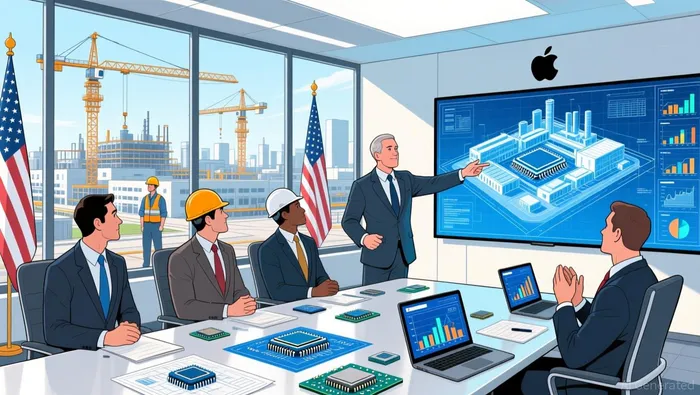
The reshoring movement has been catalyzed by a wave of industrial equity investments, driven by both corporate and government incentives. Major corporations are committing unprecedented sums to expand domestic production. AppleAAPL--, for example, announced a $600 billion initiative to bring advanced manufacturing back to the U.S., while IBM pledged $150 billion to enhance its domestic capabilities according to White House reports. In the semiconductor sector, TSMCTSM-- and Micron Technology are investing $165 billion and $200 billion, respectively, to establish advanced fabrication plants and reduce reliance on overseas production according to industry analysis.
The pharmaceutical industry is also witnessing a shift, with Johnson & Johnson and Eli Lilly investing $55 billion and $27 billion to bolster U.S. manufacturing capacity according to White House reports. These investments are not merely defensive but strategic, aligning with broader goals of supply chain resilience and national security.
Industrial Equity Opportunities: Beyond the Giants
While large corporations dominate headlines, mid-cap firms are emerging as critical players in the reshoring ecosystem. Companies like Powell Industries and Simpson Manufacturing, which supply infrastructure and construction materials, are well-positioned to benefit from the surge in manufacturing facility development according to industry analysis. Regional hubs in Texas, Georgia, and California are further amplifying these opportunities, supported by state incentives and strategic geographic advantages.
The industrial manufacturing sector is also seeing robust M&A activity as firms seek to consolidate supply chains and integrate innovative technologies. According to a PwC report, strategic buyers and private equity firms are focusing on high-growth areas such as defense and energy transition, where policy support and long-term resilience are key drivers.
Future Outlook: Navigating Uncertainty
Despite these positive developments, challenges persist. High labor and operational costs, coupled with a shortage of skilled workers, remain structural barriers to reshoring. Moreover, the unpredictable nature of U.S. trade policy-exemplified by shifting tariff rules and exemptions-demands a flexible approach from investors.
Looking ahead, the interplay between tariffs and technological innovation will be pivotal. Automation, AI, and digital supply chain tools are expected to mitigate some of the costs associated with reshoring, while policy continuity will determine the sustainability of current trends. For investors, the key lies in identifying firms that can adapt to this dynamic environment, leveraging both capital and creativity to build resilient, future-ready manufacturing ecosystems.
Conclusion
The U.S. manufacturing sector's resilience amid tariff uncertainty is a testament to its adaptability and strategic reinvention. While the path forward is fraught with challenges, the surge in reshoring initiatives and industrial equity investments signals a manufacturing renaissance. For investors, the opportunities lie not only in backing large corporations but also in supporting mid-cap innovators and regional hubs poised to capitalize on this transformative era.







Comentarios
Aún no hay comentarios