
Manchester United's Valuation Risks: Brand Erosion and Competitive Underperformance Threaten Long-Term Shareholder Value
Manchester United, one of football's most iconic brands, faces a critical juncture as declining sporting performance and financial missteps converge to challenge its long-term valuation and shareholder confidence. Despite record commercial revenues and a global brand value of €1.2 billion in 2025, the club's on-field struggles-culminating in a historic 15th-place Premier League finish in 2024–25-have exposed vulnerabilities in its financial model and brand sustainability according to a 2025 asset snapshot. This analysis examines how the disconnect between commercial strength and sporting failure is creating valuation risks, eroding investor trust, and threatening the club's position as a global football leader.
Commercial Resilience Amid Structural Weaknesses
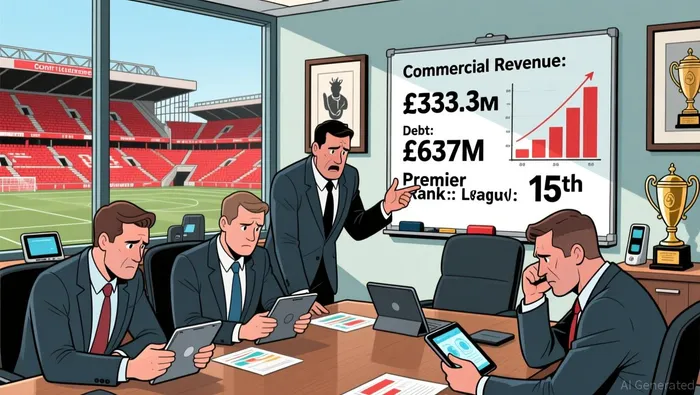
Manchester United's commercial revenue reached £333.3 million in 2025, driven by landmark deals such as the £60 million-a-year front-of-shirt sponsorship with Qualcomm and a £90 million-a-year kit agreement with Adidas. These partnerships underscore the club's enduring appeal, yet structural weaknesses persist. Sponsorship revenue fell by 9.3% in Q1 2025 due to expired training kit deals with TezosXTZ-- and impending losses from the DXC Technology sleeve sponsorship. While CEO Omar Berrada has emphasized "positive talks" with potential partners, the club's reliance on short-term, high-value contracts exposes it to volatility.
 The broader trend is equally concerning: over six seasons, commercial revenue grew by just 10%, lagging behind rivals like Manchester City and Liverpool. This stagnation reflects a failure to innovate in commercial strategies, despite the club's vast global fanbase. As Brand Finance notes, Manchester United's brand strength index (93.2/100) remains robust, but its ability to convert this into sustainable revenue is increasingly tied to on-field success-a factor it has lacked for over a decade.
Sporting Underperformance and Financial Consequences
The 2024–25 season marked one of the darkest chapters in Manchester United's history. Finishing 15th in the Premier League-a first since 1974-cost the club dearly. Broadcasting revenue plummeted due to the failure to qualify for the UEFA Champions League, while prize money from domestic competitions dwindled. According to a report by The New York Times, the club recorded a £33 million loss for the season, its sixth consecutive annual deficit.
The financial toll of poor performance extends beyond immediate revenue losses. High-profile transfers, such as Benjamin Sesko's $99 million move, have inflated debt to £637 million, straining the club's balance sheet. Meanwhile, costly managerial changes-Erik ten Hag's sacking alone cost £10.4 million in exceptional expenses-highlight operational inefficiencies. These decisions, coupled with a wage bill of £313.2 million (47% of revenue), raise questions about fiscal discipline.
Valuation Risks: A Premium on a Fractured Foundation
Manchester United's valuation remains disconnected from its financial realities. The club's price-to-sales ratio of 3.1x exceeds both the US Entertainment industry average and its estimated fair value of 1.9x, suggesting investors are paying a premium for its brand legacy rather than current performance. This disconnect is risky: while the club's enterprise value is estimated at £3.6 billion, its net debt of £637 million and negative free cash flow (-7.46%) signal precarious long-term sustainability.
Brand erosion further amplifies these risks. Despite a third-place ranking in Premier League brand value, Manchester United's lack of major trophies since 2013 (Premier League) and 2008 (Champions League) has weakened its allure for sponsors and players. Experts warn that continued underperformance could trigger a downward spiral: reduced commercial appeal, higher transfer costs to attract talent, and declining fan engagement. As one former executive noted, "Eventually, they will 'roll threes and fours' and reclaim their status-but the question is how long investors can afford to wait" according to the ESPN report.
Shareholder Confidence: A Fragile Equilibrium
Shareholder sentiment reflects this uncertainty. While Manchester United's stock price recorded a modest 7-day gain in late 2025, its 1-year total shareholder return remains negative. Cost-cutting measures-450 job cuts and a reduced wage bill-have improved operating losses by 73% year-on-year according to financial analysis, but these efforts are overshadowed by the club's inability to deliver results.
Investors are also wary of Sir Jim Ratcliffe's restructuring plans. While the Ineos owner has prioritized financial stability, his focus on long-term projects like Old Trafford redevelopment offers little near-term relief. The challenge lies in balancing immediate profitability with the high costs of rebuilding a competitive squad-a task complicated by the club's debt burden and the rising standards set by rivals like Liverpool and Manchester City.
Conclusion: A Club at a Crossroads
Manchester United's valuation risks stem from a fundamental misalignment between its commercial might and sporting mediocrity. While the club's brand power and revenue infrastructure remain formidable, these assets are increasingly undermined by on-field failures and financial profligacy. For shareholders, the stakes are clear: without a return to competitive success, the premium paid for Manchester United's legacy may not be justified. As the 2025–26 season unfolds, the club's ability to reconcile its commercial strengths with sporting ambitions will determine whether it remains a global football icon-or becomes a cautionary tale of brand erosion.





Comentarios
Aún no hay comentarios