
Lyft's Atlanta Robotaxi Launch and the Evolving Competitive Landscape in Autonomous Mobility
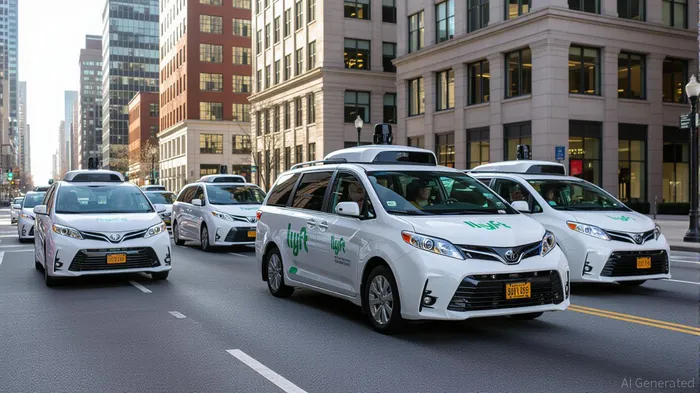
The autonomous vehicle (AV) revolution is no longer a distant promise but a tangible reality reshaping urban mobility. At the forefront of this transformation, Lyft's recent launch of robotaxis in Atlanta—partnering with May Mobility—marks a pivotal moment in the AV-as-a-Service (AVaaS) model. This initiative, now operational as of September 10, 2025, underscores Lyft's strategic ambition to secure a leadership position in a market projected to grow at a staggering 90.63% compound annual growth rate (CAGR) between 2025 and 2034 [1]. Yet, the competitive landscape is intensifying, with rivals like UberUBER-- and Waymo advancing their own scalable models. To assess Lyft's prospects, we must dissect its strategic positioning, technological partnerships, and scalability against the backdrop of a rapidly evolving industry.
Strategic Positioning: Lyft's Atlanta Pilot as a Testbed for Global Expansion
Lyft's Atlanta robotaxi service, launched in collaboration with May Mobility, represents a calculated move to leverage the city's smart infrastructure and regulatory openness [2]. The initial deployment of ToyotaTM-- Sienna minivans, equipped with redundant drive-by-wire systems and 360-degree sensor suites, operates with in-vehicle safety operators—a transitional measure aimed at building public trust while refining autonomous systems [3]. This hybrid approach allows LyftLYFT-- to balance innovation with risk mitigation, a critical advantage in an industry still grappling with public skepticism and technical challenges.
The partnership with May Mobility, a subsidiary of Toyota, highlights Lyft's asset-light strategy. By outsourcing vehicle development and fleet management to specialized firms, Lyft focuses on its core strengths: rider experience, app integration, and marketplace dynamics [4]. This contrasts with Waymo's vertically integrated model, which retains full control over hardware and software but faces higher capital expenditures. For Lyft, the partnership model reduces upfront costs and accelerates deployment timelines, enabling it to test scalability in Atlanta before expanding to Dallas and other U.S. markets [5].
Competitive Dynamics: Partnerships, Pricing, and Scalability
The AVaaS market is defined by fierce competition and strategic alliances. Uber, for instance, has adopted a broad aggregator model, partnering with Waymo, Nuro, and LucidLCID-- to deploy 20,000 self-driving vehicles over six years [6]. This diversification allows Uber to hedge against technological risks but dilutes its control over pricing and service quality. In contrast, Lyft's collaboration with Baidu's Apollo Go to launch driverless services in Europe by 2026 positions it as the first U.S. ride-hailer to enter the European AV market [7]. By leveraging FreeNow's regulatory expertise in Europe, Lyft gains a first-mover advantage in a region where Waymo and TeslaTSLA-- have yet to establish a presence.
Financial metrics further differentiate the players. Lyft reported record free cash flow of $329 million in its most recent quarter, bolstered by its hybrid human-AV network and cost efficiencies from the FreeNow acquisition [8]. Uber, meanwhile, has sought external funding to sustain its aggressive expansion, reflecting the high capital intensity of its multi-partner strategy. Waymo, with its fifth-generation autonomous systems, remains the technological benchmark but faces cost hurdles, as its current vehicles are priced at $100,000 each—far above Tesla's projected $30,000 Cybercab [9].
Market Projections and the Path to Dominance
The global robotaxi market, valued at $2.92 billion in 2025, is expected to surge to $969.63 billion by 2034, driven by urbanization, electrification, and regulatory tailwinds [1]. North America currently leads with 40% market share, but the Asia-Pacific region's 90% CAGR suggests a shifting center of gravity. For Lyft, the Atlanta pilot is a proving ground for a scalable model that could replicate in cities worldwide. Its focus on electric vehicles (EVs)—which accounted for 72.2% of the global robotaxi market in 2024—aligns with sustainability trends and reduces long-term operating costs [10].
However, scalability hinges on overcoming technical and regulatory bottlenecks. Tesla's vision-based AI approach, for example, promises faster deployment and lower costs, challenging traditional sensor-heavy systems [11]. Similarly, Waymo's planned expansion into Tokyo and Washington, D.C. underscores the importance of localized data and regulatory compliance. Lyft's success will depend on its ability to adapt its partnerships and technology to diverse markets while maintaining rider trust.
Conclusion: A Calculated Bet on the Future of Mobility
Lyft's Atlanta robotaxi launch is more than a technological milestone—it is a strategic gambit to redefine its role in the AVaaS ecosystem. By combining asset-light partnerships, hybrid human-AV operations, and a global expansion roadmap, Lyft positions itself as a flexible and cost-effective player in a market dominated by heavyweights. Yet, the path to dominance remains uncertain. As Waymo's technological edge, Uber's network breadth, and Tesla's cost advantages intensify competition, Lyft's ability to scale its Atlanta model while navigating regulatory and technical hurdles will determine its long-term success. For investors, the key takeaway is clear: the AVaaS race is not just about innovation but about strategic agility in an industry where the rules of the game are still being written.





Comentarios
Aún no hay comentarios