
The Long-Term Compounding Power of Semiconductor Stocks: A Case Study on ON Semiconductor
The semiconductor industry has long been a cornerstone of global technological progress, but its role as a driver of compounding returns for investors has become increasingly pronounced in recent years. Nowhere is this dynamic more evident than in the case of ON SemiconductorON-- (ON), a company whose strategic alignment with transformative technologies-artificial intelligence (AI), electric vehicles (EVs), and the Internet of Things (IoT)-offers a compelling lens through which to examine the interplay of financial performance and sector positioning.
A Decade of Volatility and Resilience
ON Semiconductor's stock price trajectory over the past decade underscores the dual-edged nature of semiconductor investing. In 2015, the stock closed at $9.80, with a year's range of $8.89 to $13.26 according to Macrotrends. By 2025, despite a dramatic peak of $108.09 in August 2023 according to Macrotrends, the stock had retreated to $46.70, oscillating between $31.95 and $64.51 in its 2025 range. This volatility reflects the cyclical nature of the sector, yet the 5-year CAGR of 15.53% demonstrates resilience. Even as the 12-month CAGR turned negative at -25.01%, the long-term trajectory remains anchored in the company's ability to adapt to shifting demand.
Notably, ON Semiconductor has not paid dividends since at least 2006 according to DividendMax, a decision that may frustrate income-focused investors but aligns with its reinvestment strategy. For growth-oriented investors, this underscores the importance of capital appreciation as the primary compounding mechanism-a strategy that hinges on the company's ability to capture value in high-growth markets.
Strategic Positioning: Powering the Future
ON Semiconductor's 2025 strategic initiatives reveal a company acutely aware of its role in shaping the next industrial revolution. Its focus on silicon carbide (SiC) and gallium nitride (GaN) technologies positions it at the forefront of intelligent power solutions, critical for both EVs and AI infrastructure. 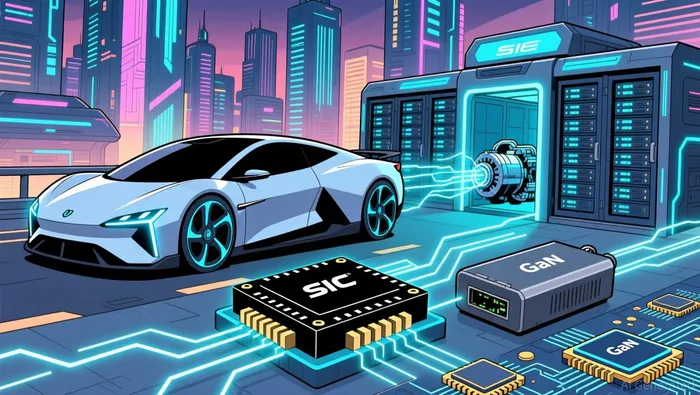 For instance, the company's SiC solutions are pivotal for 800V EV architectures, enabling faster charging and extended range. A planned €1.64 billion investment in a fully integrated 8-inch SiC fab in the Czech Republic further cements its vertical integration strategy, reducing reliance on external suppliers and enhancing margin stability.
In the AI space, ON Semiconductor is targeting data centers with its GaN platform, forecasting $250 million in AI-related revenue for fiscal 2025. This aligns with broader industry trends: AI chip sales are projected to exceed $150 billion by 2025, driven by demand for high-bandwidth memory (HBM) and advanced processors. ON's ability to capitalize on this demand, even amid a cyclical downturn in 2025 marked by weak automotive and industrial orders, highlights its strategic agility.
Industry Tailwinds and Risks
The semiconductor industry as a whole is poised for robust growth through 2026, fueled by AI, IoT, and EV adoption. According to a report by Deloitte, global semiconductor sales reached $676 billion in 2024, with the low-power/high-efficiency AI semiconductor market expected to expand significantly through 2036. ON Semiconductor's emphasis on energy-efficient technologies-such as GaN for power delivery and SiC for EVs-positions it to benefit from these trends.
However, challenges persist. Pricing pressures, supply chain bottlenecks, and geopolitical risks remain headwinds. For example, Vietnam's semiconductor market, a key growth region, is projected to grow at an 11.5% CAGR until 2029, but such expansion depends on stable global trade dynamics. ON's "Fab Right" strategy-aimed at optimizing manufacturing and inventory control-is a prudent response to these uncertainties, though its effectiveness will be tested in the near term.
The Case for Long-Term Compounding
ON Semiconductor's story is one of balancing short-term volatility with long-term potential. While its 12-month CAGR of -25.01% according to FinanceCharts may deter risk-averse investors, the company's strategic bets on AI, EVs, and IoT suggest a path to regaining momentum. The semiconductor industry's anticipated recovery in 2026, driven by AI and cloud computing, could amplify ON's gains, particularly if its SiC and GaN technologies achieve broader adoption.
For investors seeking compounding returns, the key lies in patience. ON's lack of dividends means returns are derived entirely from capital appreciation, which requires confidence in the company's ability to execute its long-term vision. Given its aggressive vertical integration, partnerships with automotive leaders, and alignment with multi-decade trends, this confidence appears justified.
Conclusion
Semiconductor stocks, by their nature, demand a long-term perspective. ON Semiconductor exemplifies this principle, with its financial performance reflecting both the risks and rewards of investing in a cyclical but innovation-driven sector. While recent volatility has tested its resilience, the company's strategic focus on high-growth areas-SiC, GaN, and AI-positions it to capitalize on the next phase of technological advancement. For investors willing to ride out the cycles, ON Semiconductor offers a compelling case study in the compounding power of sector positioning.







Comentarios
Aún no hay comentarios