
Leadership Transitions and Strategic Shifts: Assessing Better Home & Finance's Future Post-Ryan
Leadership transitions in public companies often serve as pivotal moments, reshaping strategic trajectories and investor sentiment. The recent retirement of Kevin Ryan, CFO of Better HomeBETR-- & Finance Holding (NASDAQ: BETR), marks such a turning point. Ryan's five-year tenure, characterized by aggressive capital raises, debt restructuring, and a focus on AI-driven efficiency, leaves a legacy of growth amid financial complexity. His departure-announced as "without cause" and effective September 30, 2025-has sparked scrutiny, according to a StreetInsider report.
Ryan's Legacy: Growth, Debt, and Strategic Foundations
Ryan joined Better in 2020, a critical period for the fintech lender as it navigated post-IPO challenges. During his tenure, the company achieved a 300% annual growth rate in funded loan volume, reaching $30 billion in home loans and $7 billion in insurance coverage, as shown on Kevin Ryan's LinkedIn profile. His strategic initiatives included retiring $534 million in debt through a restructuring agreement with SoftBank and prioritizing cost discipline to achieve adjusted EBITDA breakeven by Q3 2026, according to a company press release. These moves underscored a dual focus on scaling operations while stabilizing the balance sheet.
However, Better's financial health remains fragile. Despite a 37% revenue increase to $44.1 million in Q2 2025, the company reported a $27 million adjusted EBITDA loss and a debt-to-equity ratio of 13.39, according to the earnings call transcript. Analysts note that BETR's stock, which surged 63% year-to-date, has historically been volatile, including a 99.3% decline during the 2022 inflation crisis, as discussed in a HousingWire article. This volatility highlights the risks of relying on rapid growth in a sector sensitive to macroeconomic shifts.
Strategic Continuity: AI and Operational Efficiency
Under CEO Vishal Garg, Better's post-Ryan strategy appears anchored in AI innovation. The Tinman and Betsy AI platforms now drive 36% of loan volume and executed 600,000 customer interactions in Q2 2025, according to a BusinessWire release. Garg emphasized AI's role in "changing the industry altogether," with plans to expand the "NEO Powered by Better" initiative, which leverages AI to empower local loan officers, as noted in a Timothy Sykes piece. Early results from this program include a 365-basis-point gain on sale margin, outperforming 2024 benchmarks; this was also detailed in the company press release.
The company's focus on AI aligns with broader industry trends but also raises questions about short-term profitability. While Ryan's emphasis on cost discipline remains a priority, Better's Q2 2025 net loss of $36 million-a modest improvement from Q1-suggests that scaling AI infrastructure and expanding partnerships (e.g., home equity market growth of 260% YoY) may strain margins, according to the earnings call transcript.
Investor Sentiment: Optimism vs. Caution
Investor reactions to Ryan's retirement have been mixed. On one hand, the company's strategic pivot toward AI and its recent revenue growth have attracted bullish analysts. On the other, concerns persist about overvaluation and debt sustainability. As noted in a Forbes analysis, BETR's stock has "ridden a wave of optimism" but faces headwinds from high interest rates and a competitive mortgage market.
The absence of a named successor for Ryan adds uncertainty. While the company has initiated a search and emphasized a "smooth transition," the lack of immediate clarity could test investor confidence. Historical precedents suggest that CFO transitions in high-growth tech firms often trigger short-term volatility, particularly when the outgoing leader played a central role in capital strategy, as discussed in the HousingWire article.
Conclusion: A Balancing Act
Better Home & Finance's future hinges on its ability to balance growth with profitability. Ryan's departure removes a key architect of its capital strategy, but the company's AI-driven initiatives and CEO Garg's vision provide a framework for long-term resilience. For investors, the critical question is whether Better can achieve its EBITDA breakeven target while managing debt and navigating macroeconomic risks.
As the fintech sector evolves, Better's success will depend not only on technological innovation but also on its capacity to maintain strategic coherence during leadership transitions. The coming months will test the company's ability to uphold Ryan's financial discipline while capitalizing on the AI-driven opportunities he helped pioneer.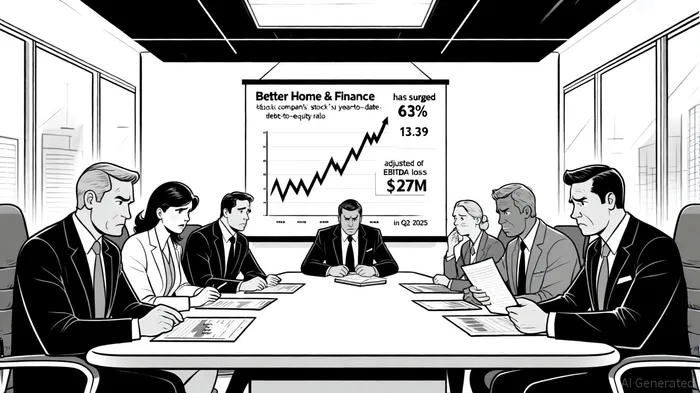





Comentarios
Aún no hay comentarios