
The Labor Market Slowdown and the Fed's Rate Cut Imminence
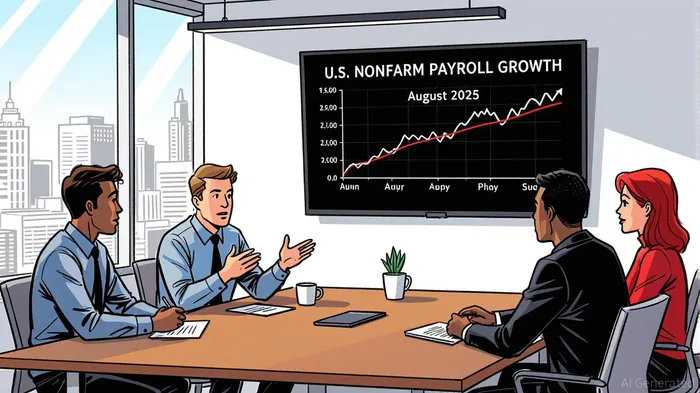
The U.S. labor market is showing unmistakable signs of strain. According to the Bureau of Labor Statistics, nonfarm payrolls increased by a mere 22,000 jobs in August 2025, far below the 75,000 forecast [1]. The unemployment rate rose to 4.3%, driven in part by a surge in labor force participation [1]. While wage growth remains robust—up 3.7% annually—job losses in sectors like federal government and energy extraction have offset gains in healthcare and social assistance [1]. These developments have intensified expectations for a Federal Reserve rate cut, with markets pricing in a 25-basis-point reduction at the September meeting [2].
The Fed’s pivot toward dovish policy is not merely a response to weak data but a recalibration of its dual mandate. Historically, sectors such as financials861076--, energy, and consumer non-cyclicals have thrived during rate-cut cycles. Financials, for instance, have averaged 16.9% gains during Fed pauses over the past decade, as lower borrowing costs boost lending activity and margins [3]. Energy firms, too, benefit from reduced financing costs for capital-intensive projects, though recent tariff-driven volatility has clouded their outlook [4]. Consumer non-cyclicals, including healthcare and utilities, tend to outperform in uncertain environments due to their stable demand profiles [5].
Yet the current context is nuanced. Tariffs imposed under the Trump administration have introduced headwinds, particularly for energy and pharmaceutical sectors. For example, a 15% tariff on pharmaceuticals under the U.S.-EU trade deal has raised inflationary pressures, squeezing margins for healthcare firms [6]. Similarly, energy companies face dual pressures: falling oil prices (down to $63.63 in Q2 2025 from $80.66 in Q2 2024) and elevated input costs from trade policies [7]. These factors complicate the traditional playbook for rate-cut beneficiaries.
Strategic positioning must account for both the Fed’s easing and sector-specific risks. Financials remain a compelling case. Regional banks and insurance firms are well-positioned to capitalize on lower rates, especially if deregulation spurs lending [8]. Energy, while challenged, could rebound if rate cuts offset some tariff-driven costs, particularly in renewable infrastructure—a sector less exposed to trade tensions [9]. Healthcare, despite Q2 losses (-7.18%), may see a recovery if FDA regulatory uncertainty abates and innovation pipelines gain momentum [10].
The Fed’s anticipated 3.25%-3.50% terminal rate by January 2026 [2] suggests a measured easing, favoring sectors with long-duration cash flows. Defensive plays like utilities and consumer staples, which historically outperform post-rate cuts, could provide ballast amid tariff-related volatility [5]. Conversely, industrials and telecommunications—sectors that underperformed during past rate-cut cycles—deserve caution [11].
In conclusion, the Fed’s dovish shift offers opportunities but demands careful sector selection. Investors should overweight financials and energy (particularly renewables) while hedging against tariff risks in healthcare and industrials. As the Fed navigates its delicate balance between labor market stability and inflation, strategic positioning will be key to capitalizing on the divergent fortunes of the real economy.
Source:
[1] Employment Situation News Release - 2025 M08 Results, Bureau of Labor Statistics [https://www.bls.gov/news.release/archives/empsit_09052025.htm]
[2] US labor market cracks widen as job growth nearly stalls in August 2025, Reuters [https://www.reuters.com/business/us-labor-market-cracks-widen-job-growth-nearly-stalls-august-2025-09-05/]
[3] Sector Returns During a Fed Pause, LPL Research [https://www.lpl.com/research/blog/sector-returns-during-a-fed-pause.html]
[4] Market Know-How 3Q 2025, UBSUBS-- [https://am.gs.com/en-ch/advisors/insights/article/market-know-how]
[5] What Sectors Could Benefit Most From the Fed's Rate Cut?, Investopedia [https://www.investopedia.com/how-the-fed-s-rate-cut-could-or-could-not-boost-stocks-8714701]
[6] Pharma CEOs downplay impact of tariffs amid rising cost concerns, Pharmaceutical Technology [https://www.pharmaceutical-technology.com/news/pharma-ceos-downplay-impact-of-tariffs-amid-rising-cost-concerns/]
[7] 3rd Quarter Economic Outlook 2025, James Investment [https://www.jamesinvestment.com/market-commentary/3rd-quarter-2025-outlook/]
[8] Strategy Outlook | UBS Global [https://www.ubs.com/global/en/assetmanagement/insights/asset-class-perspectives/hedge-funds/articles/q3-2025-uga-hf-strategy-outlook.html]
[9] Top Sectors Primed for Growth in Q3 2025, Lightport [https://markets.financialcontent.com/lightport.lightport3/article/marketminute-2025-8-27-navigating-the-currents-top-sectors-primed-for-growth-in-q3-2025]
[10] Analysis of the international Stock Market situation (Summer 2025), ISDO [https://isdo.ch/analysis-of-the-international-stock-market-situation-summer-2025/]
[11] How Do Sectors Perform After the First Interest Rate Cut?, Visual Capitalist [https://www.visualcapitalist.com/how-do-sectors-perform-after-the-first-interest-rate-cut/]







Comentarios
Aún no hay comentarios