
KKR Real Estate Finance Trust's Dividend Strategy: A Cautionary Tale for Income-Focused Investors
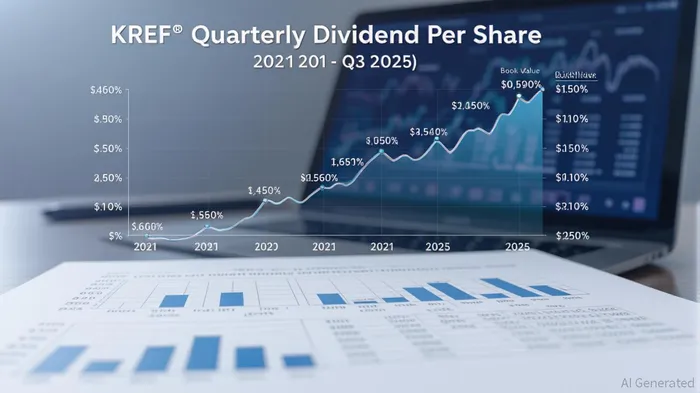
The dividend strategy of KKR Real Estate Finance Trust Inc. (KREF) presents a paradox for income-focused investors. On one hand, the company has maintained a consistent quarterly payout, most recently declaring a $0.25 per share dividend for Q3 2025[2]. On the other, its financial performance reveals a deeply unprofitable business model, with a GAAP net loss of $35 million in Q2 2025 and a distributable earnings-to-dividend payout ratio of -155%[1]. This analysis explores the sustainability of KREF's dividend strategy, the risks it poses to income investors, and the broader implications for a sector reliant on opaque financial engineering.
A History of Volatility and Declining Dividend Growth
KREF's dividend history reflects both ambition and instability. Between 2021 and 2022, its dividend per share surged from $0.3521 to $0.4063, with a brief spike to $0.4604 in Q2 2021[3]. However, the past three years have seen a sharp reversal. By Q3 2025, the payout had fallen to $0.25, a 38% decline from its 2022 peak. This aligns with a compound annual growth rate (CAGR) of 0% for the five years ending 2022[4], underscoring a stagnation that contrasts with the 30% average growth rate reported for the same period[3].
The disconnect between dividend declarations and earnings is stark. As of Q2 2025, KREF's payout ratio—calculated as dividends relative to distributable earnings—stood at -155%, meaning the company paid out more in dividends than it generated in pre-realized losses[1]. This figure is further exacerbated by a third-party calculation of 588.24% for an unspecified period[2], suggesting a pattern of overpaying dividends relative to earnings.
Financial Engineering as a Stopgap
Management has responded to these challenges with aggressive debt restructuring and reinvestment strategies. In July 2025, KREFKREF-- upsized its Term Loan B to $650 million, reducing its interest rate by 75 basis points[4]. This maneuver is expected to free up $100 million in proceeds to repay higher-cost debt and fund corporate purposes. Simultaneously, the company plans to reinvest $1 billion in repayments (expected in H2 2025) into commercial mortgage-backed securities (CMBS), European loans, and share repurchases[1].
While these actions may stabilize the balance sheet in the short term, they do not address the core issue: KREF's dividend is not supported by earnings. The company's Q2 2025 GAAP net loss of $35 million (-$0.53 per share) contrasts sharply with a book value per share of $13.84[1], highlighting the reliance on non-GAAP metrics to justify payouts. This raises questions about the transparency of KREF's financial reporting and the sustainability of its dividend in a prolonged economic downturn.
Risks for Income-Focused Investors
For income investors, the risks are twofold. First, the high payout ratio—whether 588% or -155%—indicates a dividend that is not earnings-covered. This exposes investors to the risk of sudden cuts if KREF's liquidity tightens or if its reinvestment strategy underperforms. Second, the company's reliance on debt refinancing introduces counterparty risk. The recent Term Loan B repricing, while beneficial, demonstrates the fragility of KREF's capital structure.
Moreover, KREF's dividend strategy appears to prioritize short-term stability over long-term value creation. Share repurchases and debt refinancing may temporarily bolster metrics like return on equity (ROE), but they do not address the underlying unprofitability of the business. As one analyst notes, “KREF is playing a high-stakes game of financial Jenga—each refinancing buys time, but the tower is increasingly unstable”[4].
Historical data from 2022 to 2025 further underscores the uncertainty. A simple buy-and-hold strategy around KREF's ex-dividend dates has not yielded a reliable edge, with an average cumulative return of -1.6% over 30 days—marginally better than the S&P 500's -2.1% but statistically insignificant[4]. The lowest drawdown occurred around day-10 (-0.45%), yet no clear positive window emerged, suggesting that market timing around these events has been ineffective[4].
Conclusion: A Dividend in Peril
KKR Real Estate Finance Trust's dividend strategy is a cautionary tale for income-focused investors. While the company's recent actions—such as debt refinancing and asset reinvestment—offer temporary relief, they do not resolve the fundamental mismatch between its dividend payouts and earnings. The -155% payout ratio in Q2 2025[1] and the historical volatility of its dividend per share[3] suggest a model that is unsustainable in the long term.
For investors seeking reliable income, KREF's approach is akin to chasing a mirage. The dividend may persist for now, but it is built on a foundation of debt and opaque accounting. In a market increasingly wary of financial engineering, KREF's strategy risks alienating the very investors it seeks to attract.





Comentarios
Aún no hay comentarios