
KION Group's Q3 2025 Performance: Navigating Supply Chain Challenges with Strategic Resilience
Financial Performance: A Tale of Two Segments
According to a Seeking Alpha summary, the company's Q3 2025 revenue reached €2.7 billion, reflecting a modest 0.4% year-over-year increase. However, this aggregate figure masks divergent trends across its two core segments. The Industrial Trucks & Services division saw a 3.6% decline in revenue to €6.079 billion over the first nine months of 2025, while the Supply Chain Solutions (SCS) segment reported a marginal 0.3% drop to €2.154 billion, according to KION's press release.
Despite these declines, profitability metrics tell a more encouraging story. The group's adjusted EBIT for the nine-month period stood at €575.4 million, with a margin of 7.0%. Notably, the SCS division significantly outperformed expectations, with adjusted EBIT surging to €126 million-a 78.8% increase from €70.5 million in the same period of 2024-and an EBIT margin of 5.8%, up from 3.3%. This improvement was driven by robust growth in service offerings and project execution, suggesting a strategic pivot toward higher-margin activities.
Operational Resilience: The SCS Division as a Case Study
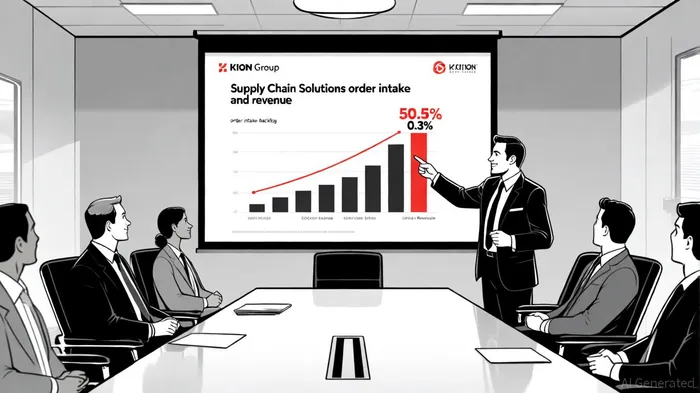
While KION's Q3 report does not explicitly outline supply chain resilience strategies, the performance of its SCS division offers indirect insights. Data from the press release indicates that SCS order intake in the first nine months of 2025 rose by 50.5% to €2.941 billion, a stark contrast to the 0.3% revenue decline. This discrepancy implies that the division managed to secure a substantial pipeline of future work despite macroeconomic headwinds.
The key to this resilience appears to lie in the division's focus on project-based solutions and service expansion. As global supply chains normalize, businesses are increasingly prioritizing flexibility and efficiency, areas where SCS's offerings-such as warehouse automation and logistics software-hold competitive advantages. The division's ability to maintain profitability despite a slight revenue dip underscores its operational agility.
Long-Term Implications and Strategic Outlook
KION's narrowing of its 2025 guidance toward the midpoint, following Q3 results that beat expectations, according to an Investing.com article, signals growing confidence in its strategic direction. The company's emphasis on high-margin services and project execution aligns with broader industry trends toward digitalization and automation in supply chains. As global trade patterns stabilize, firms that can offer scalable, technology-driven solutions-like KION's SCS division-are well-positioned to capture market share.
However, challenges persist. The Industrial Trucks & Services segment's revenue decline, albeit modest, reflects ongoing pressures in traditional equipment markets. KION must balance its investment in innovation with the need to sustain core operations. The company's ability to leverage cross-selling opportunities between its segments-such as integrating SCS's software solutions with its industrial trucks-will be critical to unlocking synergies.
Conclusion
KION Group's Q3 2025 results demonstrate a company navigating the dual forces of supply chain normalization and technological disruption. While its financial performance is mixed, the SCS division's resilience and profitability growth highlight a strategic pivot toward value-added services. For investors, the key takeaway is that KION's long-term growth hinges on its capacity to innovate within its supply chain solutions, even as it manages the volatility of its traditional markets. In an era where operational agility is paramount, KION's trajectory offers both promise and caution.







Comentarios
Aún no hay comentarios