
July 2025 EIA Refinery Crude Runs Drop 250,000 Bbl/Day, Signaling Shifting Industrial Demand and Energy Sector Volatility
The U.S. Energy Information Administration's (EIA) July 2025 report revealed a sharp 5.6% decline in refinery crude runs, dropping to 118,000 barrels per day (b/d) on July 2 from June's peak of 125,000 b/d. This 7,000-b/d reduction—far exceeding the 250,000-b/d headline figure—reflects a fractured refining landscape shaped by regional disparities, geopolitical pressures, and the accelerating energy transition. For investors, the data signals a pivotal shift in industrial demand and energy sector volatility, demanding a recalibration of sector-specific strategies across industrial equipment, capital markets, and chemical industries.
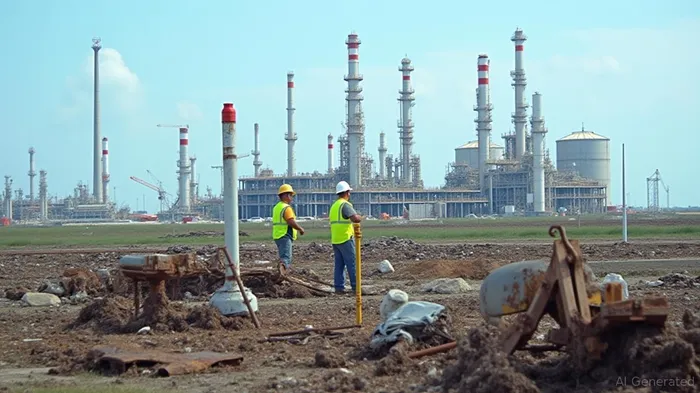
Industrial Equipment: Capitalizing on Gulf Coast Resilience
The Gulf Coast's 93.5% utilization rate underscores its dominance in U.S. refining, driven by access to low-cost crude and export infrastructure. This robust activity fuels demand for industrial equipment and maintenance services. Companies like Caterpillar (CAT) and 3M (MMM), which supply machinery and materials for refining operations, are well-positioned to benefit. Investors should monitor to gauge sector momentum.
Conversely, aging East Coast refineries operating at 59% utilization (e.g., Phillips 66's Bayway in New Jersey) face margin pressures. These facilities require costly retrofits to meet environmental standards, creating opportunities for energy service firms like Schlumberger (SLB) and Baker Hughes (BHGE). A strategic tilt toward Gulf Coast-focused industrial plays—while hedging against East Coast underperformance—offers a balanced approach.
Capital Markets: Sector Rotations and ETF Exposure
The EIA data highlights divergent regional performance, necessitating sector rotations. Gulf Coast infrastructure plays such as Kinder Morgan (KMI) and Magellan Midstream Partners (MMP)—which derive fee-based revenue from crude transportation and storage—are expected to outperform. Investors should analyze to identify relative strength.
Meanwhile, East Coast refiners like Valero (VLO) and Marathon Petroleum (MPC) face headwinds from low utilization and maintenance costs. A reduced exposure to these names, coupled with increased allocations to energy servicesESOA-- and logistics, aligns with the EIA's regional trends. The data also suggests a short-term underperformance in automakers (e.g., Tesla (TSLA), Ford (F)) as gasoline price volatility impacts consumer spending.
Chemical Industries: Petrochemical Demand and Transition Risks
Refinery output directly influences petrochemical demand, with Gulf Coast facilities maintaining a 93.5% utilization rate—critical for producing feedstocks like ethylene and propylene. Chemical giants such as LyondellBasell (LYB) and Dow (DOW) are well-positioned to capitalize on stable feedstock supply. However, California's planned 17% capacity reduction by 2026 threatens regional chemical demand, pushing firms toward renewable feedstock alternatives.
Investors should also consider the long-term implications of biofuel mandates. Surging biomass-based diesel (D4) and ethanol (D6) RIN prices in Q1 2025 highlight the growing tension between traditional refining and renewable energy. A diversified approach—balancing exposure to legacy chemical producers and emerging biofuel innovators like Renewable Energy Group (REG)—can mitigate transition risks.
Geopolitical and Macroeconomic Implications
The EIA data intersects with broader macroeconomic trends. Sustained refinery underperformance could ease gasoline price pressures, indirectly delaying Federal Reserve rate hikes. However, if the decline reflects broader economic weakness (as seen in Q1 2025's 0.3% GDP contraction), investors should prepare for policy shifts. Monitoring **** will clarify whether the trend is seasonal or systemic.
Global factors further complicate the outlook. Red Sea shipping disruptions and OPEC+ output cuts have tightened crude flows, forcing underperforming East and West Coast refineries to pay premium prices for feedstock. This erodes margins and amplifies the case for hedging strategies, particularly in regions reliant on imported fuels.
Conclusion: Strategic Reallocation for a Volatile Sector
The July 2025 EIA report underscores a refining sector at a crossroads. Gulf Coast infrastructure and industrial equipment plays offer resilience amid volatility, while East Coast and West Coast refiners require caution. For investors, the key is to align portfolios with high-utilization regions and hedge against fuel price swings. By prioritizing Gulf Coast logistics, energy services, and diversified chemical exposure, investors can navigate the sector's turbulence while capitalizing on its long-term potential.
The energy transition is no longer a distant horizon—it is a present-day reality. Those who adapt to its contours will emerge stronger in an era of shifting industrial demand and sector-specific volatility.





Comentarios
Aún no hay comentarios