
John Deere's Crossroads: Valuation, Cyclical Headwinds, and the Case for Patience
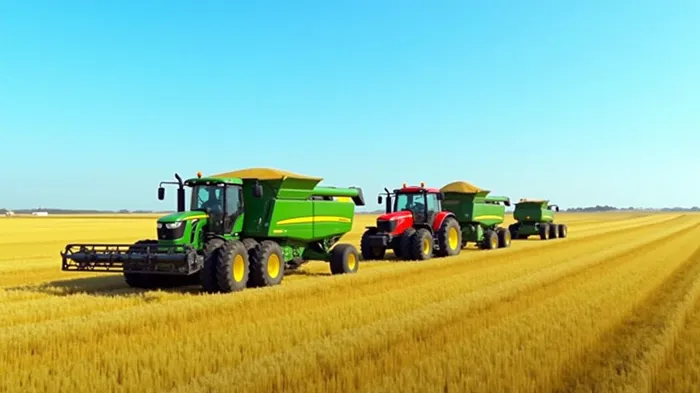
John DeereDE-- (DE) has long been a bellwether of global cyclical demand, its fortunes tied to the rhythms of farming, construction, and industrial productivity. Yet in Q3 2024, the company posted a stark 17% year-over-year decline in net sales, underscoring vulnerabilities in an environment of high interest rates, softening commodity prices, and elevated farm income pressures. This article examines whether the current $380 price tag—implied by a 15x P/E ratio—reflects a sustainable valuation or a trap for overeager buyers. The conclusion? While DE remains a structural leader in agriculture and equipment, near-term risks and mid-cycle slowdown dynamics suggest investors should avoid chasing rallies. Instead, a strategic wait-and-see approach, targeting a 10-15% correction to $325-$340, offers a safer entry point.
The Q3 2024 Results: A Harbinger of Cyclical Weakness
John Deere’s Q3 earnings reveal a company grappling with the perfect storm of macroeconomic headwinds:
- Sales Declines Across Segments:
- Production & Precision Ag: Sales fell 25% to $5.1 billion, with operating margins contracting to 22.8% amid lower shipment volumes.
- Small Ag & Turf: Sales dropped 18% to $3.05 billion, with margins pressured by warranty costs and reduced demand for lawn and garden equipment.
Construction & Forestry: A 13% sales decline to $3.2 billion reflected weak global construction activity, exacerbated by negative price realization and currency headwinds.
Farm Income Pressures:
Commodity prices for corn, soybeans, and wheat fell over 15% YoY, squeezing margins even as crop yields hit records. Farmers in the U.S. and Brazil are delaying equipment purchases to conserve cash, while high interest rates (e.g., Brazil’s 12% benchmark rate) deter borrowing for capital expenditures.
Valuation: A Fair Multiple in an Unfair World
At a trailing P/E of 23.5x (as of May 2025), DE trades at a 30% premium to Caterpillar (17.2x) and above the sector average of 23.3x. While the multiple reflects DE’s leadership in precision agriculture and automation, the risks are mounting:
Cyclical Overhang:
The U.S. economy is entering a mid-cycle slowdown, with GDP growth expected to drop to 2.1% in 2026. High interest rates—though set to ease gradually—will continue to weigh on borrowing for farm and construction equipment purchases.Inventory Glut and Dealer Dynamics:
Used equipment inventories remain elevated, depressing demand for new machinery. Dealers are holding back on orders, with 2025 Early Order Programs (EOPs) down double digits YoY.Peer Underperformance:
AGCO (AGCO), a smaller competitor, trades at 47.8x P/E—a high-risk bet on its niche precision ag solutions. Meanwhile, Kubota (KUBTY) and CNH Industrial (CNH) trade at discounts, underscoring the sector’s broader valuation skepticism.
The Case for Caution: Risks vs. Rewards
While DE’s long-term moat—rooted in its brand strength, precision technology (e.g., See & Spray), and aging fleet replacement cycles—remains intact, the near-term path is littered with obstacles:
- Interest Rate Drag:
The Fed’s delayed rate cuts (expected to total 75 bps in 2025) will keep borrowing costs elevated, deterring capital expenditures.
Commodity Volatility:
A 10% tariff hike (a downside risk) could collapse global trade volumes, worsening farm income and equipment demand.
Inventory Correction:
- Dealers may slash orders further as they work through existing stockpiles, prolonging the sales slump.
The Trefis HQ Portfolio: A Low-Volatility Counterpoint
The Trefis High Quality (HQ) Portfolio, which outperformed the S&P 500 by generating 91% returns since inception with 25% less volatility, highlights the risks of chasing cyclical stocks like DE. Its diversified, quality-driven strategy avoids the roller-coaster swings seen in industrial equities, offering a safer haven for investors wary of DE’s cyclical exposure.
Investment Strategy: Patience Pays
The bull case for DE hinges on two turning points:
1. A Fed rate cut cycle that eases borrowing costs.
2. A rebound in commodity prices, lifting farm profitability.
Until then, investors should:
- Avoid chasing the current $380 price: The stock trades at a 23.5x P/E—near its 10-year high—despite slowing growth.
- Wait for a pullback to $325-$340: This would reflect a 10-15% correction, bringing the P/E to 18-19x, closer to historical averages.
- Monitor EOPs and dealer inventory: A stabilization in order books and a reduction in used equipment supply will signal a bottoming out of demand.
Conclusion: DE’s Long-Term Strength vs. Near-Term Pain
John Deere is no doubt a titan of the agricultural and construction industries, with technological leadership and a resilient balance sheet. Yet in 2025, the company faces cyclical headwinds that demand caution. While the stock’s current valuation is far from unreasonable, the risks of further declines in a mid-cycle slowdown are too great to ignore. Investors would be wise to wait for a meaningful correction before allocating capital. In the meantime, the Trefis HQ Portfolio’s steady returns and lower volatility offer a prudent alternative to the roller-coaster ride of cyclical equities.
Final recommendation: Hold or sell at $380. Reconsider at $325-$340.





Comentarios
Aún no hay comentarios