
JBT Marel's Strategic Use of Convertible Debt: A Cost-Effective Refinancing Play with Downside Protection
JBT Marel Corporation (JBTM), a leader in industrial food processing and logistics automation, has executed a sophisticated refinancing strategy through the issuance of $500 million in 0.375% convertible senior notes due 2030. This move, coupled with hedging mechanisms and a focus on capital structure optimization, underscores the company's ability to balance growth ambitions with financial prudence in a high-volatility sector.
Strategic Refinancing: Cost, Maturity, and Flexibility
The new convertible notes, priced at a 32.5% premium to JBTM's stock price of $141.71 as of September 4, 2025 [2], offer a compelling blend of low-cost financing and flexibility. With a 0.375% coupon rate and a maturity of 10 years, the issuance extends the company's debt horizon while reducing reliance on short-term borrowing. This is particularly strategic given JBTM's plan to refinance its 0.25% convertible senior notes due in 2026 using its revolving credit facility or cash reserves [4].
The decision to issue longer-dated convertible debt reflects JBTM's confidence in its growth trajectory. The conversion price of $187.77 per share implies a 32.5% upside from current levels, aligning with the company's historical performance. For context, JBTMJBTM-- reported Q2 2025 revenue of $935 million, with adjusted EBITDA of $156 million (16.7% margin) [1], demonstrating robust operational leverage. By structuring the notes with a conversion feature, JBTM incentivizes equity conversion if its stock appreciates, effectively converting debt into equity and reducing future interest burdens.
Downside Protection: Hedging and Capital Structure Resilience
A critical component of JBTM's strategy is its use of convertible note hedge and warrant transactions to mitigate dilution risks. These privately negotiated hedges, executed with counterparties, ensure that shareholders are protected until the stock price reaches $283.42 per share [4]. This threshold, significantly above the current price, provides a buffer against short-term volatility while preserving upside potential.
The hedging strategy is particularly prudent given JBTM's beta range of 0.91–1.14 [5], indicating moderate to high sensitivity to market fluctuations. By capping dilution risks, JBTM safeguards its equity value even in a downturn, a critical consideration for a high-growth industrial tech firm navigating macroeconomic uncertainties.
Capital Structure Optimization: Leverage and Liquidity
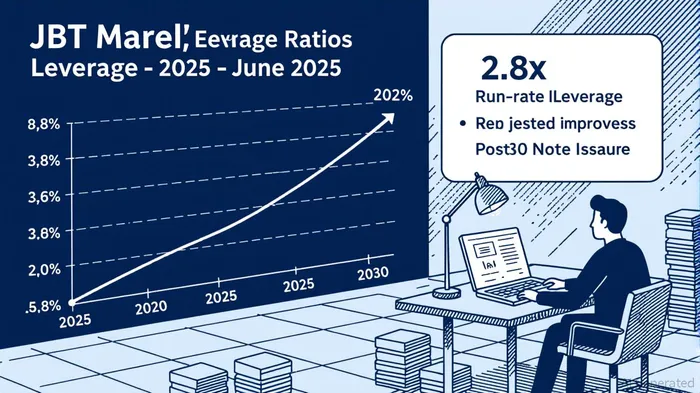
JBTM's leverage ratio of 2.8x as of June 30, 2025 [4], reflects a disciplined approach to debt management. The company's $1.92 billion total debt load is supported by strong liquidity, including $106 million in free cash flow for the first half of 2025 [4]. The refinancing of the 2026 notes via the new convertible debt and revolving credit facility further strengthens this position by extending maturities and reducing near-term refinancing pressures.
The equity-to-asset ratio of 0.53 [3] suggests a balanced capital structure, with ample room to take on incremental debt for growth initiatives. By allocating $500 million in proceeds to repay revolving credit facility borrowings, JBTM reduces its reliance on higher-cost short-term debt, thereby lowering overall borrowing costs.
Strategic Fit for a High-Growth Industrial Tech Firm
For a company like JBTM, which operates in capital-intensive, innovation-driven sectors, convertible debt offers unique advantages. The low coupon rate (0.375%) minimizes cash outflows, preserving liquidity for R&D and M&A. The conversion feature acts as a growth-linked equity raise, avoiding the need for dilutive equity offerings during periods of high stock price volatility.
Moreover, the 10-year maturity aligns with JBTM's long-term growth horizon. With recurring revenue streams accounting for over 50% of Q2 2025 revenue [1], the company is well-positioned to meet future interest and principal obligations, even if conversion does not occur.
Conclusion
JBT Marel's convertible debt issuance exemplifies strategic financial engineering tailored to its high-growth industrial tech profile. By extending maturities, securing low-cost financing, and hedging dilution risks, the company has optimized its capital structure while maintaining flexibility to fund innovation. For investors, this move signals confidence in JBTM's ability to navigate macroeconomic headwinds and deliver long-term value—a rare combination in today's market.





Comentarios
Aún no hay comentarios