
Japan's Trade Resilience Amid U.S. Tariff Pressures: Strategic Diversification in Global Supply Chains
The U.S. Trade Agreement: A Calculated Compromise
The U.S.-Japan trade agreement, finalized in September 2025, represents a pragmatic compromise. By capping tariffs at 15%, the U.S. avoided a full-blown trade war while Japan secured critical market access for its exports. In exchange, Japan committed to a structured investment package, with 50% of cash flows from special purpose vehicles (SPVs) initially allocated to the U.S. This arrangement not only addresses immediate trade imbalances but also aligns with Japan's long-term goal of strengthening its domestic industrial base, as outlined in a Federal Register notice. For instance, the agreement's provisions to eliminate additional safety tests for U.S. vehicles and expand rice imports signal a willingness to open markets, albeit in a measured manner, according to a RoanCP report.
However, uncertainties persist. The U.S. retains leverage to adjust tariffs if Japan fails to meet its investment commitments, and the timing of tariff reductions remains unclear, as noted in an East Asia Forum analysis. These risks highlight the delicate balance Japan must strike between appeasing U.S. demands and safeguarding its own economic interests.
Supply Chain Diversification: Beyond the U.S.
While the U.S. agreement provides short-term stability, Japan's broader strategy hinges on reducing overreliance on any single market. The Ministry of Economy, Trade and Industry (METI) and the Japan External Trade Organization (JETRO) have spearheaded initiatives to shift production to Southeast Asia and India, part of a "China Plus One" strategy, according to an ICTTM report. By 2025, Japan had subsidized 439 onshoring projects and 104 near-shoring projects, focusing on sectors like semiconductors, automotive parts, and medical equipment, per a Capwolf article. Vietnam and Malaysia have emerged as key hubs, with Vietnam's electronics sector and Indonesia's metals industry attracting significant foreign direct investment (FDI), according to an Asia Global Institute tracker.
India, too, has become a strategic partner. Bilateral trade between Japan and India reached $22.85 billion in FY 2023-24, with Japan committing $69 billion in investments over the next decade to integrate Indian SMEs into global supply chains, as reported in an NRIGlobe report. This partnership, bolstered by the India-Japan Next Generation Economic Security Partnership, emphasizes collaboration in semiconductors, clean energy, and logistics, as noted in a CargoInsights piece.
RCEP and Regional Integration: A Shield Against Global Volatility
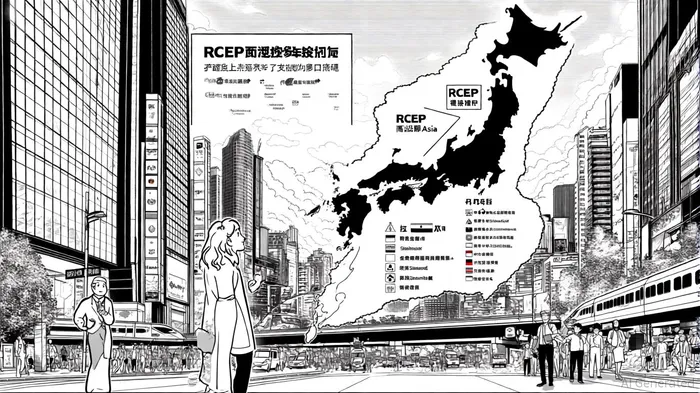
The RCEP, which accounts for 30% of global GDP, has been instrumental in Japan's diversification efforts. By eliminating 90% of tariffs within the region, RCEP has facilitated deeper economic integration, with intra-ASEAN trade rebounding by 7% in 2024, according to a WEF article. Japan's exports to RCEP partners stabilized despite a marginal contraction in 2024, reflecting a strategic shift toward regional markets, as discussed in a OneStepBeyond analysis. For example, Japan's trade with Vietnam and Malaysia grew steadily, offsetting declines in China dependency, which fell from 48% of RCEP exports in 2020 to 42.8% in 2024, per a Nippon.com report.
Economic Impact and Investor Implications
Japan's diversification strategies have yielded mixed results. While the U.S. tariffs initially disrupted sectors like automobiles (which account for 28.3% of Japan's exports to the U.S.), the shift to Southeast Asia and India has mitigated some of these shocks, according to Trading Economics data. Real GDP growth in Q2 2025 reached 0.5%, driven by preemptive export actions and domestic consumption, per the Trading Economics series. However, the OECD warns that growth may slow to 0.4% in 2026 as external demand weakens, according to an OECD outlook.
For investors, Japan's resilience lies in its ability to adapt. The $550 billion U.S. investment package, combined with RCEP-driven regional integration, offers long-term stability. Sectors like semiconductors, clean energy, and logistics are particularly promising, given Japan's strategic partnerships with India and Southeast Asia. Yet, risks remain, including geopolitical tensions and the potential for U.S. tariff adjustments.
Conclusion
Japan's response to U.S. tariff pressures exemplifies a blend of pragmatism and foresight. By leveraging the U.S. trade agreement and accelerating supply chain diversification through RCEP and regional partnerships, Japan has positioned itself to weather global volatility. For investors, the key takeaway is clear: Japan's economic resilience is not a static achievement but a dynamic strategy, continuously evolving to meet the challenges of an uncertain world.







Comentarios
Aún no hay comentarios