
Ivory Coast's Energy-Driven Economic Transformation: Strategic Investment in Upstream Oil and Gas Infrastructure
A Surge in Upstream Capacity and Regional Ambitions
The upstream sector has become a cornerstone of Côte d'Ivoire's economic strategy. EniE--, in partnership with the state-owned Petroci, has expanded the Baleine offshore project to 60,000 barrels of oil per day and 70 million cubic feet of gas per day, with Phase 3 expected to push output to 150,000 barrels of oil and 200 million cubic feet of gas. Meanwhile, the Calao discovery in Block CI-205, estimated at 1–1.5 billion barrels of light oil, has further solidified the country's offshore potential. These projects are not merely about production; they are part of a broader vision to integrate Côte d'Ivoire into regional energy markets. For instance, gas from the Baleine field is being channeled into domestic power generation, addressing energy deficits while reducing reliance on imports.
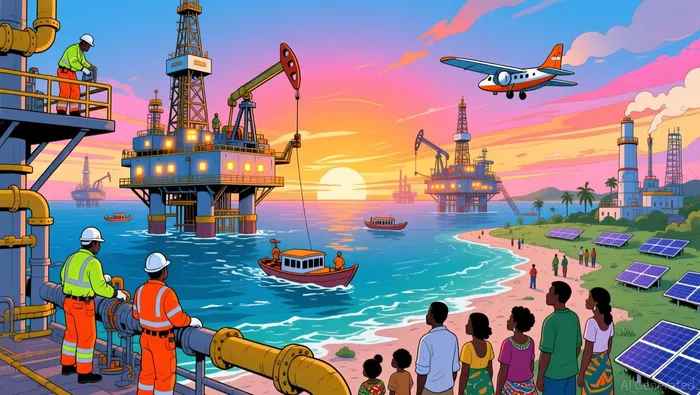
The government's ambition is clear: to reach 500,000 barrels of crude oil per day by 2035 and become one of Africa's top oil producers. This goal is supported by planned infrastructure, including a new 170,000-barrel-per-day refinery in Abidjan and a second refinery in collaboration with Yaatra Ventures. Such projects signal a move toward downstream integration, enhancing value capture and reducing dependence on foreign refining capacity.
Policy Frameworks and Local Content Imperatives
To ensure that the benefits of upstream investments extend beyond foreign operators, Côte d'Ivoire has introduced stringent local content laws. Law No 2022-408 and its implementing decree (2023-441) mandate that oil and gas companies hire 50–90% Ivorian nationals, depending on their tenure, and submit annual local content plans detailing training programs and procurement strategies. These policies aim to build domestic expertise in technical fields such as geology and health, safety, and environment (HSE) management.
While the intent is laudable, implementation remains a work in progress. For example, the government requires companies to register on a digital platform to monitor compliance, yet challenges persist in enforcing these standards, particularly in the informal sector. Moreover, the scale of job creation remains difficult to quantify. While the 2023–2025 period saw FDI-linked job creation of 5,207, the local content law's impact on employment is still emerging. The government's 2025–2030 National Development Plan, which emphasizes private-sector participation, could amplify these efforts.
Economic Impact and the Path to Inclusive Growth
The upstream sector's economic contribution is already evident. Real GDP growth hit 6.5% in 2023, with energy and infrastructure as key drivers. By 2024, the government projected 6.6% growth, reflecting confidence in the sector's ability to sustain momentum. Over the next decade, Côte d'Ivoire aims to leverage its hydrocarbon wealth to fund infrastructure, including $16 billion in oil-sector investments by 2030. These funds will support pipelines, railways, and renewable energy projects, such as the 50 MW Tchologo solar plant, aligning with a broader strategy to achieve 45% renewable energy by 2030.
Foreign direct investment (FDI) has been pivotal. Reforms like the 2012 Petroleum Code and 2014 Mining Code streamlined exploration processes, attracting $2.3 billion in IMF disbursements and $2.6 billion from Eurobond issues in 2024. The government's openness to international partners-such as BP, PETROBRAS, and VITOL-further underscores its commitment to scaling production. However, the challenge lies in ensuring that these inflows translate into long-term, high-quality jobs for Ivorians.
Challenges and the Need for Balance
Despite progress, risks remain. The local content law's effectiveness depends on rigorous enforcement, particularly in sectors where foreign labor has traditionally dominated. Additionally, while upstream projects generate significant revenue, their economic multiplier effects are limited without complementary investments in education, skills training, and SMEs. The government's focus on private-sector participation in infrastructure is a step in the right direction, but it must also address structural inefficiencies, such as bureaucratic delays in licensing and permitting.
Moreover, the volatility of global oil prices and geopolitical shifts could impact investment stability. Diversification into renewables and downstream activities will be critical to insulate the economy from such shocks. The planned 170,000-barrel-per-day refinery in Abidjan, for instance, not only enhances energy security but also creates downstream employment opportunities.
Conclusion: A Strategic Window for Investors
Côte d'Ivoire's energy-driven transformation presents a compelling case for strategic investment. The upstream sector's growth, supported by favorable fiscal terms and a robust regulatory framework, offers attractive returns for international players. At the same time, the government's emphasis on local content and infrastructure development creates opportunities for domestic firms to participate in value chains. For investors, the key lies in aligning with projects that balance short-term profitability with long-term sustainability-those that not only extract resources but also build local capacity and foster inclusive growth.
As the country moves toward its 2035 production targets, the success of this transformation will depend on its ability to navigate regulatory challenges, harness private-sector innovation, and ensure that the benefits of its energy boom are equitably shared. For now, the signs are encouraging: Côte d'Ivoire is emerging not just as an oil producer, but as a model for how resource wealth can be harnessed to drive economic and social progress.





Comentarios
Aún no hay comentarios