
Investing in the Future of Flight: The Urgent Case for Sustainable Aviation Fuel Infrastructure
The global aviation sector stands at a crossroads. With international travel rebounding post-pandemic and carbon emissions rising, the urgency to decarbonize has never been greater. At the 2023 ICAO Assembly, member states reached a landmark agreement to reduce aviation's carbon intensity by 5% by 2030 and achieve net-zero emissions by 2050, primarily through the accelerated adoption of sustainable aviation fuels (SAF) and other low-carbon technologies[1]. This framework, known as CAAF/3, has transformed SAF from a niche innovation into a central pillar of the industry's energy transition. For investors, the implications are clear: the next decade will demand unprecedented investment in SAF infrastructure, policy alignment, and technological scaling.
The Global Framework and Its Investment Imperatives
The CAAF/3 agreement outlines four “building blocks” for decarbonization: policy and planning, regulatory frameworks, implementation support, and financing[2]. Central to this is the creation of the ICAO Finvest Hub, a platform designed to connect decarbonization projects with public and private capital, particularly for developing nations[3]. This initiative underscores the recognition that SAF infrastructure cannot be built by market forces alone. Governments and multilateral institutions must bridge the gap between aspirational targets and tangible progress.
The urgency is further amplified by the stark mismatch between current SAF production and projected demand. According to the CleanBridge Global Sustainable Aviation Fuel 2025 report, only 22 SAF plants are operational globally, with a pipeline of 144 projects. Yet, as of June 2025, only seven of these projects have reached final investment decision (FID), and just one new project secured FID in the past six months[4]. This glacial pace of development highlights the critical need for policy intervention and financial innovation.
Regional Hotspots and Strategic Investment Opportunities
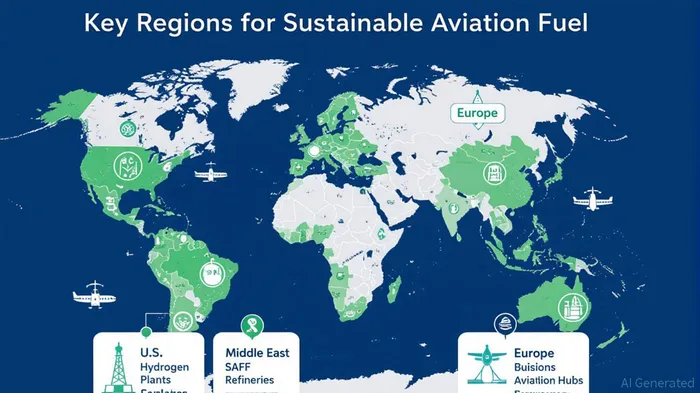
The United States and the Middle East are emerging as pivotal regions for SAF infrastructure. In the U.S., the Inflation Reduction Act (IRA) has catalyzed a wave of public-private partnerships. The Biden-Harris administration recently allocated $291 million in grants under the Fueling Aviation's Sustainable Transition (FAST) program, including $16.8 million to GevoGEVO--, Inc. to convert a Minnesota facility into an alcohol-to-jet production plant[5]. Similarly, Infinium's Project Roadrunner in Texas, backed by $935 million in debt financing, aims to produce 23,000 tons of e-SAF annually[6]. These projects are part of a broader U.S. strategyMSTR-- to leverage its 40% share of global biofuel production to dominate the SAF market[7].
The Middle East, meanwhile, is leveraging its solar energy abundance and low-cost feedstock to position itself as a global SAF hub. ADNOC's certification as the first Middle Eastern producer of ISCC-certified SAF marks a significant milestone, while SATORP's planned 1.5 million-ton annual output by 2030 demonstrates the region's ambition[8]. However, progress remains uneven. While the UAE and Saudi Arabia have made strides, regulatory frameworks and domestic demand for SAF are still nascent, creating both risks and opportunities for investors willing to engage early[9].
Europe, though ahead in regulatory maturity, faces its own challenges. The ReFuelEU Aviation initiative mandates a 2% SAF blend by 2025, but existing production capacity is insufficient to meet this target[10]. Neste, the world's largest SAF producer, is expanding its facilities in Finland, but the continent's reliance on imported feedstock and the lack of harmonized cross-border infrastructure remain hurdles[11].
Financing the Transition: Mechanisms and Market Dynamics
The SAF investment ecosystem is increasingly diverse, blending public grants, private equity, and innovative financial instruments. In the U.S., the IRA's tax credits for SAF producers have attracted venture capital firms like Breakthrough Energy Ventures, which is backing advanced biofuel technologies[12]. Green bonds and sustainability-linked loans are also gaining traction, with projects like LanzaJet's Ethanol-to-Jet facility in Georgia illustrating how environmental performance metrics can attract capital[13].
However, the sector's reliance on subsidies raises questions about long-term viability. As noted by KearneyKG--, SAF demand is projected to outpace supply by 2030, necessitating strategic financing to close the gap[14]. This is where the ICAO Finvest Hub and similar platforms could play a transformative role, particularly in developing economies where access to capital remains a barrier[15].
Challenges and the Path Forward
Despite the momentum, several challenges persist. First, the slow pace of project execution—only 5% of global SAF projects reaching FID—reflects the sector's dependence on policy certainty and feedstock availability[16]. Second, airlines' demand for SAF far exceeds current production, creating a “chicken-and-egg” dilemma where producers hesitate to scale without guaranteed off-take agreements[17]. Third, the lack of standardized accounting systems for SAF credits complicates cross-border participation, particularly for smaller operators[18].
To overcome these hurdles, governments must accelerate regulatory clarity and expand incentives. For investors, the key lies in diversifying portfolios across regions and technologies. While bio-SAF remains the most commercially viable option today, e-SAF (synthetic fuels produced via green hydrogen) and waste-to-fuel technologies represent high-growth opportunities, albeit with higher capital intensity[19].
Conclusion
The decarbonization of aviation is no longer a distant aspiration but an urgent imperative. The CAAF/3 framework has set the stage for a global transition, but its success hinges on the ability of investors, policymakers, and industry leaders to collaborate. For those willing to navigate the complexities of this nascent market, the rewards are substantial: not only in financial returns but in shaping a sustainable future for global mobility. As the sector moves from promise to practice, the next five years will determine whether aviation can truly take off into a cleaner era.





Comentarios
Aún no hay comentarios