
Investing in Financial Literacy as a Long-Term Strategy for Wealth Sustainability
The sustainability of wealth across generations hinges on more than mere asset accumulation; it depends on the cultivation of financial literacy and responsible money habits. Recent research underscores a critical insight: parental financial education and intergenerational financial behavior are not only interconnected but also pivotal in shaping long-term wealth outcomes. For investors, this presents a compelling opportunity to channel capital into education, fintech, and family wealth planning initiatives that address these dynamics.
The Intergenerational Spillover of Financial Education
Financial literacy is not a static skill but a dynamic force that transcends generations. A 2023 study in Peru demonstrated that school-based financial education for adolescents generated significant spillover effects on their parents, particularly in low-income households. Parents of participating students experienced a 26% reduction in loan or bill arrears and a 5% increase in credit scores, while their current debt levels rose by 40%-a sign of improved access to credit when managed responsibly. Notably, families with daughters saw even greater benefits, including a 6.7% increase in credit scores and a 28% reduction in loan arrears. This suggests that financial education for children can act as a catalyst for parental financial empowerment, creating a virtuous cycle of improved household financial health.
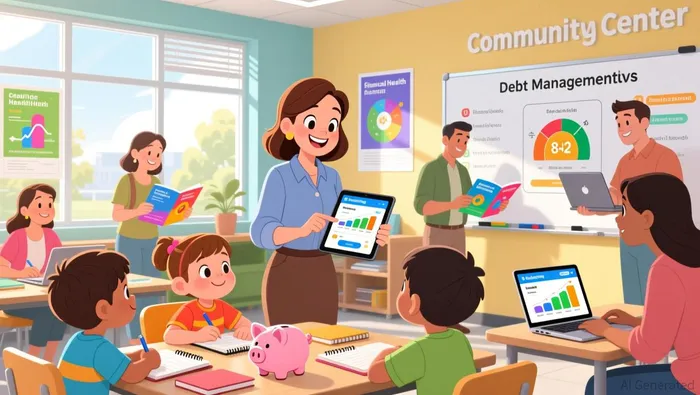 The SPARK Institute's 2025 national study further reinforces this link, revealing that young adults from college-educated or higher-income families exhibit superior financial literacy, savings behaviors, and confidence compared to peers from less-educated or lower-income households. These findings highlight a stark disparity: without targeted interventions, financial illiteracy risks perpetuating cycles of debt and under-saving. For investors, this points to the value of funding education programs that target both children and their families, particularly in underserved communities.
Fintech as a Catalyst for Financial Inclusion and Literacy
The fintech sector is rapidly evolving to address these gaps, leveraging technology to democratize access to financial tools and education. Platforms like SoFi, Wealthsimple, and Stash are not only simplifying investing but also embedding financial literacy into their services. For instance, Stash's AI-driven "Money Coach" tool builds financial literacy through personalized guidance, while Acorns' micro-investing model turns everyday spending into passive investment opportunities. According to the 2025 IMF Financial Access Survey, digital financial services have surged in usage, with mobile money transactions per adult rising from 55 in 2017 to 251 in 2024.
For investors, fintech's role in bridging literacy gaps is twofold. First, it enables scalable, low-cost education programs that reach millions. Second, it creates a more financially capable customer base for traditional institutions, which increasingly integrate financial literacy into their offerings to meet regulatory demands and enhance customer loyalty. Market data shows the global fintech market, projected to grow at a 25.18% CAGR to $1,583 billion by 2033, offers a fertile ground for investment, particularly in platforms that combine education with actionable tools.
Generational Wealth Planning and the Great Wealth Transfer
The interplay between financial literacy and generational wealth planning is further amplified by the Great Wealth Transfer-a $124 trillion shift in assets expected by 2048. This transfer is not merely a transfer of capital but a test of intergenerational preparedness. A Fidelity study reveals a striking disconnect: 52% of parents have not discussed their net worth with their children, while 95% of adult children claim readiness to manage inherited wealth. This misalignment underscores the need for structured education and open dialogue.
Family offices and wealth planners are adapting to these challenges by prioritizing generational education. For example, 70% of family wealth is at risk of being lost by the second or third generation due to a lack of financial literacy. To mitigate this, many families are adopting flexible family office models and alternative investments-private equity, crypto, and sustainable assets-that align with younger generations' preferences. According to recent trends, investors in this space should focus on platforms that facilitate intergenerational planning, such as Ellevest and Betterment, which offer tailored strategies for women and goal-based investing.
Actionable Insights for Investors
- Education Programs with Intergenerational Focus: Invest in school-based financial education initiatives that explicitly target low-income households, where spillover effects are most pronounced. The Peru study's 26% reduction in parental loan arrears illustrates the tangible returns of such programs.
- Fintech Platforms Bridging Literacy Gaps: Prioritize fintechs that integrate education with actionable tools, such as Stash, Acorns, or Wealthsimple. These platforms not only democratize investing but also foster long-term financial habits. As research shows, platforms like Stash and Acorns are transforming financial literacy into everyday practice.
- Family Wealth Planning Services: Support firms offering generational wealth transfer solutions, including flexible family offices and digital estate planning tools. According to industry analysis, the demand for these services is surging as younger generations seek transparency and involvement in financial decisions.
Conclusion
Financial literacy is the cornerstone of wealth sustainability, and its intergenerational effects are both measurable and transformative. By investing in education, fintech, and family wealth planning, investors can address systemic gaps while capitalizing on a growing market. As the Great Wealth Transfer unfolds, the ability to cultivate financially literate, empowered generations will determine not only individual outcomes but also the resilience of global wealth systems.







Comentarios
Aún no hay comentarios