
Insider Selling and Strategic Implications for Expeditors International of Washington
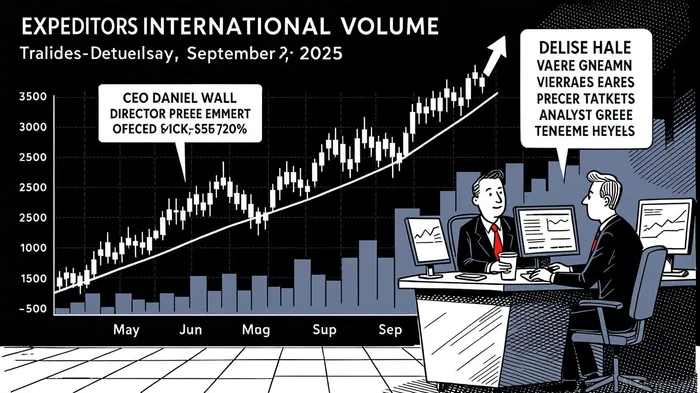
The recent surge in insider selling at Expeditors International of Washington (EXPD) raises pressing questions about its strategic implications. Between May and September 2025, multiple high-level insiders—including the CEO, directors, and officers—executed significant equity sales, totaling millions of dollars. According to a report by Yahoo Finance, Daniel R. Wall, the Chief Executive Officer, sold 1,158,636 shares at $115.91 per share on May 12, while Blake R. Bell, an Officer, offloaded 2,122,092 shares at $117.89 per share on August 6 [1]. These transactions, coupled with the sale of 497,150 shares by Director Mark A. Emmert on August 19, suggest a pattern of active divestment by key stakeholders [1].
Such activity cannot be dismissed as routine portfolio management. Insider selling often reflects private information or strategic reassessments, particularly when it involves large volumes and multiple executives. As stated by the SEC's Form 4 filings, these transactions occurred amid a backdrop of mixed institutional investor activity: AlphaQuest LLC reduced its stake by 87.6%, while Adage Capital Partners GP L.L.C. increased its position by 80.4% [3]. This divergence underscores uncertainty about the company's future trajectory.
The timing of these sales also warrants scrutiny. Expeditors reported robust Q2 2025 earnings, with an EPS of $1.34—8.06% above analyst estimates [3]. Yet, the subsequent insider selling suggests that executives may not fully align with the market's optimism. For instance, Robert Paul Carlile, a Director, sold 2,500 shares at $120.5071 per share on September 5, just days before the stock's technical forecast predicted a 6.86% rise over three months [3]. This dissonance between public performance and private actions raises red flags.
Complicating the analysis are recent leadership changes. Kelly K. Blacker and Robert A. Martinez were appointed to new executive roles in April and June 2025, respectively, while new employment agreements were formalized for several top executives [2]. These shifts could signal a strategic pivot, but the lack of official commentary from the company regarding insider selling leaves room for speculation. As noted by MarketBeat, Jeffrey F. Dickerman, the General Counsel, reduced his ownership by 16.12% through a $173,533.50 sale on August 7 [3]. Such moves, absent clear explanations, risk eroding investor confidence.
From a technical perspective, EXPD's stock faces headwinds. Analysts have assigned a “Reduce” consensus rating, with a target price of $114.22, reflecting concerns about valuation and growth sustainability [3]. While the company's Q2 earnings exceeded expectations, its institutional ownership remains skewed—94.02% held by institutions—leaving retail investors vulnerable to large-scale sell-offs [1]. The recent insider transactions, combined with the State of Wyoming's 79.2% reduction in holdings, highlight systemic risks in liquidity and price stability [2].
In conclusion, the interplay of insider selling, leadership changes, and mixed institutional sentiment demands a cautious approach. While Expeditors' earnings performance is commendable, the magnitude and timing of insider divestments suggest underlying uncertainties. Investors must weigh these red flags against the company's strategic announcements and technical outlook. Until the firm provides transparency on the rationale for these sales, prudence dictates a measured stance.





Comentarios
Aún no hay comentarios