
Insider Selling in Cloud Stocks: A Cautionary Signal for Investors
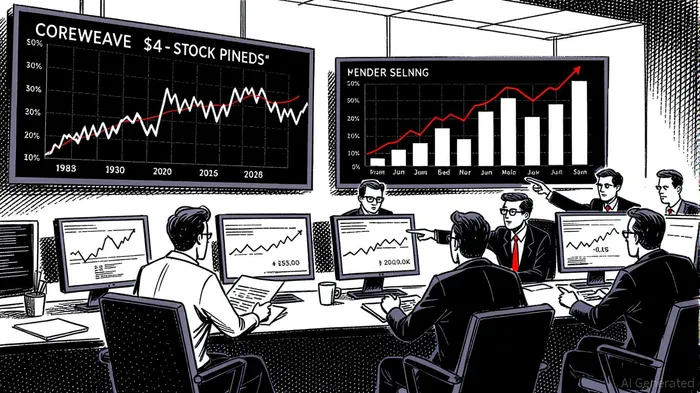
The recent wave of insider selling in cloud computing companies has reignited debates about the reliability of executive trading as a signal for investor decision-making. While insiders often sell shares for personal financial planning or diversification, such activity can also reflect underlying concerns about a company’s prospects. The case of CoreWeaveCRWV--, a high-profile cloud infrastructure provider, offers a stark example of how rapid insider selling can erode investor confidence and destabilize stock prices.
Following the expiration of its IPO lockup period in August 2025, CoreWeave’s stock plummeted more than 9% as insiders—including CEO Michael Intrator and major shareholder Magnetar Financial—offloaded millions of shares. Magnetar alone sold $94.4 million worth of stock in a single day, using collar options to hedge against price swings [1]. This selling spree coincided with a larger-than-expected second-quarter loss, compounding market anxieties. By mid-September, CoreWeave’s stock had fallen to roughly half its June peak, undermining its proposed $9 billion all-stock acquisition of Core ScientificCORZ-- [1]. Such patterns align with academic findings that rapid insider selling often signals a lack of confidence in future performance [3].
The trend is not isolated to CoreWeave. OracleORCL-- CEO Safra Catz and DellDELL-- Technologies’ Michael Dell emerged as the top insider sellers of the year, with Catz alone offloading $1.8 billion in stock [2]. While these sales may reflect strategic diversification, they also highlight a broader shift in the cloud sector. In the past quarter, insiders in cloud companies collectively sold $36 billion in shares—a decline from $62 billion in the same period in 2024 but still a significant outflow [2]. This activity raises questions about whether executives are hedging against overvaluation or anticipating sector-wide headwinds.
Academic research underscores the dual nature of insider trading. On one hand, a 2024 study found that an unanticipated increase in a firm’s cloud revenue share positively impacts stock returns and reduces idiosyncratic risk, suggesting that digital transformation can enhance shareholder value [3]. On the other, another study revealed that corporate digitalization disclosures may be strategically timed to facilitate insider selling, masking governance risks [3]. These findings complicate the interpretation of insider activity: while cloud adoption can drive growth, it may also enable executives to exploit information asymmetry.
Investor reactions to insider selling are further nuanced by market conditions. Arista NetworksANET--, for instance, reported strong insider buying alongside raised revenue guidance, signaling confidence in its AI and cloud strategies [4]. Conversely, Palantir’s stock fell 4% after its CFO and others sold shares, exacerbating concerns about macroeconomic risks and sector-specific challenges [5]. Such divergent outcomes emphasize the importance of contextual analysis.
For investors, the lesson is clear: insider selling should not be viewed in isolation. While it can serve as an early warning of governance issues or overvaluation—40% of S&P 500 scandals were preceded by abnormal insider trading, per a 2019 Stanford study [3]—it must be evaluated alongside financial performance, competitive positioning, and macroeconomic trends. The cloud sector’s rapid evolution, coupled with its reliance on long-term capital expenditures, means that executive decisions often reflect complex trade-offs.
In the end, the market’s response to insider activity is a testament to its role as a barometer of trust. When insiders sell aggressively, as in CoreWeave’s case, it risks triggering a self-fulfilling prophecy of declining confidence. Yet, as Arista Networks demonstrates, insider buying can reinforce optimism. Investors must navigate this duality with rigor, recognizing that while insider trading is a signal, it is rarely the sole signal.
Source:
[1] CoreWeave's stock slides as insider selling sparks investor concerns [https://www.morningstarMORN--.com/news/marketwatch/20250902387/coreweaves-stock-slides-as-insider-selling-sparks-investor-concerns]
[2] Oracle CEO topped Bezos, Dell with $1.8 billion stock sale [https://www.craincurrency.com/investing/oracle-ceo-safra-catz-topped-jeff-bezos-michael-dell-18-billion-stock-sale-last-quarter]
[3] The moderating role of economic policy uncertainty [https://www.sciencedirect.com/science/article/abs/pii/S1544612324007347]
[4] Spotlight On Arista Networks And 2 Other Leading Growth Companies [https://finance.yahoo.com/news/spotlight-arista-networks-2-other-113537503.html]
[5] AI Stocks Shake Markets: Big Tech Surges, Mega-Deals, and Bubble Warnings [https://ts2.tech/en/ai-stocks-shake-markets-big-tech-surges-mega-deals-and-bubble-warnings-sept-7-8-2025/]





Comentarios
Aún no hay comentarios