
India's New Transport Authority and Its Impact on Infrastructure Growth
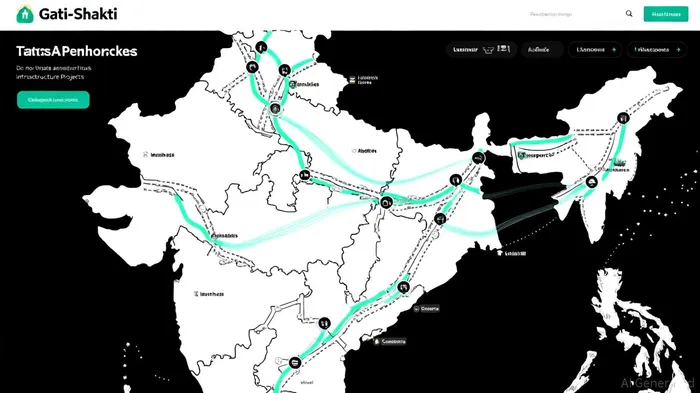
India's infrastructure landscape is undergoing a transformative overhaul, driven by the establishment of the Gati-Shakti Transport Planning and Research Organisation (GTPRO), a unified authority designed to coordinate all modes of transport under a single strategic framework. This initiative, chaired by Prime Minister Narendra Modi and operating under the Cabinet Secretariat, represents a bold departure from the fragmented, siloed approach that has historically hindered India's infrastructure development, according to a LinkedIn analysis. By integrating road, rail, shipping, aviation, and urban mobility into a cohesive system, the GTPRO aims to reduce logistics costs, enhance efficiency, and position India as a global manufacturing and logistics hub by 2047, a conclusion of a Business Standard analysis. For investors, this represents a pivotal moment in the logistics and construction sectors, where policy reforms and capital allocations are converging to unlock unprecedented opportunities.
A Structural Revolution in Transport Planning
The GTPRO's mandate is to break down institutional barriers that have long stymied India's infrastructure growth. By centralizing planning and coordination, the authority will oversee the development of multimodal transport strategies spanning 5, 10, and 15 years, moving beyond the project-by-project approach of the existing PM Gati-Shakti digital platform, as noted in the LinkedIn analysis. This platform, which already integrates data from 57 ministries and 36 states on a 1,700-layer GIS system, has identified 156 critical infrastructure gaps and facilitated the planning of 8,891 km of new roads and 27,000 km of railway lines, figures detailed in the Business Standard analysis. The GTPRO will build on this by evaluating long-term economic and environmental impacts, ensuring that investments are not only scalable but also sustainable.
The authority's structure includes a Group of Transport Experts (GTE), drawing from India's top institutions like IITs and BHU, to provide technical expertise in areas such as AI-driven network optimization and geospatial analytics, a point highlighted in the LinkedIn analysis. This emphasis on data-driven decision-making aligns with global best practices, as seen in South Korea's Korea Transport Institute (KOTI), and positions India to leapfrog traditional bottlenecks in infrastructure planning.
Investment Momentum: Budgets, PPPs, and Private Sector Participation
The Union Budget 2025-26 has allocated INR 2.87 lakh crore to the highways and logistics sector, with a focus on flagship projects like the Bharatmala initiative, which aims to construct 34,800 km of highways by 2025, according to a Manufacturing Today report. The National Highways Authority of India (NHAI) has already achieved record milestones, completing 5,614 km of national highways in FY 2024-25 and leveraging innovative financing mechanisms like Toll Operate Transfer (TOT) and Infrastructure Investment Trusts (InvITs) to monetize assets, also covered in the Manufacturing Today report.
Private sector participation is being incentivized through a 3.3% GDP allocation to infrastructure, with roads and highways receiving the largest share, as outlined in an Economic Times report. The Ministry of Road Transport and Highways (MoRTH) has set a target of INR 35,000 crore in private investment for national highway projects in FY 2025-26, a 17% increase from the previous fiscal year, per a Hindustan Times report. This is facilitated by PPP models such as Build-Operate-Transfer (BOT) and Hybrid Annuity Models (HAM), which have already accounted for 30% of national highway development, as the Hindustan Times coverage notes.
The PM Gati-Shakti National Master Plan has further catalyzed investment by identifying 434 logistics projects with a total investment of INR 11.17 lakh crore, including 35 multimodal logistics parks and 27,000 km of new railway lines, detailed in an Economic Times piece. As of October 2024, 91 cargo terminals have been commissioned, and 234 projects have received in-principle approvals, signaling rapid implementation. These projects are expected to reduce India's logistics costs from 14–16% of GDP to single digits by 2030, a critical step toward achieving the "Viksit Bharat" vision, as discussed in the Business Standard analysis.
Construction and Logistics: A Symbiotic Growth Cycle
The construction sector stands to benefit immensely from these reforms. Enhanced infrastructure and reduced transit times are driving demand for industrial parks, warehouses, and smart cities. Grade A warehouse leasing is projected to reach 30–40 million sq ft in major markets, while plug-and-play industrial parks are attracting private investment through tax incentives and streamlined approvals, as covered in the Economic Times budget reporting. The government's Maritime Development Fund (INR 25,000 crore) and interest-free loans (INR 1.5 lakh crore) for states further amplify regional development, particularly in underdeveloped corridors, according to a KNAV CPA briefing.
Sustainability is another key driver. The National Electric Mobility Mission Plan (NEMMP) and FAME schemes are accelerating the adoption of electric vehicles and green hydrogen, aligning with India's net-zero target by 2070, as noted in the Business Standard analysis. This shift is creating opportunities in green logistics, with private equity capturing 66% of H1 2024 investments in projects like Reliance Logistics & Warehouse Holdings, a trend highlighted by Manufacturing Today.
Challenges and the Path Forward
Despite this momentum, challenges remain. Bureaucratic inertia, land acquisition hurdles, and environmental clearances could delay projects. However, the GTPRO's focus on real-time course corrections and digital tools like AI and GIS analytics offers a pathway to mitigate these risks, as the LinkedIn analysis emphasizes. For investors, the key lies in aligning with projects that leverage PPPs, sustainability, and regional development-sectors where India's policy reforms are creating a fertile ground for growth.
In conclusion, India's New Transport Authority is not merely a bureaucratic reorganization but a strategic reimagining of infrastructure development. By harmonizing transport modes, incentivizing private capital, and prioritizing sustainability, the GTPRO is laying the groundwork for a logistics and construction boom. For investors, the message is clear: India's infrastructure revolution is now in motion, and the time to act is now.







Comentarios
Aún no hay comentarios