
The Impact of Eased US Bank Capital Requirements on Financial Sector Valuations
The recent recalibration of US bank capital requirements under the Basel III Endgame framework has sparked a quiet but significant re-rating of the financial sector. By reducing the initial capital burden for large banks from 19% to 9% and easing constraints on regional institutions, regulators have inadvertently created a fertile ground for strategic repositioning. This shift, while ostensibly aimed at stabilizing the system post-2008, has introduced asymmetries in capital allocation and profitability that favor mid-sized banks.
The Valuation Re-rating: P/B Ratios and ROE in Focus
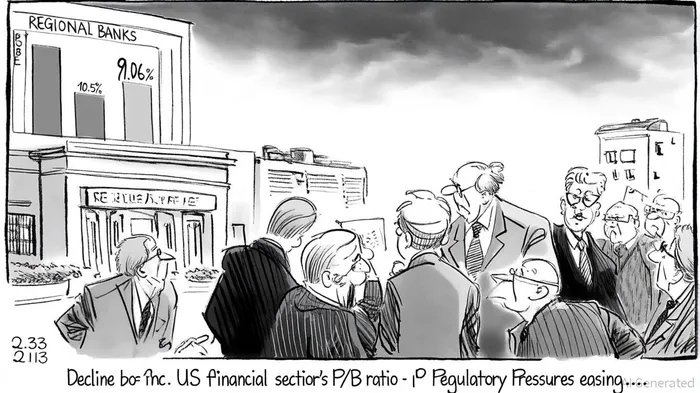
The most immediate effect of the Basel Endgame's phased implementation (July 2025–2028) has been a narrowing of valuation gaps between large and regional banks. As of June 2025, the US financial sector's price-to-book (P/B) ratio stood at 2.13, down from 2.33 in late 2024 [4]. This decline reflects a market recalibration to the new regulatory reality, where regional banks-previously penalized for higher capital costs-are now seeing their risk-adjusted returns improve.
For instance, U.S. Bancorp, a regional bank with $150 billion in assets, reported a ROE of 10.96% in Q2 2025, outperforming the industry average of 9.06% [3]. This divergence underscores the potential for regional banks to reclaim their historical profitability edge, provided they navigate the transitional compliance costs. The easing of capital requirements-particularly the 3–4% reduction for banks with $100–$250 billion in assets-has allowed these institutions to retain more earnings and reinvest in higher-margin activities like commercial real estate lending [1].
Strategic Opportunities: Consolidation and Capital Optimization
The Basel Endgame's emphasis on standardized risk models has also exposed a critical vulnerability: smaller banks' lack of technological infrastructure to manage granular capital calculations. This has accelerated a trend toward consolidation. According to Oliver Wyman, regional banks are now more likely to pursue mergers with larger peers or global systemically important banks (GSIBs), which can absorb their capital-light balance sheets [1]. For example, the acquisition of a $120 billion-asset regional bank by a GSIB in Q3 2025 was justified by the acquirer's ability to leverage its capital surpluses to offset the target's compliance costs-a strategy that could become a blueprint for future deals [1].
Capital optimization, meanwhile, is being redefined. Regional banks are increasingly adopting hybrid strategies: raising tier-1 capital through equity offerings while offloading non-core assets to reduce risk-weighted assets (RWAs). The shift to standardized approaches for operational risk has also created a $2 trillion RWA headwind for some institutions [3], but those with agile balance sheets are pivoting to low-RWA segments like small business lending.
Challenges and the Road Ahead
Despite these opportunities, challenges persist. The requirement to model trading risks at the desk level-rather than at the aggregate bank level-has forced regional banks to invest in fragmented systems, inflating operational costs [2]. Moreover, the phase-in period until 2028 means the full impact on valuations remains uncertain. Critics argue that the easing of capital rules could exacerbate systemic concentration, as smaller banks exit the market .
Yet, the data suggests a more nuanced outcome. Regional banks with strong governance and digital capabilities are already outperforming peers. For instance, Bank OZK's ROE of 14.2% in Q2 2025-despite its $55 billion asset base-demonstrates that capital efficiency can be achieved even under the new framework [1].
Conclusion
The Basel Endgame's regulatory easing has not merely stabilized the financial system-it has redefined the competitive landscape. For investors, the key lies in identifying regional banks that can leverage this transition to optimize capital, consolidate peers, or pivot to low-RWA lending. While the road ahead is fraught with compliance hurdles, the valuation re-rating already underway suggests that the sector's next chapter will be written by those nimble enough to adapt.







Comentarios
Aún no hay comentarios