
The Impact of $100,000 H-1B Visa Caps on Early-Stage Tech Startups
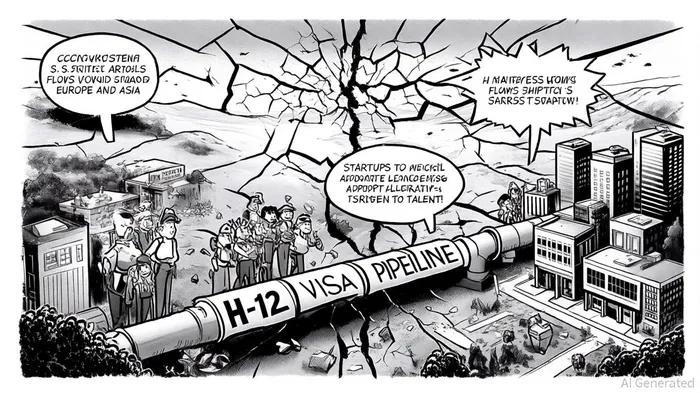
The recent imposition of a $100,000 fee for new H-1B visa petitions by the Trump administration has sent shockwaves through the U.S. tech startup ecosystem. For early-stage companies, which operate on razor-thin margins and rely heavily on global talent to drive innovation, this policy represents a seismic shift in risk exposure and operational strategy. The fee, which applies to both new applicants and extensions for those outside the U.S., has forced startups to confront a stark reality: the cost of accessing skilled labor now rivals their most ambitious financial outlays. Selin Kocalar, COO of a 23-person AI startup, encapsulated the dilemma, noting that justifying such an expense “when every dollar is scrutinized” has become a near-impossible task [2].
Venture Capital Risk Exposure: A Tipping Point?
The financial burden of the H-1B fee is not merely a line item for startups—it is a systemic risk for venture capital (VC) portfolios. According to a report by CNBC, startups that historically leveraged H-1B talent are 30% more likely to secure external funding, achieve IPOs, or be acquired compared to those that do not [1]. This correlation underscores the symbiotic relationship between global talent and venture returns. However, the new fee threatens to disrupt this dynamic. Manish Singh of Crossbridge Capital warned that investors may now “rethink their appetite for startups reliant on foreign talent,” particularly in sectors like AI and hard tech, where specialized skills are in high demand [1].
Quantitative data from the Q2 2025 State of Venture report by CB Insights reveals a troubling trend: while global VC funding rose 25% year-over-year to $189.93 billion, the U.S. share of this growth has plateaued. Deal volumes in the U.S. declined by 18% compared to Q1 2025, with investors favoring larger, later-stage bets over high-risk early-stage ventures [4]. This shift aligns with the broader anxiety over H-1B-related uncertainties, as VCs increasingly prioritize companies with diversified talent strategies or those operating in jurisdictions with more favorable immigration policies.
The geographic reallocation of capital is already underway. Laura Willming of Octopus Ventures noted that European markets, particularly the U.K. and Germany, are gaining traction as alternatives to the U.S. for tech talent and investment [1]. While exact percentages of U.S. capital migration remain unquantified, anecdotal evidence suggests that firms like Titan Capital in India are capitalizing on the exodus by launching seed programs to attract returning H-1B workers. This trend mirrors the 2020 “brain drain” reversal, where European hubs saw a 12% increase in tech talent inflows amid U.S. policy volatility [3].
Founder Retention Strategies: Innovation in the Face of Constraints
For startups, the challenge of retaining founders and key talent under restrictive immigration policies has become a matter of survival. Traditional strategies—such as equity incentives and vesting schedules—are being augmented by creative legal and operational solutions. Restricted Stock Agreements (RSAs), for instance, are gaining traction as a tool to align founder interests with long-term company goals while mitigating liquidity constraints [5]. Similarly, startups like Workstream have turned to offshore partnerships, relocating critical operations to London or Bangalore to bypass U.S. visa bottlenecks [2].
The case of Titan Capital illustrates another approach: leveraging diaspora networks to create “return pipelines” for skilled professionals. By offering mentorship, funding, and regulatory support, Titan has attracted over 50 returning H-1B holders in 2025 alone, many of whom previously worked for U.S. startups [4]. This model not only addresses talent gaps but also reduces dependency on the U.S. visa system, a critical advantage in an era of policy unpredictability.
However, not all strategies are equally effective. Startups in sectors with long green-card backlogs—such as India's IT industry—are resorting to aggressive green-card sponsorship, despite the associated costs. Desmond Lim of Workstream described this as a “necessary evil,” given that the average processing time for green cards in India now exceeds seven years [1]. Such measures, while pragmatic, highlight the fragility of the current system and the need for structural reforms.
The Long-Term Implications for U.S. Competitiveness
The cumulative effect of these challenges is a reconfiguration of the global innovation landscape. The U.S. has long benefited from its role as a magnet for global talent, but the H-1B fee hike risks eroding this advantage. As stated by Charles-Henry Monchau, a venture capitalist based in Paris, “The U.S. is ceding ground to regions that recognize talent as a strategic asset rather than a liability” [3]. This sentiment is echoed by the 26.5% decline in H-1B registrations observed in March 2025, a drop attributed to both the fee hike and stricter port-of-entry scrutiny [6].
For venture capital, the stakes are clear: portfolios that fail to adapt to this new reality may face underperformance. Conversely, firms that pivot toward geographically diversified strategies—whether through nearshoring, hybrid teams, or cross-border partnerships—stand to gain a first-mover advantage. The key lies in balancing short-term pragmatism with long-term vision, ensuring that the U.S. remains a viable hub for innovation even as global competition intensifies.







Comentarios
Aún no hay comentarios