
The Illusion of Retail Revival: Regulatory Red Flags and Investor Due Diligence in a Post-Ponzi Era
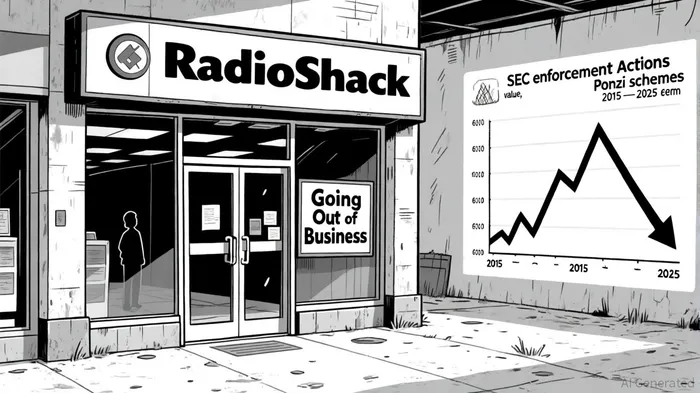
The allure of reviving a once-great brand is a siren song in retail investing. Yet, as the collapse of RadioShack demonstrates, such narratives often mask deeper structural vulnerabilities. While the Securities and Exchange Commission (SEC) has not formally linked RadioShack to a Ponzi scheme, its financial demise offers a cautionary tale for investors navigating the risks of retail revival strategies. These risks, amplified by regulatory red flags and the need for rigorous due diligence, demand closer scrutiny.
The SEC's Role in Unmasking Fraudulent Schemes
The SEC's recent enforcement actions against Ponzi schemes highlight patterns that investors should recognize. For instance, Edwin Brant Frost IV's $140 million fraud, which defrauded 300 investors, relied on personal and political expenditures to sustain returns[2]. Similarly, Daryl F. Heller's $770 million scheme used high-interest loans and new investor funds to prop up distributions, while siphoning $185 million for personal use[3]. These cases underscore a commonality: the misappropriation of capital and the reliance on continuous inflows to maintain the illusion of profitability.
The SEC's TCR (Tips, Complaints, and Referrals) system, which allows whistleblowers to report fraud anonymously, has been instrumental in exposing such schemes[1]. Whistleblowers who provide actionable intelligence—such as financial records or emails—can receive awards of up to 30% of sanctions exceeding $1 million. This mechanism not only deters fraud but also empowers investors to act as sentinels of market integrity.
RadioShack: A Case of Structural Collapse, Not Fraud
RadioShack's decline, while not fraudulent, shares eerie parallels with Ponzi schemes in its reliance on unsustainable business models. The company filed for Chapter 11 bankruptcy in 2015 and again in 2017, driven by declining sales, failed partnerships, and an inability to compete with e-commerce giants like Amazon[3]. Its partnership with Sprint, for example, collapsed under allegations of breached co-branding agreements, leading to the loss of nearly 6,000 jobs[3].
Unlike Ponzi schemes, which involve deliberate deception, RadioShack's downfall stemmed from operational mismanagement and market obsolescence. However, its story reveals critical red flags for investors: over-reliance on a single business model, failure to adapt to technological shifts, and excessive debt. These factors, while not illegal, often precede catastrophic losses in retail investing.
Investor Due Diligence: Beyond the Hype
The RadioShack saga underscores the importance of due diligence in evaluating retail revival stories. Investors must scrutinize not only a company's financial health but also its strategic adaptability. Key questions include:
1. Capital Allocation: Are funds being directed toward innovation or personal interests?
2. Market Position: Can the company compete with digital disruptors?
3. Regulatory Scrutiny: Has the SEC flagged any irregularities in financial reporting?
For instance, the SEC's enforcement actions against fraudulent schemes often highlight “red flags” such as unregistered securities offerings or misappropriation of funds[1]. While RadioShack's issues were not fraudulent, its repeated bankruptcies and reliance on short-term fixes (e.g., store closures, lease renegotiations) mirror the fragility of Ponzi-like structures[3].
The Path Forward: Vigilance and Systemic Reform
The SEC's whistleblower program and enforcement actions are vital tools in curbing fraud. However, investors must also adopt a skeptical lens when evaluating retail revival narratives. As RadioShack's case illustrates, nostalgia for a brand's legacy can cloud judgment, leading to overvaluation of assets and underestimation of risks.
Conclusion
Retail revival schemes, whether fraudulent or structurally flawed, pose significant risks to investors. The SEC's role in exposing Ponzi schemes like those of Frost and Heller is critical, but it cannot replace individual due diligence. RadioShack's collapse serves as a reminder that even non-fraudulent companies can unravel when they fail to adapt. In an era of rapid technological change, investors must balance optimism with skepticism, ensuring that their portfolios are not built on sand.







Comentarios
Aún no hay comentarios