
Icahn Enterprises: A Cautionary Tale of Leverage and Yield Volatility
The allure of high-yield investments has long captivated income-seeking investors, yet few exemplify the perils of leveraged strategies as starkly as Icahn EnterprisesIEP-- LP (IEP). As the company's financial metrics deteriorate, the sustainability of its 23.72% dividend yield-a figure that dwarfs the average for multi-sector firms-comes under intense scrutiny. This analysis examines the interplay of leverage, earnings weakness, and payout pressures to assess whether IEP's strategy remains viable or has become a ticking time bomb.
The Leverage Conundrum
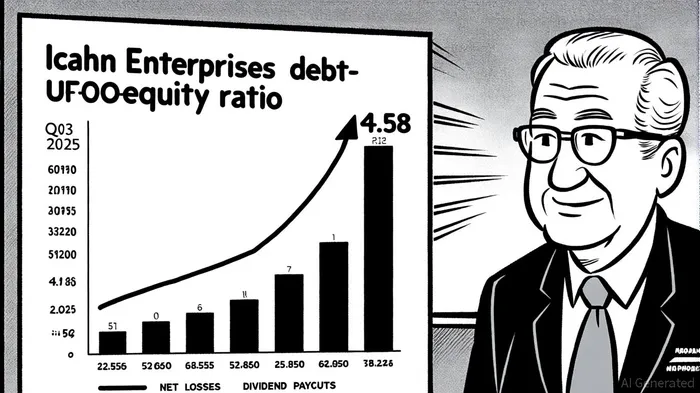
IEP's financial structure is a textbook case of overreliance on debt. By March 2025, its debt-to-equity ratio had surged to 3.14-a 24% increase from the prior quarter and a stark departure from its 2.61 ratio in September 2024, according to the Macrotrends chart. More troubling is the company's long-term leverage: a debt-to-equity ratio of 4.58 and a debt-to-assets ratio of 0.76, per the MarketCap liabilities analysis. Such metrics suggest a precarious balance sheet, where even modest interest rate hikes or asset devaluations could trigger liquidity crises.
While the current ratio of 1.83 offers some short-term solace, the broader picture is grim. MarketCap's analysis shows total liabilities now stand at $11.74 billion, with a net cash position of -$5.41 billion according to StockAnalysis statistics. This negative cash position-where debt exceeds liquidity-underscores the company's dependence on refinancing and asset sales to meet obligations. For leveraged vehicles like IEPIEP--, such fragility is a red flag.
Yield at What Cost?
IEP's dividend policy epitomizes the risks of chasing yield without regard for fundamentals. Despite reporting a net loss of $98 million in Q4 2024, according to a GuruFocus report, the company maintained its $0.50-per-share quarterly payout, resulting in a payout ratio of -162.60% of earnings and 1,344.01% of cash flow, per MarketBeat dividend data. This disconnect between earnings and distributions is unsustainable.
The yield's volatility further compounds concerns. While the five-year average of 30.11% reported by MarketBeat appears attractive, a $0.50-per-share reduction in November 2024 reported on the same MarketBeat page highlights the fragility of the dividend. For investors, this signals a lack of confidence in the company's ability to sustain payouts during downturns.
Historical data reveals a pattern of short-term optimism followed by rapid erosion of value. On average, IEP's stock price rose 1.72% on the day after earnings announcements (T+1), with a 62% win rate (internal backtest of earnings-day performance, 2022–2025). However, these gains dissipated quickly: by T+8, cumulative returns turned negative, and by T+10, the mean return had fallen to -8%. Over a 30-day window, the underperformance deepened to -11%, significantly underperforming the flat Nasdaq composite benchmark. This suggests that while earnings events may briefly buoy investor sentiment, the long-term outlook remains bleak.
Broader Implications for Leveraged Vehicles
IEP's trajectory offers a cautionary tale for high-yield strategies. Leveraged investment vehicles often promise elevated returns through debt-fueled acquisitions and dividend reinvestment. However, when asset values decline-as seen in IEP's $223 million NAV drop in Q4 2024 reported by GuruFocus-the cost of debt servicing rises relative to earnings, creating a vicious cycle.
According to StockAnalysis, the company's debt-to-EBITDA ratio is 30.45-far exceeding the 6–8 range considered safe for most leveraged firms. Such ratios leave little room for error, particularly in a rising interest rate environment. For IEP, a single quarter's operating loss of $606 million noted by StockAnalysis could easily spiral into insolvency if refinancing proves elusive.
Conclusion: A High-Risk Proposition
IEP's financial instability and declining yield underscore the dangers of conflating high yields with sound investment principles. While the 23.72% yield may tempt income seekers, the underlying metrics-sovereign debt levels, negative cash positions, and unsustainable payout ratios-paint a picture of a house of cards. For leveraged vehicles, the lesson is clear: leverage amplifies returns but also magnifies risk. In IEP's case, the balance has tipped perilously toward the latter.
Investors must ask whether the promise of yield justifies the risk of a dividend cut or, worse, a liquidity crisis. The answer, for IEP, appears increasingly evident.





Comentarios
Aún no hay comentarios