
Hudbay Minerals' Strategic Position in the Evolving Metals Market Amid Green Transition Demand
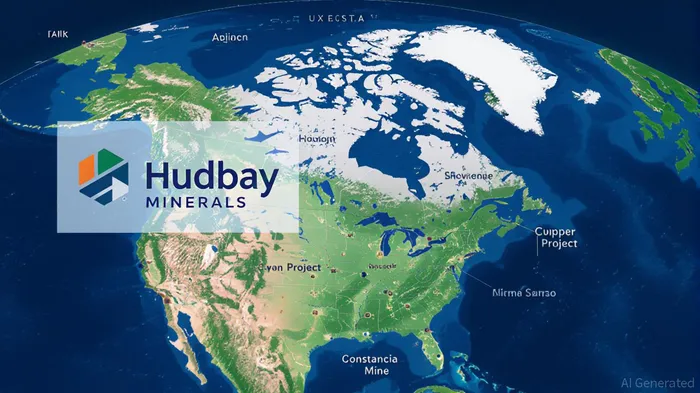
Hudbay Minerals Inc. has emerged as a pivotal player in the global green transition, leveraging its copper-centric strategy to align with the surging demand for critical metalsCRML-- in renewable energy and electric vehicle (EV) infrastructure. As the world accelerates its shift toward decarbonization, copper—a cornerstone of wind turbines, solar panels, and EVs—has become a strategic asset. Hudbay's operational resilience and growth potential are underscored by its low-cost, long-life assets in politically stable jurisdictions, coupled with a robust pipeline of projects designed to meet this demand while adhering to stringent environmental, social, and governance (ESG) standards[1].
Strategic Alignment with the Green Transition
Hudbay's commitment to sustainability is not merely aspirational but operationalized through concrete targets. The company has pledged to achieve net-zero greenhouse gas (GHG) emissions by 2050, with an intermediate goal of reducing Scope 1 and 2 emissions by 50% by 2030[2]. This aligns with global decarbonization frameworks and positions HudbayHBM-- to capitalize on regulatory tailwinds, such as the U.S. Inflation Reduction Act, which incentivizes domestic clean energy production[3].
A flagship example is the Copper World Project in Arizona, a fully permitted, low-carbon copper development designed to produce cathode on-site. By eliminating the need for overseas shipping and processing, the project is projected to reduce energy consumption and emissions by up to 40% compared to traditional methods[4]. Additionally, the project's integration of renewable energy and electric haul trucks further reinforces its environmental credentials. With a 20-year mine life and proximity to U.S. manufacturing hubs, Copper World is poised to strengthen domestic supply chains while addressing the anticipated 50% surge in copper demand by 2030.
Financial Resilience and Operational Performance
Hudbay's 2024 financial results highlight its operational resilience. The company produced 137,943 tonnes of copper, 332,240 ounces of gold, and 33,339 tonnes of zinc, generating $2.021 billion in revenue, with copper and gold accounting for 90% of total sales[7]. Operating income reached $400 million, and net income stood at $76 million, reflecting efficient cost management despite macroeconomic headwinds.
The company's balance sheet also demonstrates prudence, with total assets valued at $5.487 billion and equity of $2.553 billion, indicating a debt-to-equity ratio of approximately 0.76. This conservative leverage profile provides flexibility for capital expenditures, particularly in advancing its growth projects. For context, Hudbay's EBITDA margins, while not explicitly disclosed, are expected to benefit from its low-cost production model and the rising price of copper, which hit a 10-year high in 2024 due to supply constraints[10].
Competitive Advantage in the Green Transition Sector
Hudbay's strategic differentiation lies in its dual focus on scale and sustainability. Unlike peers who prioritize short-term production gains, Hudbay has invested in long-life assets with extended mine lives (e.g., Constancia in Peru, Copper Mountain in Canada) and a pipeline of projects in mining-friendly jurisdictions[11]. The Mason Project in Nevada, another key initiative, is designed to add 100,000 tonnes of copper equivalent annually by 2027, further diversifying its geographic exposure.
Compared to competitors, Hudbay's ESG performance is a critical differentiator. Its 50% emissions reduction target by 2030 outpaces industry averages, and its collaboration with labor unions on projects like Copper World signals strong stakeholder alignment—a rare advantage in an industry often plagued by social license challenges. Analysts at Bloomberg note that companies with robust ESG frameworks are increasingly favored by institutional investors, a trend Hudbay is well-positioned to exploit[14].
Challenges and Mitigation Strategies
Despite its strengths, Hudbay faces risks, including permitting delays, commodity price volatility, and geopolitical tensions in its operating regions. However, the company has mitigated these through proactive engagement with regulators and communities. For instance, the Copper World Project secured key permits in 2025, including aquifer protection and air quality approvals, demonstrating its ability to navigate complex regulatory environments[15]. Additionally, its diversified portfolio across North and South America reduces regional exposure to political instability.
Conclusion: A Strategic Buy for the Green Transition Era
Hudbay Minerals is uniquely positioned to thrive in a decarbonizing global economy. Its combination of low-cost, long-life assets, a robust growth pipeline, and aggressive sustainability targets aligns perfectly with the structural demand for copper in the energy transition. With the Copper World and Mason projects set to drive production growth and EBITDA expansion, and its ESG commitments resonating with a new generation of investors, Hudbay represents a compelling long-term investment. As the green transition accelerates, the company's ability to balance profitability with planetary stewardship will likely cement its status as a leader in the next era of mining.





Comentarios
Aún no hay comentarios