
HSBC’s Share Repurchase Strategy: A Calculated Path to Capital Efficiency and EPS Growth
In the aftermath of a global recession, banks face a dual challenge: restoring profitability while rebuilding trust with shareholders. HSBC Holdings plcHSBC-- has emerged as a standout example of strategic capital management, leveraging aggressive share repurchase programs to enhance capital efficiency and drive earnings-per-share (EPS) growth. This approach, rooted in disciplined cost control and a robust balance sheet, offers a compelling case study for investors navigating the complexities of post-recession banking.
Capital Efficiency: A Foundation for Shareholder Value
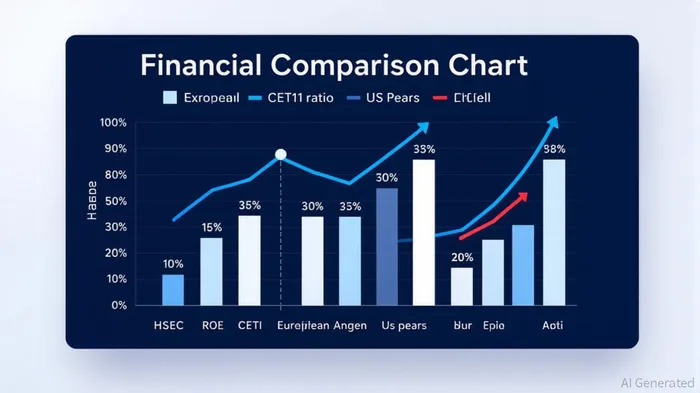
HSBC’s capital efficiency metrics are among the most impressive in the European banking sector. In 2023, the bank reported a return on equity (ROE) of 14.58%, significantly outpacing the European average of 10% [1]. This performance is underpinned by a cost-to-income ratio of 52%, reflecting rigorous operational discipline [1]. By maintaining a Common Equity Tier 1 (CET1) capital ratio of 14.9%—well above the regulatory minimum—HSBC has created a buffer that allows for aggressive shareholder returns without compromising financial resilience [1]. This contrasts sharply with U.S. peers like JPMorgan ChaseJPM-- (CET1: 11.5%) and Morgan StanleyMS-- (CET1: 12.1%), which, while profitable, operate with thinner capital cushions [1].
The bank’s recent $3 billion share repurchase program, announced in July 2025, exemplifies this strategy. By reducing equity through buybacks, HSBCHSBC-- aims to boost ROE and EPS by 1.1% [1]. This move is not merely a short-term tactic but part of a broader capital restructuring, including a $16.57 billion reserve reclassification, to align with long-term growth targets [1]. The forward price-to-earnings (P/E) ratio of 6.8x and a price-to-tangible-book (P/TB) ratio of 1.07 further suggest that HSBC’s shares are undervalued, making buybacks a cost-effective tool for enhancing shareholder value [1].
EPS Growth: A Post-Recession Playbook
Share repurchases are a proven mechanism for EPS accretion, and HSBC’s execution has been methodical. Between 2023 and 2025, the bank has repurchased over $10 billion in shares, reducing the number of outstanding shares and amplifying earnings per unit. This strategy is particularly effective in a post-recession environment, where revenue volatility remains a concern. For instance, HSBC’s fixed income and equities revenue has shown higher variability compared to peers like BarclaysBCS--, yet its cost discipline and capital strength have insulated it from the worst of the downturn [3].
The restructuring of HSBC into “Eastern Markets” and “Western Markets” has further bolstered this strategy. By streamlining operations and targeting $300 million in annual cost savings by 2026 [2], the bank is creating a leaner structure that amplifies the impact of buybacks. This approach mirrors the playbook of successful post-crisis banks, which prioritize operational efficiency to offset macroeconomic headwinds.
Risks and Realities
No strategy is without risks. HSBC’s reliance on Asian markets—where it derives 45% of revenue—exposes it to geopolitical tensions and trade slowdowns [2]. Additionally, pre-tax profits fell 29% in Q2 2025, partly due to falling interest rates and rising interest rate volatility [3]. These challenges underscore the importance of balancing buybacks with capital preservation. Unlike peers pursuing aggressive growth, HSBC has adopted a cautious approach, ensuring its CET1 ratio remains within the 14%–14.5% range [2]. This prudence positions the bank to weather further shocks while continuing to reward shareholders.
Conclusion: A Model for Post-Recession Resilience
HSBC’s share repurchase strategy is a masterclass in capital efficiency and shareholder value creation. By leveraging its strong ROE, disciplined cost management, and robust capital ratios, the bank has positioned itself to outperform in a challenging environment. While risks persist, the long-term benefits of its buyback program—particularly a 1.1% EPS accretion—are likely to materialize within 12–18 months [1]. For investors, HSBC’s approach offers a blueprint for navigating the delicate balance between growth and stability in post-recession banking.
Source:
[1] HSBC's Share Buy-Back Strategy: A Calculated Move to ... [https://www.ainvest.com/news/hsbc-share-buy-strategy-calculated-move-boost-earnings-shareholder-2508/]
[2] Interim Results 2025 quick read | HSBC Holdings plc [https://www.hsbc.com/investors/results-and-announcements/all-reporting/interim-results-2025-quick-read]
[3] European banks' battle for scale: Is HSBC the latest casualty? [https://www.euromoney.com/article/2eceygib0g0rtwc6oy5fk/capital-markets/european-banks-battle-for-scale-is-hsbc-the-latest-casualty/]





Comentarios
Aún no hay comentarios