
Honda Ends U.S. Acura Production: Strategic Implications for Automotive Restructuring and Investment Opportunities
The recent decision by HondaHMC-- to cancel U.S. production of the Acura ZDX electric SUV marks a pivotal moment in the automotive industry's ongoing restructuring. This move, driven by evolving market dynamics and strategic recalibration, reflects broader trends in electrification and consolidation. For investors, it underscores the need to reassess risk profiles and identify opportunities in a sector undergoing profound transformation.
Strategic Shifts in Electrification: From Aggression to Pragmatism
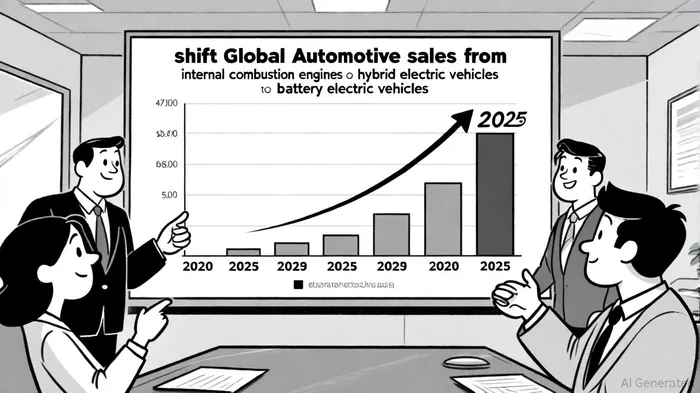
Honda's cancellation of the ZDX, a high-margin electric SUV, is emblematic of a sector-wide recalibration. The company cited challenges such as the expiration of federal EV tax credits, rising production costs due to tariffs, and a slowdown in EV demand as key factors[1]. These pressures are not unique to Honda. Global light vehicle sales are projected to grow modestly in 2025, with EVs expected to capture less than 30% of the market—far below earlier forecasts[2].
Honda's response has been to pivot toward hybrid electric vehicles (HEVs), which are gaining traction as a more practical solution to range anxiety and affordability. The company plans to introduce 13 new HEV models between 2027 and 2030, with a focus on improving fuel efficiency by over 10% and reducing hybrid system costs by 50% compared to 2018 models[3]. This shift aligns with industry trends: hybrid sales are projected to grow by 20–25% in 2024–2025, driven by automakers like Toyota and Chinese competitors such as BYD, which offer cost-competitive hybrids priced below some EVs[2].
For investors, this signals a critical inflection point. While EVs remain a long-term goal, the immediate focus is on hybrids as a transitional technology. Companies excelling in hybrid innovation—such as Toyota and Honda—may outperform peers in the near term. Additionally, suppliers of hybrid components, including battery manufacturers and energy management systems, present compelling investment opportunities.
Consolidation and Restructuring: A New Industry Landscape
The automotive sector is also witnessing a wave of consolidation, particularly in ancillary industries. For example, collision repair firms like VIVE Collision and Brightpoint Auto Body have aggressively expanded through acquisitions, increasing their U.S. locations by over 150% in 2025[4]. Tesla, too, has expanded its corporate-owned repair network, reflecting a broader trend of vertical integration[4].
Honda's own restructuring efforts include organizational changes to streamline product development and integrate EV and ICE functions under a unified Automobile Development Operations division[3]. Such moves are designed to enhance efficiency and accelerate innovation, but they also highlight the sector's need for operational agility. For investors, consolidation in both manufacturing and services suggests opportunities in M&A activity and partnerships. Private equity firms, for instance, are increasingly targeting mid-sized regional operators in the collision repair sector, signaling a shift toward scalable, asset-light models[4].
Software-Defined Vehicles and Autonomous Driving: The Next Frontier
Beyond electrification and consolidation, the industry is pivoting toward software-defined vehicles (SDVs) and autonomous driving. Honda's collaboration with Momenta Global Limited in China to develop localized autonomous driving technologies exemplifies this trend[3]. Similarly, global automakers are investing heavily in Level 3 and Level 4 autonomy, with Chinese firms like Xpeng and Baidu leading the charge[2].
The SDV market is projected to be dominated by North America, which will account for 43% of global demand in 2025[2]. This growth is driven by advancements in AI and semiconductor technologies, with companies like NVIDIA, Intel, and Qualcomm playing pivotal roles. For investors, the rise of SDVs represents a paradigm shift: value is increasingly shifting from hardware to software and data. Startups specializing in autonomous systems, AI-driven infotainment, and cybersecurity for connected vehicles are likely to attract significant capital.
Conclusion: Navigating the New Automotive Ecosystem
Honda's decision to halt ZDX production is not a retreat from electrification but a recalibration in response to market realities. For investors, the key takeaway is the importance of flexibility. The automotive sector is transitioning from a one-size-fits-all approach to a diversified ecosystem encompassing hybrids, EVs, SDVs, and autonomous technologies.
Opportunities lie in companies that can adapt to this complexity. These include:
1. Hybrid and EV technology suppliers (e.g., battery manufacturers, energy management systems).
2. Software and AI firms enabling SDVs and autonomous driving.
3. Consolidators in ancillary sectors (e.g., collision repair, logistics).
As the industry navigates these shifts, investors must balance long-term vision with short-term pragmatism. The future of mobility is not a single destination but a mosaic of interconnected innovations.





Comentarios
Aún no hay comentarios