
HIVE Digital Technologies: A Case Study in Bitcoin Mining Efficiency and the Future of Digital Asset Infrastructure
The recent 8% surge in HIVE DigitalHIVE-- Technologies' stock price, driven by a 22% month-over-month increase in BitcoinBTC-- production to 247 BTC in August 2025, underscores a critical shift in the digital asset infrastructure sector. This performance is not merely a function of speculative fervor but a reflection of operational discipline, strategic energy sourcing, and the broader industry's recalibration post-halving. To understand the significance of HIVE's trajectory, one must examine the interplay between technological efficiency, energy economics, and the maturation of Bitcoin mining as a capital-intensive industry.
Operational Efficiency: The New Competitive Battleground
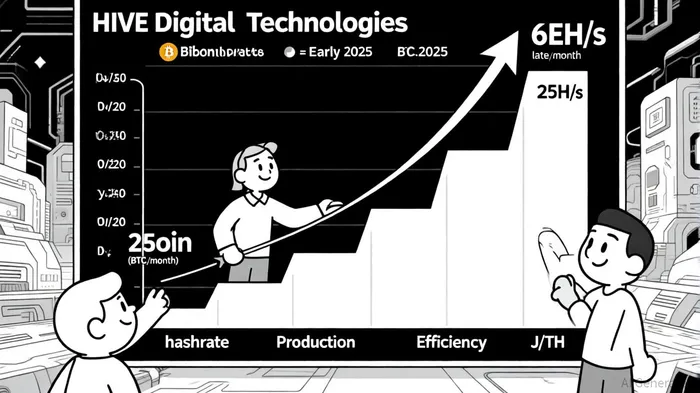
HIVE's operational metrics reveal a company prioritizing efficiency over brute-force scale. By August 2025, its global hashrate had surged to 18.5 EH/s, with a fleet efficiency of ~18.5 J/TH—well below the industry average of 20–22 J/TH[1]. This improvement, driven by the deployment of Bitmain S21+ Hydro miners and the completion of Phase 3 at its Valenzuela site, has reduced the cost per Bitcoin to ~$50,000, a figure underpinned by fixed-rate hydroelectric power and minimal incremental labor costs[1]. Such efficiency is critical in an environment where the 2024 halving slashed block rewards by 50%, forcing miners to rely on transaction fees and operational margins for profitability[2].
The company's strategic acquisitions further amplify its competitive edge. The acquisition of a 200 MW hydro-powered facility from Bitfarms, for instance, is projected to boost HIVE's hashrate to 25 EH/s by November 2025—a 317% increase from its early 2025 baseline[3]. This expansion, combined with the completion of Phase 2 of its Yguazú Project in Paraguay, has enabled HIVEHIVE-- to produce over 8.5 BTC per day using renewable energy, positioning it as a low-cost producer in a sector where energy expenses account for ~60–70% of total costs[1].
Industry-Wide Trends: Efficiency Over Everything
HIVE's performance mirrors broader industry trends. The global Bitcoin hashrate reached 921 EH/s in early 2025—a 77% increase from 2024 levels—despite the halving's deflationary impact[2]. This growth reflects a sector-wide pivot toward energy efficiency, with miners increasingly relocating to regions like Oman and the UAE, where electricity costs as low as $0.035–$0.07 per kWh provide a structural advantage[2]. In contrast, U.S. miners face higher energy costs, pushing them to adopt hybrid models that integrate Bitcoin mining with AI and high-performance computing (HPC) workloads to optimize power utilization[4].
Profitability, however, remains under pressure. The hashprice—a measure of revenue per terahash—has fallen from $0.12 in April 2024 to $0.049 by April 2025, while network difficulty hit an all-time high of 123T[2]. This compression of margins has intensified the race for efficiency, with companies like CoreWeave and Riot PlatformsRIOT-- diversifying into AI to offset Bitcoin's cyclical volatility[4]. HIVE's recent partnership with Bell Canada to enhance AI capabilities[3] aligns it with this trend, creating a dual-revenue model that mitigates exposure to Bitcoin's price swings.
Broader Investment Implications
HIVE's trajectory highlights the maturation of digital asset infrastructure as an asset class. The sector is no longer dominated by speculative bets on Bitcoin's price but by companies that can demonstrate operational rigor, energy arbitrage, and technological adaptability. This shift is evident in the growing institutionalization of Bitcoin mining, with sovereign-backed initiatives in the Gulf leveraging surplus power and stable regulatory frameworks to scale operations[4].
For investors, HIVE's performance signals an opportunity to capitalize on the convergence of Bitcoin mining, AI, and renewable energy. The company's liquidity position—bolstered by cash and BTC holdings—enables further expansion, while its transparent disclosure of hashrate milestones[1] aligns with the governance standards demanded by institutional capital. Moreover, the sector's resilience—despite the halving's headwinds—suggests that firms with low-cost structures and diversified revenue streams will outperform in the long term.
Conclusion
HIVE Digital Technologies' 8% stock surge is a microcosm of the digital asset infrastructure sector's evolution. By marrying operational efficiency with strategic energy sourcing and diversification into AI, the company exemplifies how Bitcoin mining is transitioning from a speculative niche to a capital-efficient industry. For investors, the lesson is clear: in an era of shrinking margins and geopolitical uncertainty, the winners will be those who prioritize efficiency, adaptability, and long-term value creation.





Comentarios
Aún no hay comentarios