
High-Yield Stocks in Low-Growth Sectors: Are They a Strategic Bet in a Slowing Economy?
In an era of persistent macroeconomic uncertainty, investors are increasingly scrutinizing the role of high-yield stocks in low-growth sectors—such as utilities and consumer staples—as potential hedges against volatility. These sectors, often dismissed for their modest growth prospects, have historically demonstrated resilience during downturns, offering a compelling case for risk-adjusted returns and capital preservation. This analysis examines their performance during past recessions, evaluates their risk profiles, and considers their strategic value in today's uncertain climate.
Historical Resilience: A Pattern of Stability
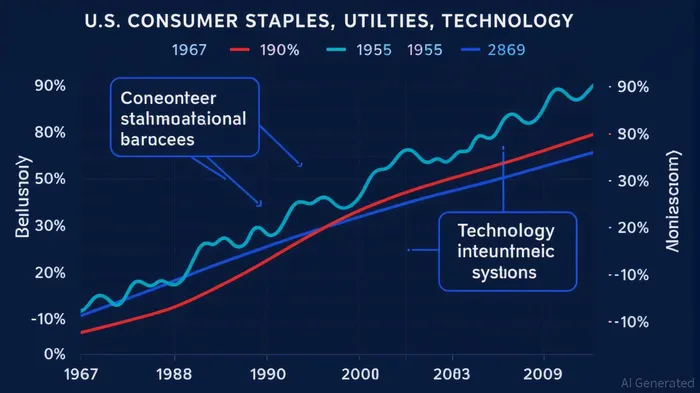
Defensive sectors have long served as safe havens during economic contractions. In the United States, data spanning 1967 to 2009 reveals that consumer staples delivered an annualized return of approximately 13.6%, while utilities returned 11.3% annually, both with significantly lower volatility compared to cyclical sectors like technology and financials [1]. The standard deviation of returns for consumer staples was around 15.8%, and for utilities, 13.7%, underscoring their capacity to generate consistent returns amid market turbulence [1].
European markets mirror this trend. Over the past three decades, defensive sectors have outperformed broader indices and other sectors by delivering robust returns with minimal downside risk [1]. During the Global Financial Crisis (2008), the MSCI/S&P Consumer Staples sector experienced a maximum drawdown of roughly –34%, a stark contrast to the near-50% declines in financials and technology [1]. Similarly, during the 2020 pandemic-induced crash, defensive sectors rebounded more swiftly, reflecting their essential nature and stable cash flows [1].
Risk-Adjusted Returns: Sharpe Ratios and Capital Preservation
The superior performance of defensive sectors is not merely a function of lower volatility but also of their ability to generate strong risk-adjusted returns. Sharpe ratios—a metric that measures excess return per unit of risk—have historically favored utilities and consumer staples. For instance, the low volatility and consistent dividends of these sectors have translated into Sharpe ratios that outperform cyclical peers, particularly during downturns [1].
Capital preservation further reinforces their appeal. During the 2008 crisis, while the S&P 500 fell by nearly 50%, consumer staples and utilities lost less than half that amount, preserving a larger portion of invested capital [1]. This resilience is attributed to their inelastic demand—consumers continue to buy essentials like food, utilities, and household goods regardless of economic conditions.
Strategic Relevance in Today's Climate
Current market dynamics amplify the case for defensive equities. With global growth slowing and inflationary pressures persisting, BlackRockBLK-- has recently advocated for increased exposure to low-volatility strategies and defensive sectors, despite their current premium valuations [2]. The firm argues that the combination of stable cash flows, dividend yields, and downside protection makes these sectors attractive in a high-uncertainty environment.
However, investors must remain cautious. Defensive stocks are not immune to macroeconomic shocks. For example, rising interest rates can pressure utility stocks, which are often sensitive to borrowing costs. Similarly, consumer staples may face margin compression during periods of stagflation. Diversification and careful sector selection remain critical.
Conclusion
High-yield stocks in low-growth sectors are not a panacea for economic uncertainty, but their historical performance offers a compelling case for inclusion in a diversified portfolio. Their ability to deliver risk-adjusted returns, coupled with superior capital preservation during downturns, positions them as strategic assets in a slowing economy. While current valuations may appear stretched, the enduring demand for essentials and the structural advantages of these sectors suggest their long-term value remains intact. As markets grapple with the next phase of the economic cycle, defensive equities may well prove to be both a shield and a steady hand.







Comentarios
Aún no hay comentarios