
High-Yield Canadian Equities: A Strategic Approach to Long-Term Income and Compounding
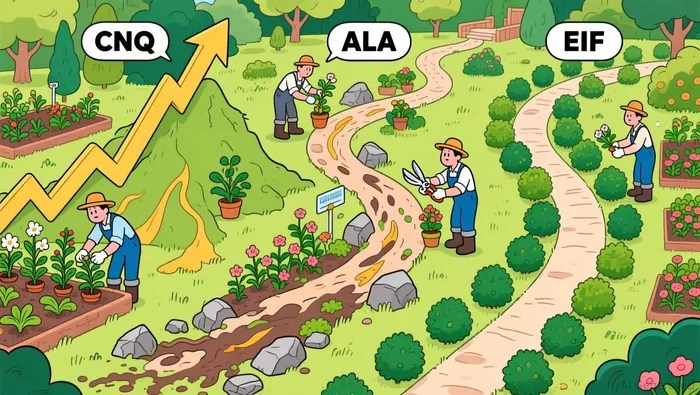
The pursuit of long-term income generation through equities hinges on two critical pillars: consistent dividend growth and the compounding power of reinvested returns. In Canada, a select group of high-yield equities has demonstrated resilience and strategic adaptability, making them compelling candidates for investors seeking sustainable income streams. This analysis examines three such companies-Canadian Natural Resources Limited (CNQ), AltaGas Ltd. (ALA), and Exchange Income Corp. (EIF)-through the lens of their dividend histories, growth trajectories, and future projections.
Canadian Natural Resources: A Legacy of Volatility and Resilience
Canadian Natural Resources (CNQ) has long been a cornerstone of Canada's energy sector, with a 25-year history of dividend growth at a compound annual rate (CAGR) of 21%. However, the past decade has revealed a more nuanced picture. From 2015 to 2025, CNQ's dividend surged from $0.115 to $0.5875 per share, reflecting a complex interplay of market volatility and strategic debt reduction. While the 3-year average growth rate stands at 16.25%, the 10-year CAGR is tempered by a 3-year decline of -13.72% in 2022. This volatility underscores the cyclical nature of energy markets but also highlights CNQ's ability to maintain dividend growth even during downturns.
Looking ahead, CNQCNQ-- projects a 2–56% annual dividend increase, with forward-looking metrics suggesting a share price CAGR of 14.63% and a dividend CAGR of 16.34%. These figures, while optimistic, require careful scrutiny given the sector's exposure to commodity price swings. For investors with a high risk tolerance, CNQ's current yield of 5.06% and its historical resilience make it a compelling, albeit volatile, addition to a diversified portfolio.
AltaGas: Stability Amidst Structural Challenges
AltaGas (ALA) presents a contrasting narrative. While the company has raised its dividend annually since 2020, its 10-year history reveals structural challenges. In 2015, ALA's annual dividend stood at $1.72 per share, declining to $1.26 by 2025-a 1.9% annual decline over the period. This decline, however, masks recent improvements: ALA has committed to a 5–7% CAGR in dividends through 2029. The company's current yield of 3.21% is supported by a payout ratio of 49.7%, indicating robust earnings coverage.
The key question for ALA lies in its ability to sustain this growth trajectory. A 2025 guidance update noted a six percent dividend increase, extending a five-year streak of annual hikes. Yet, the company's history of dividend cuts-most notably in 2022- raises concerns about its vulnerability to external shocks. For income-focused investors, ALA's defensive characteristics and forward-looking guidance offer reassurance, but its mixed historical performance necessitates cautious optimism.
Exchange Income Corp: The Power of Monthly Compounding
Exchange Income Corp. (EIF) distinguishes itself through its unique business model and monthly dividend structure. Since 2004, EIF has increased its dividend 16 times, culminating in a current annualized payout of $2.64 per share. Its 2025 projections indicate a payout ratio of 70%, ensuring strong earnings coverage. More compellingly, EIF projects a 2% annual dividend growth rate over the next five years, a modest but sustainable pace that, when compounded monthly, could significantly enhance long-term returns.
The company's diversified portfolio-spanning equipment finance, insurance, and energy-provides a buffer against sector-specific downturns. With a current yield of 5.3%, EIF exemplifies how regular, reinvested payouts can amplify compounding effects, particularly for investors prioritizing income consistency.
Strategic Implications for Long-Term Investors
The analysis of CNQ, ALA, and EIF underscores a critical insight: high-yield equities must be evaluated not in isolation but within the context of their growth trajectories and risk profiles. CNQ's energy-sector exposure offers high returns but demands tolerance for volatility. ALA's recent consistency is promising, yet its historical volatility necessitates a longer-term perspective. EIF, meanwhile, provides a model of disciplined growth and compounding, albeit with a lower yield.
For investors seeking to harness compounding, the key lies in diversification and reinvestment. CNQ's projected 16.34% dividend CAGR and EIF's monthly payouts illustrate how even modest growth rates can yield substantial returns over decades. ALA's 5–7% guidance, if sustained, could further anchor a portfolio's income stream.
Conclusion
High-yield Canadian equities remain a cornerstone of long-term income strategies, but their selection requires rigorous analysis of historical performance, forward-looking guidance, and sector dynamics. CNQ, ALA, and EIF each offer unique advantages, from CNQ's cyclical resilience to EIF's compounding potential. By aligning these investments with individual risk profiles and reinvestment strategies, investors can construct portfolios that not only generate income but also harness the transformative power of compounding.





Comentarios
Aún no hay comentarios