
Hexagon Composites: Navigating Short-Term Turbulence Amid Long-Term Clean Energy Megatrends
Strategic Resilience in a Downturn
Hexagon Composites has responded to the downturn with a Group-wide cost savings program, targeting improved EBITDA break-even points and liquidity preservation, as detailed in the company's Q3 release. This pragmatic approach mirrors broader industry trends, where companies are prioritizing operational efficiency amid macroeconomic uncertainty. For instance, Clean Energy FuelsCLNE-- Corp (CLNE), a collaborator in renewable natural gas (RNG) infrastructure, reported strong Q3 2025 EBITDA despite a net loss, underscoring the sector's ability to generate cash flow in challenging conditions, as shown in Clean Energy Fuels' Q3 highlights.
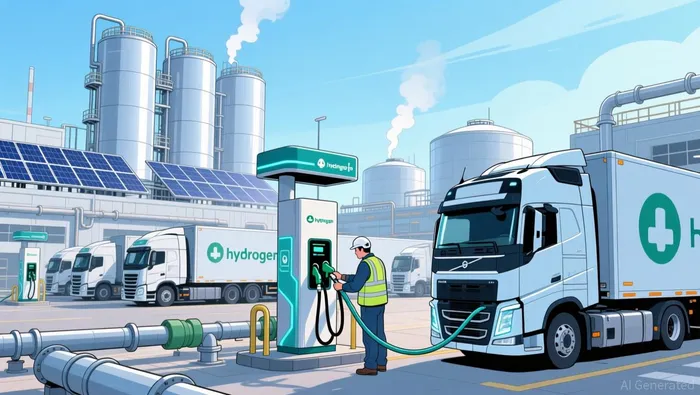
The company's focus on hydrogen and carbon capture technologies further strengthens its strategic resilience. Partnerships such as the Pioneer Clean Fleet Solutions initiative-with Cummins and Hexagon Agility-aim to lower adoption barriers for RNG-powered equipment, including the X15N engine, as noted in a GuruFocus recap. This engine, already adopted by fleets like Walmart and Amazon, positions Hexagon to benefit from the aging U.S. truck fleet and growing demand for cleaner transportation solutions (as described in the company's Q3 release).
Sector Positioning and Long-Term Megatrends
While Hexagon's Q3 results highlight near-term fragility, its positioning in the hydrogen and carbon capture sectors suggests robust long-term potential. The global push for decarbonization, driven by policy frameworks and corporate sustainability goals, ensures that technologies like RNG and carbon capture utilization and storage (CCUS) will remain critical. For example, Honeywell's carbon capture project in Indiana-capturing 1.65 million tons of CO2 annually-demonstrates the scalability of such solutions even in economically uncertain times, as reported in a TradingView roundup. Similarly, Kiwetinohk Energy Corp's CCUS initiatives in Canada illustrate how energy firms are integrating carbon management into their core operations, according to a MarketScreener update.
Hexagon's RNG upstream business, though scaled back from initial production targets, remains a strategic asset. The revised goal of 20 million gallons by 2027 aligns with industry caution in the face of low freight rates and regulatory delays, as reported in Clean Energy Fuels' Q3 highlights. This measured approach contrasts with overambitious expansions that could exacerbate financial strain during downturns.
Balancing Act: Risks and Opportunities
The path forward for Hexagon Composites is not without risks. Uncertain policy environments and cyclical fluctuations in freight demand could delay the adoption of hydrogen and RNG technologies. However, the company's collaborative ecosystem-spanning partnerships with industry leaders and alignment with global decarbonization goals-mitigates these risks. As CEO Philipp Schramm noted, the X15N engine and aging truck fleets represent "catalysts for growth" in the natural gas trucking industry, according to the company's Q3 release.
Investors must also consider the broader context: Clean Energy Fuels Corp's infrastructure expansion and hydrogen fueling contracts signal a maturing market, as described in Clean Energy Fuels' Q3 highlights. While Hexagon's Q3 performance is bleak, its role in enabling this transition-through storage, transportation, and conversion solutions-positions it to capitalize on eventual upturns, a point further outlined in Hexagon's Q3 invitation.
Conclusion
Hexagon Composites exemplifies the duality of the clean energy sector: short-term turbulence coexists with long-term promise. Its cost-cutting measures and strategic partnerships are designed to weather the current downturn while maintaining alignment with decarbonization megatrends. For investors, the key lies in distinguishing between transient financial pain and enduring structural opportunities. As the global economy recalibrates, companies like Hexagon that balance resilience with innovation will likely emerge stronger.





Comentarios
Aún no hay comentarios