
Hapag-Lloyd’s Trans-Pacific Surge: A Tactical Play in a Volatile Sea
The global shipping sector remains a tempestTPST-- of volatility, with geopolitical tensions, supply chain disruptions, and shifting trade policies creating both opportunities and pitfalls. Nowhere is this duality clearer than in Hapag-Lloyd’s recent performance. The German shipping giant has ridden a 50% surge in China-U.S. container bookings—a post-tariff rebound—to position itself as a near-term beneficiary of trans-Pacific demand recovery. Yet beneath the surface, structural risks loom: tariff reversals, Red Sea bottlenecks, and overcapacity in other trade lanes threaten to cap gains. For investors, this presents a compelling tactical play—but one requiring careful hedging against downside risks.
The Catalyst: A 50% Surge, But How Long Does It Last?
The 50% leap in China-U.S. container bookings reported by The Wall Street Journal in early 2025 marks a pivotal inflection point. Hapag-Lloyd’s Q1 results confirm this, with Trans-Pacific volumes rising 13.1% year-on-year to 947,000 TEUs, outpacing global trade growth of just 4.2%. This surge stems from a U.S.-China tariff truce, which released pent-up cargo delayed by prior trade wars. Yet CEO Rolf Habben Jansen warns: “This could be a short-lived spike.”
The timing is critical. While Hapag-Lloyd’s freight rates rose 11% year-on-year to $1,692/TEU—defying broader declines in the SCFI—the truce’s expiration in April 2025 triggered a sharp drop in China-U.S. bookings. Investors must ask: Is this a durable recovery or a fleeting reprieve? The answer hinges on Hapag-Lloyd’s ability to capitalize on the upswing while mitigating risks.
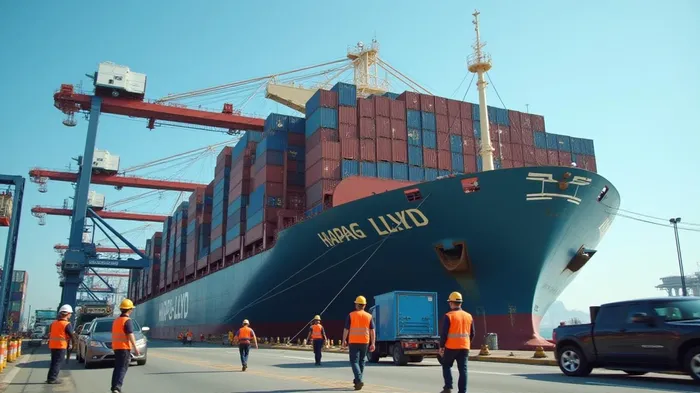
Strategic Positioning: Gemini, Terminals, and Cost Discipline
Hapag-Lloyd’s Gemini Cooperation alliance with Maersk is its crown jewel. With 90% schedule reliability—versus competitors’ 50-75%—this partnership has transformed the company’s service offering. By deploying larger vessels on Trans-Pacific routes and eliminating “blank sailings,” Hapag-Lloyd has cut costs while boosting capacity. The alliance’s gradual rollout (95% of ships phased in by early 2025) ensures scalability without overextending.
Equally vital are terminal investments. Hapag-Lloyd’s acquisition of a majority stake in the CNMP LH Terminal in Le Havre, France, and expansions in Wilhelmshaven and India, have reduced congestion and boosted throughput. These moves, combined with a $1 billion cost-reduction program targeting vessel efficiency and procurement, position the company to weather volatility.
Near-Term Gains: Riding the Trans-Pacific Wave
The case for a tactical long position in HAHN.GR is strong:
1. Margin Expansion: The Gemini alliance’s reliability and scale allow Hapag-Lloyd to command premium rates on high-demand routes. Even with rising bunker costs ($61/TEU year-on-year due to Red Sea rerouting), its cost discipline keeps margins intact.
2. Capacity Constraints: Red Sea diversions via the Cape of Good Hope have tightened global container capacity, artificially propping up rates. A delayed return to the Suez Canal could extend this scarcity.
3. Strategic Agility: Hapag-Lloyd’s swift shift from smaller to larger vessels post-truce highlights its operational flexibility—a rare asset in turbulent markets.
Long-Term Risks: Tariffs, Overcapacity, and Geopolitical Whiplash
The downside is equally stark:
- Tariff Reversals: If the U.S.-China truce unravels, Trans-Pacific demand could crater anew. Hapag-Lloyd’s April 2025 volume drop underscores this vulnerability.
- Overcapacity Elsewhere: While Trans-Pacific is booming, other routes like Asia-Europe face oversupply. A global economic slowdown could exacerbate this imbalance.
- Red Sea Uncertainty: Even if the Suez reopens, rerouting delays have already added $61/TEU to costs. Prolonged instability could erode margins.
The Investment Thesis: A Tactical Long with Stops
Buy HAHN.GR for the next 6–12 months, targeting a 20% return, but set stops at the $10.50 level (a 20% drop from May 2025 highs) to guard against tariff reversals. Key catalysts to watch:
- Q2 2025 Earnings: Confirm whether the Trans-Pacific surge is sustained.
- Red Sea Developments: Monitor for Suez Canal reopenings or further Houthi attacks.
- Tariff Talks: Track U.S.-China negotiations for signs of a durable truce.
Conclusion: Navigate the Storm, but Stay Anchored
Hapag-Lloyd’s Trans-Pacific surge offers a rare window to profit from trade normalization. Its Gemini alliance and cost discipline make it a standout player in an otherwise fragmented sector. Yet investors must tread carefully: tariffs could flip sentiment overnight, and Red Sea risks linger. This is not a buy-and-hold stock—it’s a tactical bet for those willing to monitor geopolitical winds closely. For now, the waves are in Hapag-Lloyd’s favor—but the storm remains offshore.
Disclosure: The author holds no position in HAHN.GR at the time of writing. This analysis is for informational purposes only.







Comentarios
Aún no hay comentarios