
Government Funding for Vaccine Research: Navigating Uncertainty and Opportunity in Biotech Investment
The U.S. government's role in funding vaccine research has long been a cornerstone of public health and economic resilience. Yet, as the nation grapples with shifting fiscal priorities and emerging infectious threats, the landscape for biotech investment is becoming increasingly complex. This analysis examines the interplay between federal funding mechanisms, public health policy, and the biotech sector's capacity to innovate—and the implications for investors seeking to capitalize on this dynamic field.
The Pillars of Government-Funded Vaccine Research
The National Institutes of Health (NIH), Biomedical Advanced Research and Development Authority (BARDA), and Defense Advanced Research Projects Agency (DARPA) form the triad of U.S. agencies driving vaccine innovation. The NIH, with a 2022 budget of $45 billion, remains the largest public funder of biomedical research, allocating over 80% of its resources to extramural grants for universities and institutions [2]. BARDA, meanwhile, specializes in de-risking vaccine candidates through clinical trials and public-private partnerships, as exemplified by its Project NextGen initiative, which targets next-generation vaccines for SARS-CoV-2 variants and pan-coronavirus solutions [3]. DARPA, though less frequently cited in recent vaccine research, has historically supported high-risk, high-reward projects, such as universal flu vaccines [1].
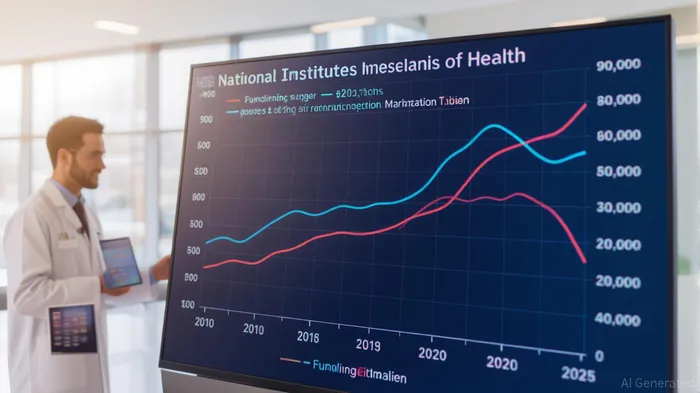
However, the stability of these programs is under threat. In May 2025, the White House proposed a 40% budget cut to the NIH, reverting to 2007 funding levels [4]. While Congress has resisted such drastic reductions, the proposal has created a climate of uncertainty. For investors, this signals a potential shift in the risk-reward calculus for biotech firms reliant on federal grants.
The Economic and Health Care Implications of Funding Cuts
The NIH's role in foundational research cannot be overstated. Its investments have historically yielded transformative breakthroughs, from statins for cholesterol to cisplatin for cancer treatment [4]. A sustained reduction in funding could stifle innovation in areas with long payback periods, such as universal vaccines or mucosal delivery technologies. This would not only delay public health advancements but also weaken the pipeline of scientific talent, as reduced grants limit opportunities for early-career researchers [4].
For the biotech sector, the implications are twofold. First, firms dependent on NIH grants may face liquidity constraints, forcing them to pivot toward projects with shorter development cycles or clearer commercial pathways. Second, BARDA's focus on de-risking candidates through Phase I/II trials could become a critical differentiator. Companies securing BARDA contracts—such as those under the Rapid Response Partnership Vehicle (RRPV)—may enjoy a competitive edge, as these programs mitigate financial and regulatory risks [3].
Assessing Investment Opportunities in a Shifting Landscape
Despite the challenges, the biotech sector remains a compelling arena for investors, albeit with a nuanced strategy. Key opportunities lie in firms aligned with three trends:
1. Next-Generation Vaccine Platforms: BARDA's emphasis on mucosal vaccines and pan-coronavirus solutions suggests a growing market for companies developing flexible, multi-pathogen platforms.
2. Public-Private Partnerships: Firms with established collaborations with BARDA or the NIH, particularly those leveraging existing infrastructure (e.g., NIAID's clinical trial networks), are better positioned to navigate funding volatility [3].
3. Adaptive Business Models: Companies diversifying revenue streams—such as those combining government grants with commercial partnerships or public health contracts—may prove more resilient to policy shifts.
However, investors must remain cautious. The absence of publicly disclosed grant recipients for 2023–2025 (as noted in the background research) underscores the opacity of current funding allocations. This lack of transparency complicates due diligence, necessitating a focus on indirect indicators, such as a firm's track record in securing BARDA or NIH contracts or its alignment with high-priority initiatives like Project NextGen [3].
Conclusion: Balancing Risk and Resilience
The U.S. government's investment in vaccine research is both a public health imperative and an economic lever. For biotech firms, the path to success lies in navigating the tension between foundational research and commercial viability. While proposed budget cuts pose significant risks, they also create opportunities for agile firms capable of leveraging public-private partnerships and adapting to policy shifts.
Investors, in turn, must adopt a long-term perspective, prioritizing companies that align with strategic government priorities and demonstrate resilience in the face of fiscal uncertainty. In an era of persistent health threats and evolving fiscal constraints, the biotech sector's ability to innovate will depend not only on scientific ingenuity but also on its capacity to navigate the complex interplay between public funding and market forces.







Comentarios
Aún no hay comentarios