
Gold's Strategic Role in a Post-Fed Rate Cut World: A Macro-Driven Analysis
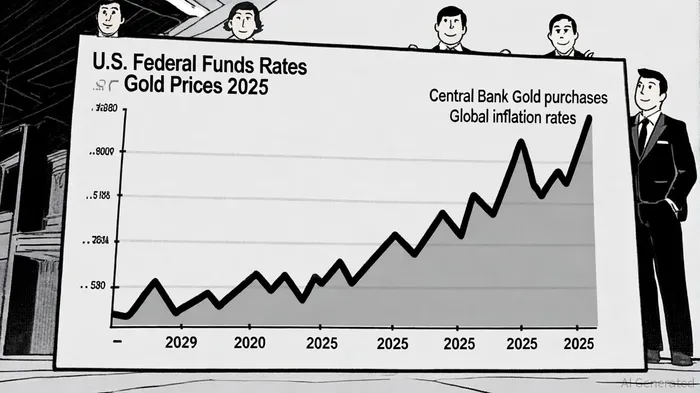
The U.S. Federal Reserve's September 2025 rate cut—its first reduction of the year—has reignited debates about gold's role in a post-dovish monetary policy world. By lowering the federal funds rate by 25 basis points to 4.00%–4.25%, the Fed signaled a shift toward accommodative policy, citing slowing labor market growth and persistent inflationary pressures[1]. This decision, coupled with projections for two further cuts by year-end, has created a macroeconomic environment where gold's dual role as a safe-haven asset and inflation hedge is being reexamined by investors and central banks alike[2].
The Mechanics of Gold's Response to Rate Cuts
Gold prices are inherently sensitive to changes in real interest rates, which are calculated by subtracting inflation from nominal rates. As the Fed signals rate cuts, real rates fall, reducing the opportunity cost of holding non-yielding assets like gold. This dynamic was evident in September 2025, when gold surged to an intraday high of $3,707 per ounce immediately after the rate cut announcement, only to retreat to $3,634 as the U.S. dollar strengthened unexpectedly[1]. The dollar's resilience, driven by policy divergence from other central banks and geopolitical risks favoring dollar assets, temporarily offset gold's traditional inverse relationship with rates[1].
However, the longer-term outlook remains compelling. Analysts project gold prices could reach $4,000–$5,000 by mid-2026 if the Fed maintains its dovish stance and global economic uncertainty persists[4]. This is supported by the Federal Reserve's own projections, which anticipate core PCE inflation remaining at 3.1% in 2025 before gradually declining to 2.0% by 2028[4]. Such a trajectory ensures that real rates will remain low for years, providing a structural tailwind for gold.
Central Bank Demand: A Structural Floor for Gold
Central bank purchases have emerged as a critical pillar of gold's price resilience. In 2025, emerging market central banks—particularly those in China, Kazakhstan, Turkey, and Poland—have continued to accumulate gold at an unprecedented pace[4]. For instance, the People's Bank of China added 36 tonnes of gold over nine consecutive months through July 2025, while the National Bank of Kazakhstan accumulated 25 tonnes year-to-date[4]. These purchases reflect a strategic shift away from U.S. Treasuries, as central banks diversify reserves to hedge against dollar volatility and geopolitical risks[1].
This trend has created a physical floor for gold prices, preventing sharp declines even amid periods of dollar strength. By July 2025, global central banks had added 10 tonnes of gold to their reserves, with the National Bank of Poland—the largest net purchaser of the year—holding 67 tonnes y-t-d[4]. Such behavior underscores gold's role as a neutral, liquid asset in an era of monetary fragmentation.
Inflationary Pressures and Portfolio Reallocation
While U.S. inflation is projected to stabilize near 2.3% in 2025, global inflation remains uneven. The International Monetary Fund (IMF) forecasts a global inflation rate of 4.4% for 2025, with countries like Türkiye experiencing a stark 37.93% CPI inflation rate, while Switzerland reports near-zero inflation[3]. This divergence amplifies demand for assets like gold, which offers a hedge against both high inflation and currency devaluation.
Investors are increasingly reallocating portfolios to include gold as a counterbalance to equities and bonds. The September 2025 rate cut, described by Fed Chair Jerome Powell as a “risk management” decision, has heightened uncertainty about the trajectory of monetary policy[1]. In such an environment, gold's lack of correlation with traditional asset classes becomes a strategic advantage. For example, the Dow Jones Industrial Average surged by 400 points post-announcement, but gold's mixed performance highlighted its role as a stabilizer in volatile markets[2].
Strategic Implications for Investors
The interplay between Fed policy, central bank behavior, and inflation dynamics suggests that gold should occupy a core position in diversified portfolios. For institutional investors, the growing trend of central bank accumulation provides a degree of price insulation, while retail investors may benefit from gold's potential to outperform in a low-yield world. However, caution is warranted. The Fed's data-dependent approach means that unexpected economic developments—such as a sharper-than-anticipated slowdown in inflation or a reversal in labor market trends—could disrupt gold's trajectory[2].
In conclusion, gold's strategic role in a post-Fed rate cut world is underpinned by macroeconomic forces that transcend short-term volatility. As central banks continue to prioritize gold for diversification and inflation remains a persistent risk, the metal's appeal as a safe-haven asset is likely to endure. For investors, the challenge lies in balancing exposure to gold with broader portfolio objectives, ensuring resilience in an era of monetary uncertainty.







Comentarios
Aún no hay comentarios