
Gold's Resurgence: A Safe-Haven Asset in an Age of Uncertainty
In the past five years, the investment landscape has been reshaped by a confluence of macroeconomic turbulence and shifting investor sentiment. Nowhere is this more evident than in the performance of gold relative to the S&P 500. From 2020 to 2025, gold has outperformed the stock index in critical periods, defying traditional asset correlations and underscoring its evolving role as a hedge against systemic risk. This divergence, driven by central bank behavior, ETF inflows, and geopolitical volatility, raises pressing questions about the future of portfolio construction in an increasingly uncertain world.
A Tale of Two Assets: Performance Divergence and Macroeconomic Drivers
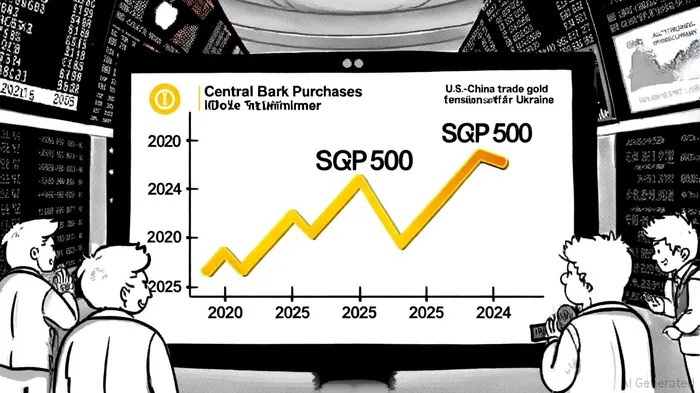
The most striking evidence of gold's outperformance emerged in 2024 and early 2025. While the S&P 500 delivered a robust 25% return in 2024, gold surged 27%, a rare instance of simultaneous strength in both assets, according to a Gold vs S&P 500 comparison. However, the trend diverged sharply in early 2025: gold rose over 14% year-to-date by October, while the S&P 500 fell 3.5%, as shown in a CNBC analysis. This contrast reflects gold's unique position as a safe-haven asset during periods of economic and geopolitical stress.
Historically, gold has thrived during crises. During the 2008 financial collapse, it gained 5.4% while the S&P 500 plummeted 37%. Similarly, in the early stages of the 2020 pandemic, gold rose 24% as equities tumbled, according to an Investopedia article. The 2024-2025 period mirrors these patterns, with gold's gains fueled by fears of prolonged U.S.-China trade tensions, the war in Ukraine, and a weakening U.S. dollar.
Long-term data reinforces this narrative. From 1971 to 2025, the S&P 500's 11.52% compound annual growth rate (CAGR) outpaced gold's 8.19% CAGR, according to a SmarterWealth analysis. Yet, in shorter timeframes-such as 2004-2024-gold's 9.8% annualized return bested the S&P 500's 9.2%, as noted by goldtrends.net. This duality highlights a critical insight: while equities dominate in stable, growth-oriented environments, gold's role as a diversifier becomes paramount during uncertainty.
Investor Sentiment: Central Banks and ETFs as Catalysts
The surge in gold demand has been institutionalized by central banks and retail investors alike. Central banks added 1,045 tonnes of gold to their reserves in 2024 alone, with Poland, Turkey, India, and China leading the charge, according to the World Gold Council survey. By mid-2025, global central bank gold holdings had reached 40% of total reserves-the highest level in 30 years, as reported by a Forbes article. This shift reflects a strategic move away from dollar-centric assets, as nations seek to hedge against currency debasement and geopolitical risks.
Gold ETFs have mirrored this trend. In 2025, global physically backed gold ETFs attracted $38 billion in inflows by July, the strongest first-half performance since 2020, according to a GuruFocus report. The SPDR Gold Shares (GLD) alone saw $3.9 billion in early 2025 inflows, pushing its price 26% higher, per an S&P Global report. These flows were driven by both retail investors seeking safety and institutional players capitalizing on gold's inverse relationship with real interest rates. When inflation-adjusted rates turn negative-as they have been since 2022-gold's appeal intensifies, as noted by J.P. Morgan Private Bank.
Macroeconomic Uncertainty: The New Normal?
The macroeconomic backdrop has been a key driver of gold's outperformance. Three factors stand out:
1. Geopolitical Tensions: The war in Ukraine, U.S.-China trade frictions, and Middle East instability have heightened demand for assets perceived as immune to political risk.
2. Inflation and Currency Erosion: Despite falling headline inflation, persistent supply-side pressures and central bank balance sheet expansion have kept inflation expectations anchored, favoring gold's role as a hedge, as detailed in a FinancialContent report.
3. U.S. Dollar Dynamics: A weakening dollar, exacerbated by divergent monetary policies and dollar overhang, has reduced the opportunity cost of holding non-yielding assets like gold, according to an EBC article.
The S&P 500, meanwhile, faces headwinds. While it reflects corporate innovation and productivity gains, its performance is increasingly tied to macroeconomic stability. A 3.5% decline in early 2025 underscores equities' vulnerability to sudden shifts in risk sentiment.
Implications for Investors
Gold's recent outperformance challenges conventional wisdom about its role in portfolios. Traditionally viewed as a niche asset, it now offers diversification benefits comparable to traditional safe-haven bonds, with lower correlation to equities during downturns, as CNBC has noted. For investors, this suggests a need to rebalance allocations toward assets that can withstand systemic shocks.
However, gold is not a panacea. Its long-term returns lag behind equities, and its price is subject to cyclical swings. The key lies in strategic allocation: a 5-10% exposure to gold or gold ETFs can enhance portfolio resilience without sacrificing growth potential, as goldtrends.net has observed.
Conclusion
The 2024-2025 period has redefined the relationship between gold and the S&P 500. Driven by central bank purchases, ETF inflows, and macroeconomic uncertainty, gold has emerged as a critical component of modern portfolios. While the S&P 500 remains the engine of long-term wealth creation, gold's role as a hedge against volatility and currency risk is no longer a marginal consideration-it is a necessity in an era of persistent uncertainty.







Comentarios
Aún no hay comentarios