
Gold's Resilience Amid U.S. Tariff Uncertainty and Dollar Dynamics
The global economy stands at a crossroads as U.S. tariff policies, now extended to an August 1 deadline, continue to reshape trade dynamics and market sentiment. Amid this uncertainty, gold has emerged as both a barometer of instability and a refuge for investors. This article examines how evolving trade tensions, currency fluctuations, and technical factors are influencing gold's safe-haven appeal, offering actionable insights for navigating volatility.
Tariff Uncertainty: A Double-Edged Sword for Gold
The U.S. administration's repeated delays in finalizing tariffs—most recently extending the July 9 deadline to August 1—have tempered immediate panic. Initial declines in gold prices, such as the dip below $3,300/oz in early July, reflected reduced short-term fear. Yet unresolved issues, including unresolved talks with China, Japan, and the EU, maintain a ceiling of uncertainty.
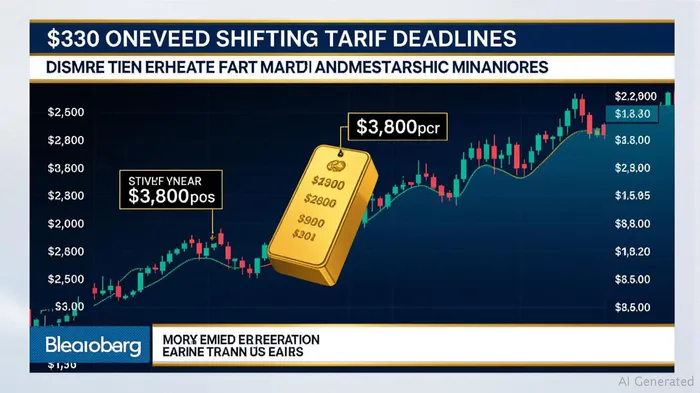
The “boomerang effect” of tariff threats cannot be underestimated. While partial deals (e.g., Vietnam's 20% auto tariff) ease near-term pressure, the risk of escalation—particularly with BRICS nations facing additional levies—ensures gold retains its role as an inflation hedge.
Dollar Dynamics: The Counterweight to Gold's Appeal
The U.S. dollar's resurgence, driven by reduced tariff-driven inflation fears and Fed policy stability, poses a countervailing force. A stronger dollar typically depresses gold demand, as seen in its inverse correlation with the Dollar Index.
However, the dollar's rally may be limited by broader geopolitical risks. If trade talks falter, a flight to safety could reignite demand for gold, even as the dollar gains. Investors must monitor the “dollar-gold seesaw” closely, particularly ahead of the August 1 deadline.
Technical Indicators: Overbought or Oversold?
Gold's technical outlook is mixed. While long-term momentum indicators (MACD, PMO) suggest overbought conditions—similar to 2011 and 2020 peaks—recent support levels ($3,245/oz) have held. A breakdown below this threshold could signal a bearish shift, but institutional buying may cushion declines.
Central Banks and ETFs: The Anchor of Demand
Central banks added 20 tonnes of gold to reserves in May 2025, a modest but consistent signal of long-term confidence. Meanwhile, ETF inflows have surged, with SPDR Gold Shares (GLD) attracting $1.2 billion in June alone. These flows reflect a structural shift: gold is no longer just a crisis hedge but a “permanent portfolio component” for diversification.
Investment Strategy: Positioning for Volatility
- Hedging with Gold ETFs: Allocate 5-10% of portfolios to gold via GLDGLD-- or IAU to balance equity exposure.
- Mining Stocks (Pick Your Moment): While gold miners (e.g., NewmontNEM-- (NEM), BarrickB-- (GOLD)) offer leverage to rising prices, low trading volumes signal caution. Wait for a confirmed breakout above $3,360/oz before scaling into equities.
- Dollar Carry Trade with Caution: Shorting the dollar against safe-haven currencies (e.g., CHF) could amplify returns, but monitor Fed rate signals closely.
- Diversify Geographically: Invest in regions less exposed to tariffs, such as Canada or Southeast Asia, while using gold as a buffer.
Conclusion: Gold's Role in the New Trade Reality
Gold's resilience hinges on unresolved trade tensions and the dollar's trajectory. While technical overbought conditions pose short-term risks, its structural appeal as a safe haven remains intact. Investors should treat gold as a “stress-test asset”—a portfolio anchor in an era where policy unpredictability is the only certainty.
Act now by rebalancing exposures, but stay nimble: the August 1 deadline will test both gold's resolve and the dollar's dominance.
Data sources: World Gold Council, Federal Reserve Economic Data (FRED), Bloomberg Terminal.





Comentarios
Aún no hay comentarios