
Gold ETFs and the New Bull Market: Assessing Sustainability Amid Macroeconomic Crosscurrents
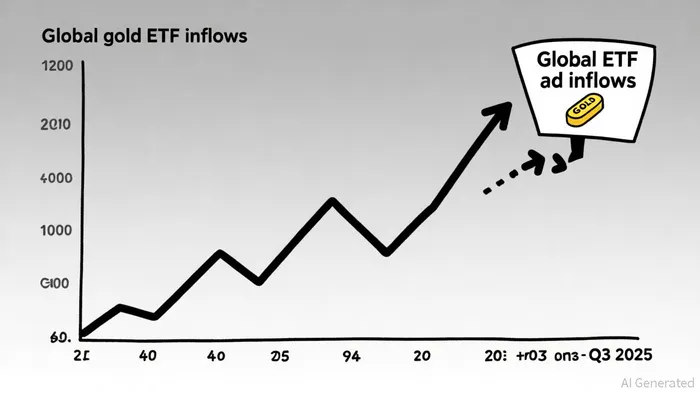
The surge in gold exchange-traded fund (ETF) inflows in 2025 has propelled the metal to record prices, with spot gold breaching $3,700 per troy ounce by September 2025. This rally, driven by a confluence of macroeconomic risks and shifting investor behavior, raises critical questions about its sustainability. While historical patterns suggest that ETF-driven demand often precedes and amplifies bull markets, the current environment is marked by both tailwinds and headwinds that demand careful scrutiny.
The Drivers of the 2025 Rally
The recent inflows into gold ETFs reflect a broad-based reallocation of capital toward safe-haven assets. According to a report by the World Gold Council, global gold ETF holdings surged by over 861,000 ounces in September 2025 alone, pushing total holdings to 95.8 million ounces[2]. This momentum is underpinned by three key factors:
- Geopolitical and Economic Uncertainty: Persistent geopolitical tensions, coupled with stagflationary risks—high inflation and weak growth—have intensified demand for gold as a hedge[1].
- Federal Reserve Policy: Anticipation of two to three rate cuts in 2025 has reduced the opportunity cost of holding non-yielding assets like gold[1].
- Institutional and Regional Shifts: Asian markets, particularly China, have seen a structural shift in investment behavior. Despite representing only 9% of global gold ETF assets, China's ETF holdings increased by 24.2% in a two-week period in early 2025[3], signaling a growing appetite for gold as a strategic allocation.
Historical Correlation and Structural Changes
Gold ETF flows have historically mirrored bull markets. For instance, the 2005–2007, 2009–2012, and 2019–2020 bull cycles were all preceded by sustained ETF inflows[1]. The 2025 surge appears to follow this pattern, with SPDR Gold Shares (GLD) recording a $2.2 billion single-day inflow in April 2025[2]. However, the current cycle differs in its regional dynamics. While North American and European ETFs have been the primary beneficiaries, Asian funds have experienced mixed flows, with China's equity markets drawing capital away from gold in September 2025[3].
This divergence highlights a nuanced shift: gold is increasingly viewed as a strategic reserve asset in Asia, whereas Western investors remain focused on short-term hedging[3]. Such structural changes could stabilize long-term demand, even amid regional volatility.
Sustainability: Tailwinds and Headwinds
The sustainability of the current rally hinges on two critical factors:
- Macroeconomic Resilience: Gold's appeal as a hedge depends on the persistence of inflation and geopolitical risks. If stagflationary pressures abate or the Fed's rate cuts fail to materialize, ETF inflows could reverse. For example, in 2024, gold ETFs faced outflows despite a 27% price rally, as investors prioritized liquidity over long-term holdings[1].
- ETF Mechanics and Physical Supply: ETF inflows tighten physical gold fundamentals, but this dynamic is not self-sustaining. Central bank purchases and Chinese retail demand have historically offset ETF outflows[1]. However, sluggish recycling activity post-pandemic limits the availability of physical gold, potentially creating bottlenecks if ETF demand accelerates further[1].
The Road Ahead
The interplay between ETF-driven demand and macroeconomic forces will determine whether the current bull market is a fleeting surge or a structural shift. If the Federal Reserve delivers on its rate-cut projections and geopolitical risks persist, gold prices could test $4,000 per ounce. Conversely, a premature economic recovery or a pivot toward tighter monetary policy could trigger a correction.
Investors must also consider the role of alternative assets. While gold's safe-haven status remains intact, the rise of cryptocurrencies and inflation-linked bonds offers competing avenues for hedging. The resilience of gold ETFs will depend on their ability to outperform these alternatives in a low-yield environment.
Conclusion
The 2025 gold rally, fueled by ETF inflows and macroeconomic anxieties, represents a compelling case study in market dynamics. While historical correlations and institutional shifts suggest a durable bull trend, sustainability will require navigating headwinds such as regional outflows and evolving investor preferences. For now, gold's ascent appears justified, but its future trajectory will hinge on the delicate balance between fear and confidence in global markets.





Comentarios
Aún no hay comentarios