
Global Trade Uncertainty and Canadian Resilience: Strategic Investment in Productivity-Driven Sectors
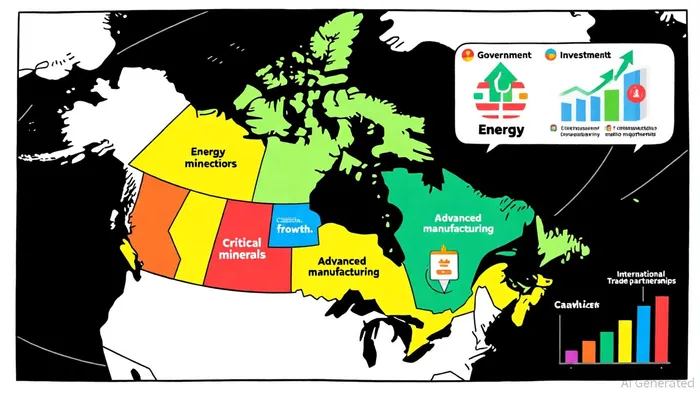
The Canadian economy stands at a crossroads, buffeted by escalating global trade uncertainty and the fallout from U.S.-Canada tariff disputes. Yet, amid these headwinds, a narrative of resilience and strategic adaptation is emerging. This analysis examines how Canada is navigating trade volatility through targeted investments in productivity-driven industries, with a focus on energy, critical minerals, and advanced manufacturing.
The Impact of Trade Uncertainty
Recent data underscores the severity of trade-related challenges. According to the 2025 Trade Confidence Index (TCI) from Export Development Canada (EDC), Canadian exporter confidence plummeted to 65.7, one of the lowest levels on record[1]. A staggering 63% of exporters anticipate tariffs will harm international sales, while 40% report declining U.S. orders—the United States remains Canada's largest trading partner, accounting for over 70% of its exports[1]. The Bank of Canada has warned that this uncertainty is stifling business investment and hiring, with Governor Tiff Macklem noting that firms are delaying decisions amid policy ambiguity[3].
The ripple effects extend beyond trade. Nearly 70% of Canadian businesses rely on international supply chains, and 48% report rising input costs due to disrupted trade flows[1]. The Canadian Federation of Independent Business (CFIB) found that 71% of business owners view the tariff situation as creating "exceptional uncertainty," with 42% fearing they cannot sustain operations without government support[4]. These trends highlight a broader economic vulnerability: Canada's heavy reliance on the U.S. market and its exposure to geopolitical tensions.
Resilient Sectors and Strategic Diversification
Despite these challenges, certain sectors are demonstrating resilience. The Canadian government has identified energy, critical minerals, and advanced manufacturing as pillars of long-term growth, allocating significant resources to bolster their competitiveness.
Energy and Critical Minerals
The energy sector, particularly in oil, gas, and clean energy, has received a $5 billion Strategic Response Fund to support projects in highly trade-exposed industries[2]. This includes investments in a national East-West electricity grid and fast-tracking clean energy projects to enhance energy sovereignty[2]. Similarly, the critical minerals sector is being prioritized through the $500 million Critical Minerals Infrastructure Fund (CMIF), which supports infrastructure development for mining and processing[1]. For instance, Denison Mines and E3 Lithium Ltd. have secured conditional funding to improve market access and energy infrastructure[3].
Advanced Manufacturing and Innovation
Advanced manufacturing is another focal point. The 2025 Advanced Manufacturing Outlook survey reveals that 89% of Canadian manufacturers report benefits from Industry 4.0 technologies, including automation, AI, and IoT-driven systems[2]. Companies like Magna International and Bombardier exemplify this shift: Magna has integrated AI-driven automation to reduce costs, while Bombardier uses 3D printing to streamline aerospace production[2]. Government initiatives, such as the Strategic Innovation Fund (SIF), further incentivize digital transformation and sustainability[2].
Case Studies in Resilience
Prince Edward Island's Tourism Success
While trade tensions have hit industrial sectors, Prince Edward Island (PEI) offers a counterexample. In 2024, PEI welcomed 1.71 million tourists—a 6% increase from 2023—generating $520.7 million in direct spending[5]. This growth, driven by improved transportation access and year-round engagement strategies, contributed 6% to the province's GDP and supported 8,900 jobs[5]. PEI's success underscores the potential of diversifying beyond traditional trade-dependent industries.
Critical Minerals and Indigenous Partnerships
The critical minerals sector also highlights Canada's strategic approach. The Indigenous Natural Resource Partnerships (INRP) program has allocated $50 million to increase Indigenous participation in mineral projects[3]. This aligns with the G7 Critical Minerals Action Plan, which emphasizes responsible production and supply chain diversification[2]. By 2025, Canada aims to become a global "critical minerals superpower," leveraging its natural resources and sustainable practices[1].
Policy Efficacy and Productivity Gaps
Canada's productivity growth remains a concern. While Quebec and Newfoundland and Labrador saw 2.0% and 1.1% increases in labor productivity in 2024, most provinces recorded declines[6]. Weakness in research and development investment, coupled with insufficient intellectual property generation, has hampered competitiveness[6]. However, post-2025 policies, such as the extension of the 15% Mineral Exploration Tax Credit and streamlined regulatory approvals, aim to address these gaps[1].
Conclusion
Canada's response to trade uncertainty is a blend of pragmatism and vision. By investing in energy security, critical minerals, and advanced manufacturing, the country is positioning itself to weather global volatility while fostering long-term resilience. Yet, challenges persist: reducing reliance on the U.S. market, closing productivity gaps, and ensuring equitable workforce participation remain critical. As the OECD notes, Canada's ability to innovate and adapt will determine its success in a rapidly shifting economic landscape[7].







Comentarios
Aún no hay comentarios