
Global Supply Chain Shifts in the Christmas Decoration Industry: The Rise of Emerging Markets as Manufacturing Hubs
The global Christmas decoration industry, long dominated by China, is undergoing a profound transformation. Driven by geopolitical tensions, trade tariffs, and a growing emphasis on sustainability, manufacturers are diversifying production to emerging markets such as Vietnam, India, Poland, and the Czech Republic. This shift is not merely a response to short-term disruptions but a strategic recalibration of supply chains to align with evolving economic and environmental priorities. For investors, understanding these dynamics is critical to navigating a market poised for both opportunity and risk.
China's Dominance and the Push for Diversification
China has historically accounted for 80-87% of global Christmas decoration exports, with its 2024 output valued at $5.9 billion-far outpacing competitors like the Netherlands ($249 million) and India ($117 million) according to Visual Capitalist. This dominance stems from its vast manufacturing infrastructure, cost efficiency, and rapid production capabilities. However, rising trade tensions and tariffs, particularly in 2024, have incentivized firms to seek alternatives. According to Bloomberg, companies are increasingly prioritizing diversification to mitigate risks associated with over-reliance on a single region.
The Rise of Emerging Markets
Vietnam has emerged as a key player, with its Christmas decoration exports reaching $52.9 million in 2023, primarily destined for the U.S., Mexico, and Canada according to OEC. The country's strategic location, cost competitiveness, and government policies supporting manufacturing make it an attractive hub. While 2024 data is incomplete, projections suggest continued growth, fueled by rising disposable incomes and urbanization.
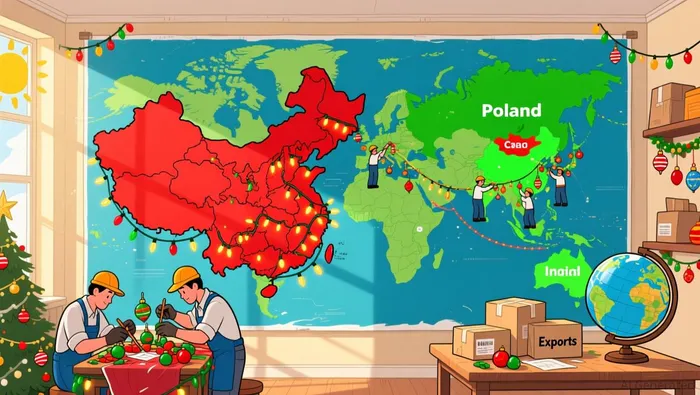 India and Poland are also gaining traction. India exported $117 million worth of decorations in 2024, ranking third globally after China and the Netherlands according to Visual Capitalist. Poland, with $92 million in exports, focuses on higher-quality, niche products for European and North American markets according to TBS News. These countries benefit from proximity to key consumer bases and trade agreements that reduce logistical barriers.
The Czech Republic, though smaller in scale, exported $7.36 million in 2023 according to World Bank Trade Data. Its growth is driven by increasing consumer spending on festive goods and the rise of e-commerce, which now captures a significant share of sales according to Market Data Forecast.
Drivers of the Shift
Several factors underpin these supply chain adjustments:
1. Cost Efficiency: Labor and raw material costs in emerging markets remain lower than in China, even when accounting for transportation expenses.
2. Sustainability Pressures: Consumers and regulators are demanding eco-friendly products, such as LED lighting and sustainable materials. Vietnam and India are investing in automation and green manufacturing to meet these standards.
3. Geopolitical Risks: Trade wars and geopolitical tensions have made over-reliance on China untenable for many firms. Diversification reduces exposure to tariffs and political instability.
Challenges and Risks
Despite these opportunities, challenges persist. Supply chain disruptions, volatile raw material costs, and the seasonal nature of the market-where timely logistics are critical-remain significant hurdles according to Yahoo Finance. For instance, Vietnam's 2024 export prices stabilized at $8.3 per unit, but fluctuations in material costs could erode margins. Additionally, while automation is rising, labor-intensive segments of the industry remain vulnerable to disruptions.
Investment Implications
For investors, the Christmas decoration industry offers a mix of resilience and volatility. Emerging markets like Vietnam and India present high-growth potential, with the global market projected to expand from $8.39 billion in 2025 to $11.30 billion by 2033 at a 3.75% CAGR according to Market Data Forecast. However, success hinges on strategic diversification, adoption of smart technology, and a focus on sustainability.
The U.S. market, valued at $2.6 billion in 2024 and expected to grow to $3.7 billion by 2033, further underscores the importance of aligning with consumer trends toward eco-friendly and customizable products. E-commerce platforms, which now dominate sales, will likely continue reshaping traditional retail models according to Global Growth Insights.
Conclusion
The Christmas decoration industry is at a crossroads. While China's dominance remains formidable, the rise of emerging markets as manufacturing hubs reflects a broader shift toward supply chain resilience and sustainability. For investors, the key lies in balancing the opportunities of these dynamic markets with the risks of geopolitical instability and logistical challenges. As the industry evolves, those who adapt to the twin imperatives of diversification and innovation will be best positioned to thrive.







Comentarios
Aún no hay comentarios