
Global Bank Rotation in International Growth Portfolios: Strategic Shifts in European and Asian Financial Exposure
The global financial landscape in 2025 is marked by a striking reallocation of capital between European and Asian banking sectors, driven by divergent strategic imperatives and macroeconomic forces. For international growth portfolios, this shift represents both a recalibration of risk and an opportunity to capitalize on regional strengths. European banks, navigating a landscape of consolidation and digital reinvention, contrast sharply with Asian institutions, which are leveraging technological innovation and emerging-market dynamism to redefine their competitive edges.
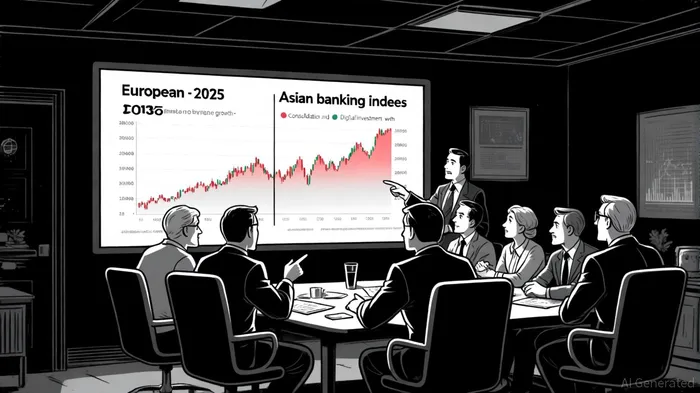
European Banks: Consolidation and Digital Resilience
European banks in 2025 are locked in a strategic battle for scale and efficiency. According to an Oliver Wyman report, over €27 billion in M&A deals have been announced in the region, with institutions like UniCredit aggressively expanding through cross-border acquisitions, including its stake in Commerzbank and Banco BPM. As stated by European Banks 2025, core banking segments such as corporate and investment banking have shown surprising resilience, with BNP Paribas reporting a 12.5% revenue increase in Q1 2025.
Digital transformation remains a cornerstone of European strategy. Banks are allocating 12% more to IT and digital initiatives in 2025, focusing on AI-driven risk reporting and blockchain-enabled cross-border payments, according to that Datastudios analysis. However, these efforts are constrained by geopolitical headwinds, including U.S.-EU trade disputes that have eroded investor confidence and elevated credit risk for export-dependent firms, as the same analysis outlines. For international investors, the combination of consolidation and digital investment has created a more concentrated banking sector, offering improved profitability but requiring careful scrutiny of regional trade tensions.
Asian Banks: Digital Disruption and Emerging-Market Momentum
In contrast, the Asian banking sector is being reshaped by a surge in digital-first strategies and open banking frameworks. As highlighted in a Capco report, virtual banks in markets like Thailand are set to launch mid-2026, leveraging low operating costs and gamified customer experiences to drive financial inclusion. Hyper-personalization, powered by AI and generative AI, is enabling banks to offer services such as automated tax filings and real-time financial advice, while open banking initiatives like Thailand's "Your Data" program are expanding access to credit for SMEs, as the Capco analysis notes.
The region's economic performance is equally compelling. Fitch Ratings notes that Vietnam and Sri Lanka are outpacing peers with robust credit growth and declining asset-quality risks, even as China and Hong Kong grapple with property-sector woes, as reported by International Banker. This divergence has prompted international portfolios to adopt a nuanced approach, favoring Southeast Asian markets while hedging against Chinese risks. JPMorgan Chase anticipates policy support for China's banking system, including potential recapitalization measures, but cautions that uneven central bank rate cuts across Asia could test local bank resilience, a point also covered by the International Banker article.
Portfolio Implications: Rotation and Diversification
The strategic shifts in Europe and Asia are directly influencing international growth portfolio allocations. By June 2025, global assets under management (AUM) had surged to $147 trillion, with Asia-Pacific attracting 8.4% net flows in 2024-nearly double previous years, according to McKinsey. This reflects a broader "great convergence" in asset management, where investors are blending traditional and alternative strategies to exploit regional opportunities. For example, European banks' focus on fee-based income and capital market activities has made them attractive in a low-rate environment, while Asian banks' digital ecosystems are drawing inflows from tech-savvy investors, as noted in Deloitte.
However, the rotation is not without risks. European banks face tightening capital constraints under Basel III reforms, while Asian markets remain vulnerable to regulatory shifts and cybersecurity threats, which Deloitte's outlook also highlights. The key for investors lies in balancing exposure: overweighting Asian digital innovators while selectively investing in European consolidators with strong capital positions.
Conclusion
The 2025 reallocation of capital between European and Asian banking sectors underscores a fundamental truth: strategic adaptation determines competitive advantage. European banks are betting on scale and digital efficiency to weather macroeconomic storms, while Asian institutions are harnessing technology and emerging-market growth to redefine their roles in the global economy. For international growth portfolios, the challenge-and opportunity-lies in aligning with these trajectories while mitigating regional risks. As the year unfolds, the interplay between consolidation in Europe and digital disruption in Asia will remain a defining force in global banking.







Comentarios
Aún no hay comentarios