
Geopolitical Risks and Emerging Opportunities in African Markets: The Impact of Foreign Military Recruitment Networks
Africa's strategic importance in global geopolitics has never been more pronounced. As foreign military recruitment networks expand across the continent, they are reshaping regional stability and investor sentiment in ways that demand careful scrutiny. The interplay between security dynamics, great power competition, and economic development is creating a complex landscape where risks and opportunities coexist.
The Rise of Foreign Military Alliances and Regional Instability
The Sahel region has become a focal point of this transformation. Military-led regimes in Mali, Burkina Faso, and Niger-collectively forming the Alliance of Sahel States-have increasingly turned to Russian military support through the Africa Corps, a shadowy network providing security assistance in exchange for access to natural resources like uranium and gold. This shift reflects a broader trend: African states leveraging foreign military partnerships to counter jihadist threats and internal instability, while deepening geopolitical entanglements with non-Western powers.
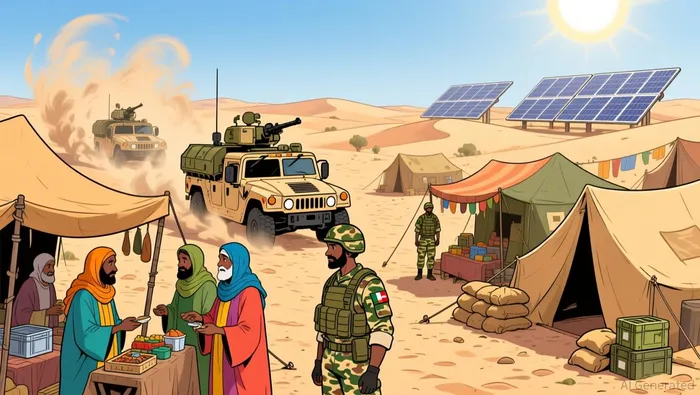
Russia's presence is not isolated. China, Turkey, and the UAE have also expanded their military and security engagements, often through opaque channels. For instance, Turkey's sale of drones to countries like Nigeria and Ethiopia has altered regional power balances, while China's infrastructure investments in the Gulf of Guinea have drawn scrutiny for their strategic implications. These developments signal a "new scramble for Africa," where military recruitment is increasingly intertwined with resource extraction and geopolitical rivalry.
The consequences for regional stability are profound. In the Sahel, the deployment of Russian mercenaries and military advisors has exacerbated local tensions, complicating efforts to address root causes of conflict. Meanwhile, U.S. threats of sanctions against Nigeria over religious protection concerns have triggered economic volatility, with the Nigerian Stock Exchange plummeting and the naira weakening according to financial reports. Such episodes underscore how geopolitical posturing can directly undermine macroeconomic stability, deterring foreign investment and deepening uncertainty.
Investor Sentiment and the Dual Edges of Geopolitical Risk
The impact on investor sentiment is nuanced. While some sectors face headwinds, others are emerging as attractive opportunities. Foreign direct investment in Africa reached $97 billion in 2024, driven by infrastructure and energy projects. However, the distribution remains uneven, with countries like Egypt, Morocco, and South Africa-benefiting from political stability and strategic partnerships-outpacing peers in the Sahel and Horn of Africa according to investment data.
The infrastructure sector, in particular, is a case study in this duality. Africa requires approximately $190 billion annually to address its energy deficit, alongside $45–55 billion for transport and $25–30 billion for water and sanitation according to analysis. Renewable energy projects, such as green hydrogen initiatives in Mauritania and solar farms across the continent, are attracting FDI aligned with global decarbonization goals. Yet, persistent challenges-limited access to capital, high project costs, and regulatory inefficiencies-remain significant barriers according to UNCTAD reports.
Resource sectors, too, are evolving. Investments in critical minerals like lithium, cobalt, and copper are surging, driven by demand for electric vehicles and renewable energy technologies. The Democratic Republic of Congo and Zambia, for example, are seeing increased foreign interest, though extractive industries often fail to generate broader economic linkages according to industry analysis. The African Union's 2024 Green Minerals Strategy aims to address this by promoting local beneficiation, but progress is uneven according to policy documents.
Navigating the New Geopolitical Order
For investors, the key lies in balancing risk and opportunity. Geopolitical tensions, while destabilizing, also create openings. The African Continental Free Trade Area (AfCFTA) is redefining regional trade flows, enabling cross-border commerce and attracting FDI in sectors like digital infrastructure according to trade analysis. The digital economy, in particular, is growing rapidly, with FDI in digital infrastructure increasing by 4% in 2024 according to UNCTAD data. Initiatives like the Smart Africa Alliance are fostering innovation, though least-developed countries lag due to weak regulatory environments according to investment reports.
However, success hinges on policy coherence. Countries like Burkina Faso, despite rich mineral resources, rank low on economic freedom and corruption perception indices, deterring investment according to government reports. To attract and retain FDI, African governments must implement reforms that enhance transparency, strengthen institutions, and align foreign investment with national development goals.
Conclusion
Africa's investment landscape is at a crossroads. Rising foreign military recruitment networks and geopolitical rivalries are reshaping regional stability, creating both risks and opportunities. While instability in the Sahel and U.S.-China competition pose challenges, infrastructure, renewable energy, and digital sectors offer promising avenues for growth. For investors, the path forward requires a nuanced understanding of these dynamics, coupled with a long-term commitment to supporting policy reforms that enhance resilience and inclusivity.







Comentarios
Aún no hay comentarios