
Geopolitical Risk Mitigation in Middle East-Linked Assets: Assessing Short-Term Opportunities Amid Evolving Hostage Dynamics and Regional Stability Signals
The Middle East remains a region of profound geopolitical complexity, yet recent developments suggest a tentative shift in dynamics that could reshape investment strategies. The October 2025 Israel-Hamas ceasefire agreement, brokered by the Trump administration, marks a critical inflection point. This deal, which includes the release of Israeli hostages and Palestinian prisoners, alongside a U.S.-led humanitarian aid surge, has temporarily reduced immediate conflict risks in Gaza, according to an Al Jazeera report. However, the broader implications for regional stability-and, by extension, investment opportunities-require careful dissection.
The Ceasefire as a Stabilizing Catalyst
The Israel-Hamas agreement, while fragile, has created a window for recalibrating risk assessments. According to The Financial Analyst, the resolution of the hostage crisis has reduced short-term volatility in energy and defense sectors, which had been heavily impacted by prior hostilities. The U.S. commitment to deploy 200 troops to coordinate the ceasefire, according to CNN, further underscores its role as a stabilizing force, at least in the near term. For investors, this suggests a temporary easing of geopolitical risk premiums in Middle East-linked assets, particularly in infrastructure and humanitarian supply chains.
Yet, the deal's long-term success hinges on unresolved issues, such as Hamas's disarmament and Gaza's governance. As noted by CNN, sporadic Israeli military strikes during the ceasefire's first day highlight the fragility of the agreement (see CNN coverage). This duality-reduced immediate risk versus lingering structural instability-demands a nuanced approach to portfolio allocation.
Trump's Investment Diplomacy: Opportunities and Challenges
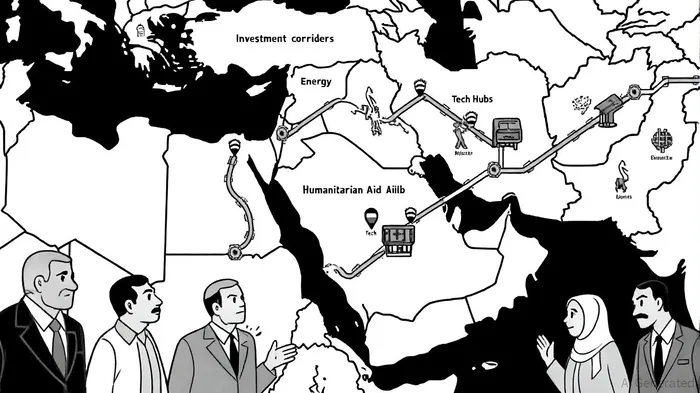
The Trump administration's Middle East policy has unlocked unprecedented investment flows. During his May 2025 Gulf tour, Trump secured over $2 trillion in agreements, including $600 billion from Saudi Arabia and $1.2 trillion from Qatar, spanning energy, technology, and defense, according to a White House fact sheet. These deals reflect a strategic pivot to align U.S. economic interests with regional allies' diversification goals. For instance, the U.S.-UAE AI partnership aims to harmonize regulatory frameworks, creating a fertile ground for tech investments, as analyzed by CSIS.
Simultaneously, the lifting of Syria sanctions has opened new corridors for Gulf capital. Qatar's $7 billion energy investment in Syria, as detailed by the CSIS, exemplifies how geopolitical realignments can unlock previously restricted markets. However, such opportunities are not without caveats. The humanitarian and infrastructural devastation in Syria necessitates long-term engagement, which may deter short-term speculative bets.
Sector-Specific Implications
- Energy: The resumption of Gulf investments in Syria's energy sector, coupled with regional stability in Gaza, could drive demand for infrastructure rebuilding. Yet, the risk of renewed U.S.-Iran tensions-exacerbated by Trump's military strikes on Iranian nuclear facilities-remains a wildcard (see CSIS analysis).
- Defense: While the ceasefire reduces immediate demand for conflict-related spending, the U.S. military's expanded coordination role suggests sustained defense contracts for allied nations.
- Technology: The U.S.-UAE AI pact and broader regional tech partnerships signal growth potential, though regulatory hurdles like CFIUS reviews may slow implementation, as noted by Carter.
Navigating the Risks
Despite these opportunities, investors must remain vigilant. The Trump administration's "America First Investment Policy," while streamlining approvals for allied nations, introduces regulatory uncertainty if followed by policy reversals (see CSIS). Additionally, the humanitarian crisis in Gaza-where famine and infrastructure collapse persist-could reignite hostilities, spiking risk premiums.
The key to mitigating these risks lies in diversification and hedging. For example, pairing investments in Gulf energy projects with insurance against political instability or allocating capital to U.S.-aligned tech ventures while avoiding overexposure to Syria's nascent markets.
Conclusion
The October 2025 ceasefire and Trump's investment diplomacy have created a unique confluence of risk and reward in the Middle East. While short-term stability offers a rare opening for capital deployment, the region's inherent volatility demands disciplined, adaptive strategies. Investors who balance optimism with caution-leveraging geopolitical shifts while hedging against their fragility-may yet find value in this complex landscape.







Comentarios
Aún no hay comentarios