
Geopolitical Risk, Elite Networking, and the Alchemy of Capital: The Trump-King Charles State Dinner as a Market Signal
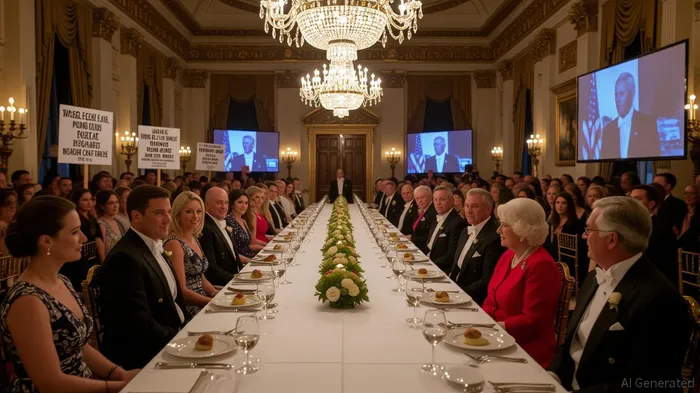
In an era of escalating geopolitical tensions and fragmented global cooperation, high-profile diplomatic events have become more than symbolic gestures—they are strategic instruments of economic influence. The 2025 state dinner between U.S. President Donald Trump and King Charles III at Windsor Castle exemplifies this duality. While the event was steeped in tradition, its economic implications were anything but ceremonial. By examining the interplay of elite networking, symbolic diplomacy, and market psychology, we uncover how such gatherings shape investor sentiment and capital flows in a world increasingly defined by uncertainty.
The State Dinner as a Signal of Stability
The Trump-King Charles III banquet was meticulously designed to reinforce the "special relationship" between the U.S. and the U.K., a phrase that carries both historical weight and contemporary economic urgency. According to a report by The New York Times, the event featured a £150 billion ($205 billion) investment package from American firms like MicrosoftMSFT-- and BlackstoneBX--, alongside British pharmaceutical giant GSK's $30 billion pledge to the U.S. [1]. These commitments were not incidental; they were part of a broader strategy to stabilize transatlantic trade amid rising protectionism.
Such gatherings serve as "confidence plays" for global investors. When influential business leaders—Apple's Tim Cook, Blackstone's Stephen Schwarzman, and media mogul Rupert Murdoch—attend state dinners, their presence signals alignment between political and economic elites. As noted by Bloomberg, the event's guest list included "prominent figures from global finance, tech, and politics," reinforcing the perception of continued cooperation despite divergences on issues like Ukraine and climate policy [3]. This alignment, in turn, reduces perceived risks for cross-border investments, particularly in sectors like technology and energy.
Geopolitical Tensions and the Safe-Haven Shift
Yet the broader geopolitical landscape in 2025 is one of profound instability. The imposition of a 10% global tariff by the U.S. and retaliatory measures from China and the EU have triggered market volatility, with the S&P 500 plummeting over 10% in two days following the April 2025 announcement [4]. Simultaneously, conflicts in the Middle East and the Russia-Ukraine war have shifted investor priorities toward systemic risk. According to a report by the CFA Institute, gold prices surged to $3,167.57 per ounce in April 2025, reflecting a "flight to safety" as traditional safe havens like the U.S. dollar lost ground [4].
Here, the state dinner's role becomes paradoxical. While it aimed to reassure markets of transatlantic unity, the event itself was shadowed by protests linking Trump to Jeffrey Epstein, a reminder of the reputational risks embedded in elite networks [5]. Such contradictions highlight the fragility of market confidence: investors are increasingly parsing not just policy outcomes but the integrity of the relationships underpinning them.
The Strategic Value of Symbolic Gestures
Symbolic gestures, from the choice of a 1945 vintage port to King Charles's toast on environmental sustainability, are not mere pageantry. They encode messages about shared values and priorities. For instance, the emphasis on nuclear energy collaboration between the U.S. and U.K. during the visit signaled alignment on critical infrastructure, even as broader climate policies diverged [1]. These signals matter because they influence sector-specific capital flows. Defense contractors and cybersecurity firms, for example, have seen increased investment amid fears of cyberattacks and regional conflicts [3].
Moreover, elite networking at such events facilitates "quiet diplomacy." The presence of figures like NVIDIA's Jensen Huang and Microsoft's Satya Nadella at the Windsor banquet likely accelerated private-sector commitments to the U.K., bypassing some of the friction in public negotiations. As The Financial Times observed, "the blending of statecraft and corporate strategy at these events creates a feedback loop where political stability is both cause and effect of capital allocation" [6].
Navigating the New Normal
For investors, the lesson is clear: geopolitical risk is no longer confined to military or economic shocks. It now includes the calculus of elite relationships and the symbolic language of diplomacy. The Trump-King Charles state dinner, for all its controversies, underscores how high-profile events can act as both stabilizers and stress tests for global capital.
Conclusion
In a world where trust is the scarcest resource, the alchemy of geopolitics and elite networking becomes a critical determinant of capital flows. The 2025 state dinner was a microcosm of this reality—a blend of spectacle, strategy, and subtext. For investors, the challenge lies in discerning which signals are substantive and which are merely ceremonial. The answer, as always, lies in the interplay of power, perception, and the relentless pursuit of stability in an unstable world.





Comentarios
Aún no hay comentarios