
Geopolitical Risk and Altcoin Volatility: Navigating the New Frontier of Crypto Investment
The cryptocurrency market, particularly altcoins, has emerged as a barometer for global geopolitical risk. Unlike traditional asset classes, digital currencies operate in a decentralized, 24/7 environment, making them uniquely susceptible to real-time geopolitical developments. As the 2025 U.S. trade war and ongoing conflicts in Eastern Europe and the Middle East demonstrate, altcoin volatility is not merely a function of market speculation but a direct reflection of shifting geopolitical tides.
Geopolitical Catalysts and Altcoin Reactions
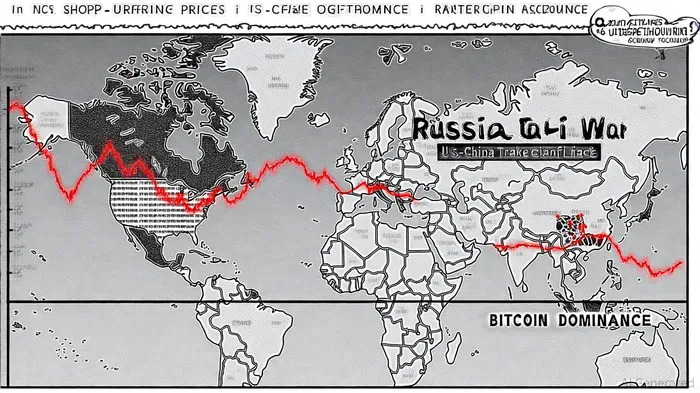
The Russia-Ukraine war has been a defining case study. During acute escalations, such as the U.S. military strike on Iranian nuclear facilities in 2024, altcoins experienced sharper price drops than BitcoinBTC--, which acted as a relative safe haven[1]. Conversely, when tensions eased—such as the Iran-Israel ceasefire brokered by former President Trump—altcoins like ADAADA-- and DOGEDOGE-- surged by double digits, reflecting a rapid shift in risk appetite[2]. This duality underscores the dual role of cryptocurrencies: as both speculative assets and tools for geopolitical resilience.
Stablecoins, notably TetherUSDT-- (USDT), have played a critical role in conflict zones. During the Russia-Ukraine war, demand for USDTUSDT-- surged as individuals bypassed frozen bank accounts and capital controls[3]. Similarly, in sanctioned economies like Iran, Bitcoin trading volumes spiked following U.S. sanctions, illustrating how geopolitical restrictions inadvertently drive crypto adoption[4].
Bitcoin Dominance and Altcoin Suppression
Bitcoin's rising dominance has further complicated altcoin dynamics. As Bitcoin's market capitalization share hit cycle highs in 2025, altcoins faced downward pressure, with metrics like the Altcoin Season Index hitting two-year lows[5]. This trend aligns with Bitcoin's evolving identity as a store of value—a role that competes with altcoins during periods of perceived stability. For instance, during the 2025 U.S. trade war, which saw tariffs of 54% on Chinese goods, Bitcoin outperformed altcoins as investors prioritized liquidity and safety over speculative bets[6].
Regulatory Uncertainty and Market Sentiment
Regulatory developments have amplified geopolitical risks. The Ripple v. SEC case, for example, created a cloud of uncertainty over XRPXRP-- and other altcoins, with investor confidence fluctuating alongside court rulings[7]. Meanwhile, JPMorgan analysts argue that regulatory clarity—potentially under a pro-crypto TrumpTRUMP-- administration—could catalyze a 2025 altcoin rebound[8]. However, government crackdowns, such as China's 2021 crypto ban, have historically triggered sharp sell-offs, highlighting the fragility of altcoin markets under regulatory stress[9].
The Path Forward: Strategies for Investors
For investors, the key lies in balancing exposure to Bitcoin's stability with altcoin opportunities during geopolitical lulls. Historical patterns suggest that altcoins often recover swiftly when tensions ease, as seen in the post-Iran-Israel ceasefire rally[10]. However, this requires vigilance against macroeconomic headwinds, such as the U.S. dollar's strength and fears of a government shutdown, which can overshadow geopolitical optimism[11].
Institutional adoption of Bitcoin has further tilted the playing field. As public companies like MicroStrategy and Tesla build Bitcoin treasuries, altcoins face an uphill battle for capital. Yet, niche altcoins with clear use cases—such as cross-border payment tokens or privacy-focused coins—may still thrive in regions with weak traditional financial infrastructure.
Conclusion
The interplay between geopolitical risk and altcoin volatility is a defining feature of the 2020s. While Bitcoin increasingly mirrors gold as a safe-haven asset, altcoins remain tethered to the whims of global instability and regulatory shifts. For investors, the challenge is to navigate this duality: hedging against geopolitical shocks with Bitcoin while selectively capitalizing on altcoin rebounds during periods of de-escalation. As the 2025 geopolitical landscape continues to evolve, so too will the strategies required to thrive in this dynamic market.






Comentarios
Aún no hay comentarios