
GE's Q3 2025 Earnings Performance and Strategic Shifts: Assessing Long-Term Value Creation Amid Industrial Transformation
Aerospace: A Model of Operational Excellence
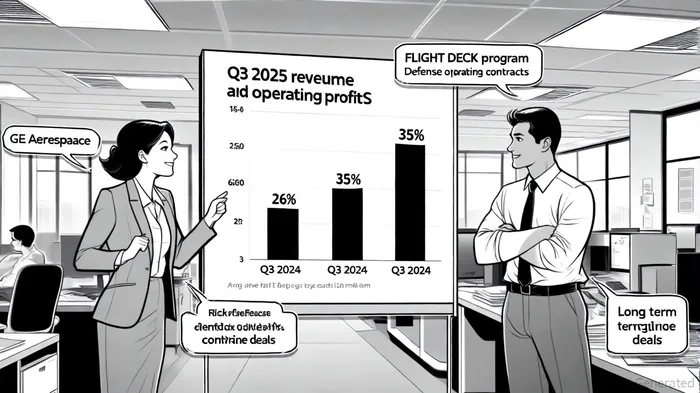
GE Aerospace delivered a standout performance in Q3 2025, with revenue surging 26% year-on-year to $11.3 billion and adjusted earnings per share (EPS) of $1.66, surpassing analyst expectations by 13% according to the Q3 slides. This success is driven by the FLIGHT DECK program, a targeted initiative to enhance supplier coordination and internal efficiency. By achieving 95% supplier volume delivery, the company boosted internal shop visit revenue by 33% and spare parts growth by over 25%, as the Q3 slides show. Such operational discipline has enabled GE AerospaceGE-- to raise full-year guidance, projecting operating profit of $8.65–$8.85 billion (per the same slides).
The division's strategic alignment with global defense spending trends further strengthens its outlook. Participation in U.S. Air Force programs like the F-15EX Eagle-II and the NGAD XA100 engine project positions GEGE-- to benefit from Cold War-era system modernization, according to the industry playbook. Meanwhile, long-term contracts-such as the $175 billion order book bolstered by a deal with Qatar Airways-ensure sustained cash flow, consistent with the slides' disclosures.
Energy Transition: Progress Amid Challenges
GE Vernova, the company's energy division, reported $8.9 billion in Q3 revenue, up 8% year-on-year, driven by 28% growth in gas power equipment orders and 22% electrification revenue growth, according to the Vernova report. However, the wind segment faced headwinds, with a 19% decline in orders due to turbine blade failures and supply chain bottlenecks-details also covered in the Vernova report. Despite these challenges, Vernova's focus on AI-driven grid optimization and low-carbon technologies aligns with the global energy transition. A $600 million investment in grid software, for instance, aims to address surging demand from AI-driven data centers, according to a Monexa analysis.
The division's strategic pivot toward gas and digital energy solutions reflects a pragmatic response to market realities. While renewable energy projects lag, gas power remains a critical bridge to decarbonization, particularly in markets where coal still dominates, as the Vernova report notes. This duality-balancing short-term profitability with long-term sustainability-will define Vernova's success.
Healthcare: AI as a Catalyst for Efficiency
GE HealthCare's Q3 results highlight the transformative potential of artificial intelligence in healthcare. The division reported $4.86 billion in revenue, with adjusted EPS of $1.14, exceeding estimates per a Yahoo Finance report. A key driver is the CareIntellect platform, a cloud-first AI solution developed in partnership with health systems like The Queen's Health Systems and Duke Health. Early results from Command Center software-GE's precursor to CareIntellect-demonstrate a 41.2% reduction in emergency department length of stay and $20 million in annual cost savings, as shown in the Q3 slides.
Beyond operational efficiency, GE HealthCare is expanding its AI Innovation Lab, exploring agentic AI for radiology and partnerships in digital therapeutics-initiatives highlighted in the Monexa analysis. These initiatives align with a broader industry shift toward value-based care, where technology optimizes outcomes rather than merely volume.
Strategic Synergies and Long-Term Outlook
GE's industrial transformation hinges on cross-sector synergies. For instance, AI advancements in healthcare (e.g., predictive analytics) mirror those in energy (e.g., grid optimization), enabling shared R&D investments. Similarly, the company's focus on electrification-spanning aerospace, energy, and healthcare-positions it to capitalize on the global shift toward decarbonization, an angle discussed in the Vernova report.
However, risks persist. GE Vernova's wind segment struggles and GE HealthCare's reliance on U.S. market growth underscore the need for geographic diversification. Moreover, while AI integration is promising, its ROI depends on adoption rates and regulatory acceptance.
Conclusion
General Electric's Q3 2025 results reflect a company navigating the complexities of industrial transformation with a mix of pragmatism and innovation. While aerospace remains the standout performer, strategic investments in energy transition and AI-driven healthcare offer pathways to long-term value. For investors, the key question is whether these initiatives can scale sustainably-particularly in volatile markets-without compromising operational discipline. The answer will likely determine whether GE's renaissance is a fleeting success or a durable transformation.





Comentarios
Aún no hay comentarios