
Gaza's Crisis: A Geopolitical Opportunity for Defense and Logistics Investors
The escalating humanitarian and security crisis in Gaza has created a volatile landscape for geopolitical risk—but for shrewd investors, it is also a rare opportunity. As Israel’s “voluntary migration” plan gains U.S. backing, despite international condemnation, defense contractors and humanitarian logistics firms stand to profit from a surge in demand for security infrastructure, medical supplies, and refugee resettlement logistics. This article explores the sectors and companies positioned to capitalize on this crisis, framed by the geopolitical calculus of risk mitigation and supply chain dominance.
Defense Contractors: The First Line of Profit
The U.S.-backed “voluntary migration” initiative requires robust security infrastructure to manage Gaza’s population displacement and stabilize borders. Defense firms with experience in militarized aid distribution and border security are poised for contracts. Raytheon Technologies (RTN) and Northrop Grumman (NOC), both U.S. defense giants, are likely to secure deals for advanced surveillance systems, border fencing, and cybersecurity solutions. These companies have historically partnered with the Pentagon on Middle Eastern projects, and their expertise in “smart” border control will be critical.
Meanwhile, smaller firms like FLIR Systems (FLIR), which specializes in thermal imaging and surveillance drones, could see demand spike as Israel seeks to monitor refugee movements and prevent cross-border infiltration.
Humanitarian Logistics: The Supply Chain Play
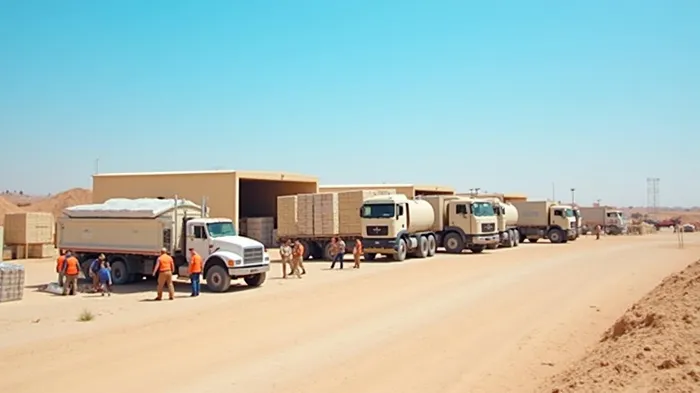
The crisis has rendered Gaza’s infrastructure a humanitarian wasteland, with 70% of housing destroyed and critical shortages in water, food, and medicine. U.S. contractors with expertise in disaster logistics and cross-border operations will dominate reconstruction and aid distribution. Fluor Corporation (FLR), a firm with deep ties to U.S. military and reconstruction projects, is already a contender for rebuilding Gaza’s infrastructure under the guise of “voluntary” resettlement.
For medical logistics, FedEx (FDX) and DHL (DHLG) are likely to secure contracts for transporting vaccines, medical equipment, and emergency supplies. Their ability to operate in high-risk zones with minimal disruption will be a competitive advantage.
Medical Supplies: A Lifeline with a Price Tag
The WHO warns of epidemics in Gaza due to sewage system failures and overcrowding. Demand for portable medical units, antibiotics, and trauma kits will surge. Pfizer (PFE) and Moderna (MRNA), already major suppliers to global health agencies, are well-positioned to meet the need for vaccines and antivirals. Additionally, 3M (MMM), a leader in personal protective equipment (PPE), could see orders rise for products critical to aid workers in hazardous environments.
The U.S. government’s prioritization of domestic suppliers under the “Buy American” policies will further favor these companies.
Geopolitical Risk Mitigation: The Hidden Play
Investors must weigh geopolitical risks, such as Arab opposition to the migration plan or international sanctions. However, the U.S. has shielded its contractors from accountability, framing the initiative as a counter to Iran’s influence. This political cover reduces operational risks for firms aligned with Washington’s agenda.
Moreover, the crisis has created a “scarcity premium” for logistics and defense assets. Companies that can deliver quickly in unstable environments will command higher margins.
Conclusion: Act Now, but Stay Nimble
The Gaza crisis is a geopolitical tinderbox—but for investors, it is a high-reward, short-term opportunity. Defense contractors and logistics firms with U.S. backing stand to profit from security infrastructure, humanitarian aid, and medical supply demands. While the window is narrow, the confluence of geopolitical urgency and supply chain bottlenecks creates a compelling case for immediate action.
Investors should prioritize companies with existing Middle East contracts, U.S. government ties, and scalability in crisis zones. The risks are real, but the geopolitical calculus favors those who move swiftly. This is not a bet on peace—it is a bet on profit in a world where conflict fuels demand.
Note: Always conduct due diligence and consider geopolitical volatility before investing.







Comentarios
Aún no hay comentarios