
Freedom Holding Corp's Strategic Ecosystem Expansion and Financial Resilience in Q2 FY2026
Financial Resilience: A Foundation for Growth
Freedom Holding Corp's Q2 FY2026 performance reflects a disciplined approach to capital allocation and operational efficiency. Net income for the quarter reached $38.7 million, with 1H FY2026 net income climbing to $69.1 million, outpacing revenue growth, according to the Stock Titan report. This margin expansion is particularly notable given the competitive pressures in its core markets. The company's ability to convert scale into profitability-evidenced by a net margin of approximately 7.4% in Q2-suggests robust cost management and pricing power, as noted in the Stock Titan report.
Such financial resilience is further reinforced by its customer base, which now exceeds 6.2 million across brokerage, banking, and insurance segments, according to the Stock Titan report. This diversification mitigates sector-specific risks, a critical advantage in volatile markets. As noted by CEO Timur Turlov, the company is "reinvesting profits into technology and infrastructure to drive regional leadership," a strategy that aligns with the long-term value creation framework favored by institutional investors, according to the Nasdaq press release.
Ecosystem Expansion: Digital Integration as a Strategic Lever
The heart of FRHC's growth lies in its vertically integrated ecosystem, which now spans brokerage, banking, insurance, telecom, and e-commerce. A pivotal development in Q2 was the acquisition of Astel Group Ltd in Kazakhstan, a move that not only expanded its telecom footprint but also created synergies with existing platforms like Freedom Telecom and Freedom Pay, according to the Stock Titan report. This acquisition exemplifies the company's playbook: leveraging cross-sector synergies to enhance user retention and monetization, as described in the Nasdaq press release.
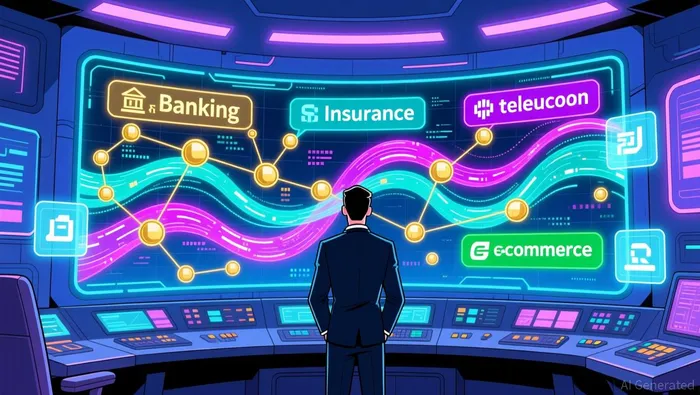
The results of this strategy are already materializing. Brokerage customers reached 776,000, banking customers 3.6 million, and insurance customers 1.3 million by Q2's end, according to the Stock Titan report. Such granularity in customer segmentation allows FRHC to tailor offerings and cross-sell effectively. Moreover, the integration of telecom services-particularly in emerging markets like Kazakhstan-opens new revenue streams and deepens customer relationships, a critical edge in a fragmented industry, as noted in the Nasdaq press release.
Long-Term Value Creation: Rating Upgrades and Strategic Reinvention
The recent S&P upgrade of Freedom Life's ratings is a testament to the company's financial prudence and risk management capabilities, according to the Stock Titan report. This recognition not only reduces borrowing costs but also enhances credibility with institutional investors, who increasingly prioritize long-term stability over short-term volatility, as noted in the Nasdaq press release.
FRHC's reinvestment strategy further cements its long-term appeal. By prioritizing digital infrastructure-such as AI-driven customer analytics and blockchain-enabled settlement systems-the company is future-proofing its operations against technological disruption, according to the Nasdaq press release. This approach mirrors the successful models of fintech giants like Ant Group and PayPal, which have leveraged ecosystem breadth to dominate regional markets, as described in the Nasdaq press release.
Conclusion: A Model for Sustainable Fintech Growth
Freedom Holding Corp's Q2 FY2026 results and strategic initiatives present a compelling narrative for investors seeking exposure to a digitally integrated, diversified fintech ecosystem. Its financial resilience, coupled with aggressive ecosystem expansion, positions it to capitalize on the convergence of financial services and technology. While risks such as regulatory scrutiny in emerging markets persist, the company's disciplined reinvestment and cross-sector synergies suggest a durable competitive advantage. For long-term investors, FRHC embodies the potential of strategic ecosystems to redefine value creation in the 21st-century economy.





Comentarios
Aún no hay comentarios