
The Fragile U.S. Labor Market: Implications for 2026 Equity and Bond Investments
The U.S. labor market, once a pillar of economic resilience, now exhibits signs of fragility that demand careful scrutiny. Structural slowdowns in hiring, coupled with a cautious Federal Reserve, are reshaping the investment landscape for 2026. This analysis examines the interplay between labor market dynamics and monetary policy, offering insights for equity and bond investors navigating an uncertain horizon.
Structural Slowdowns and Sectoral Shifts
The labor market's deceleration is no longer a cyclical anomaly but a structural trend. According to the Bureau of Labor Statistics, nonfarm payroll growth in September 2025 stood at 119,000, a figure that has shown little improvement since April. While healthcare, food services, and social assistance sectors have offset job losses in transportation and government, the broader picture reveals a labor market increasingly reliant on narrow sectors for stability. This concentration raises concerns about long-term dynamism, as highlighted by U.S. Bank Economics, which notes that the Private Education and Health Services industry alone accounted for more than the total monthly net gain in July 2025.
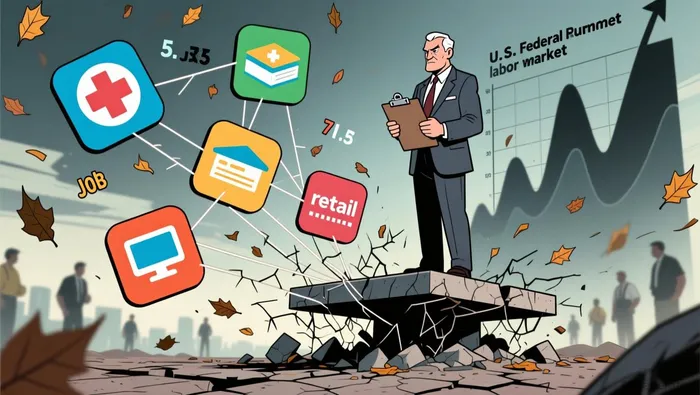 Compounding these challenges is the impact of artificial intelligence and tighter immigration policies, which are reshaping labor demand. Meanwhile, LinkedIn's Economic Graph reports a 5.8% decline in hiring activity compared to October 2024. The ADP National Employment Report further underscores fragility, revealing a 32,000 private-sector job loss in November 2025-the largest drop in two and a half years. These trends suggest a labor market that is not merely slowing but reconfiguring, with uneven impacts across demographics and industries.
The Fed's Dovish Pivot and Policy Uncertainty
The Federal Reserve's response to this fragility has been cautious but increasingly dovish. With the unemployment rate edging toward 4.4%-the highest since October 2021-and a "low-hire, low-fire" phase taking hold, the Fed has signaled a pivot toward rate cuts. A 25-basis-point reduction in December 2025 was framed as risk management, acknowledging that the labor market's resilience is overstated by official data. Looking ahead, Goldman Sachs Research anticipates two more rate cuts in 2026, bringing the federal funds rate to 3–3.25% by year-end, while J.P. Morgan projects a similar trajectory.
However, the Fed's path is constrained by inflationary pressures and fiscal uncertainties. Tariff policies and demographic shifts-such as an aging workforce-continue to weigh on labor supply. The central bank's forward guidance emphasizes a delicate balancing act: supporting growth without reigniting inflation. This uncertainty is reflected in the bond market, where a steepening yield curve suggests investors expect prolonged Fed easing.
Implications for 2026 Equity and Bond Markets
For bond investors, the Fed's dovish stance creates a favorable backdrop. Schwab's Fixed Income Outlook highlights that high-quality credit and intermediate-term durations are likely to outperform, with returns driven by coupon income rather than price appreciation. Treasury Inflation-Protected Securities (TIPS) and municipal bonds are particularly attractive as inflation hedges. Morningstar analysts further note that a potential shift to quantitative easing (QE) in response to market confidence shocks-similar to the UK's 2022 crisis-could further lower long-term yields and reduce risk premiums.
Equity markets, meanwhile, face a dual scenario. In a non-recessionary easing environment, UBS projects an index level of 7,300 by mid-2026. Historical data supports this, showing strong equity performance when the Fed cuts rates amid stable growth. However, risks persist. A deeper labor market slowdown could trigger a shift toward risk-off assets like gold and Treasuries. Small-cap stocks, particularly in sectors like retail and hospitality, may face heightened volatility due to their sensitivity to hiring trends.
Strategic Considerations for Investors
Investors must navigate this landscape with a dual focus on liquidity and diversification. Positioning portfolios for falling interest rates-by extending duration or allocating to inflation-protected securities-aligns with the Fed's projected trajectory. For equities, sector rotation toward defensive industries (e.g., healthcare, utilities) and companies with strong balance sheets may mitigate downside risks.
Yet, the labor market's fragility cannot be overstated. A sudden rise in layoffs, even in a low-hire environment, could accelerate unemployment growth. This underscores the importance of hedging against macroeconomic shocks, particularly as the Fed's policy tools-rate cuts and potential QE-remain its primary instruments. According to Reuters, the Fed could surprise the market with a T-bill buying binge.
Conclusion
The U.S. labor market's structural slowdown and the Fed's cautious response define a pivotal moment for 2026 investments. While bond markets benefit from dovish policy and a steep yield curve, equities face both opportunities and risks depending on the trajectory of growth. Investors must remain agile, leveraging forward guidance and sectoral insights to navigate an environment where stability is an illusion and adaptability is key.





Comentarios
Aún no hay comentarios