
Six Flags' Extended Peanuts Licensing as a Strategic Catalyst for Brand Rejuvenation and Guest Engagement
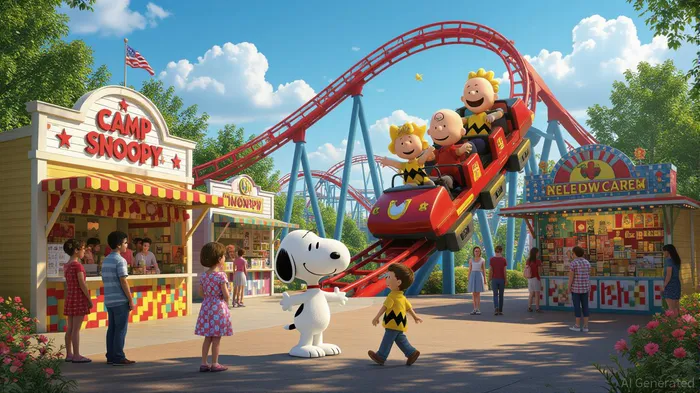
In the post-merger amusement sector, Six FlagsFUN-- Entertainment Corporation's recent extension of its licensing agreement with Peanuts Worldwide through December 31, 2030, represents a calculated move to leverage intellectual property (IP) as a cornerstone of brand rejuvenation and operational revitalization. This five-year renewal, announced in September 2025, ensures the continuation of Peanuts-themed attractions, merchandise, and immersive experiences across 11 Six Flags parks, including Knott's Berry Farm, Carowinds, and Cedar Point[1]. The decision underscores the company's recognition of IP-driven strategies as a critical tool for enhancing guest engagement, driving in-park spending, and differentiating itself in a competitive market.
The Strategic Value of IP Monetization
The Peanuts franchise, with its enduring cultural resonance, has long served as a family-friendly anchor for Six Flags' parks. By extending the licensing agreement, Six Flags avoids the costly and disruptive process of rebranding existing attractions while maintaining a consistent draw for repeat visitors. According to a report by BusinessWire, the partnership includes investments in new rides and interactive experiences, such as Carowinds' recent additions to Camp Snoopy, which blend nostalgia with modern innovation[2]. These attractions are designed to extend dwell time—a key metric for theme park profitability—by encouraging guests to spend more on food, merchandise, and ancillary services.
Financially, while Six Flags' Q2 2025 results revealed a 9% decline in attendance due to adverse weather and macroeconomic headwinds, the company's in-park per capita spending reached $62.46, with $28.27 attributed to food and merchandise[3]. Though specific revenue figures for Peanuts-themed attractions remain undisclosed, industry benchmarks suggest that IP-driven parks can achieve higher margins through premium pricing and cross-selling. For instance, Universal's Epic Universe, which opened in 2025, leverages its IP portfolio to justify ticket price premiums and generate ancillary revenue through themed dining and merchandise[4].
Operational Revitalization in a Post-Merger Landscape
Six Flags' merger with legacy Cedar Fair operations has increased operating costs, with Q2 2025 expenses reaching $711 million[3]. In this context, the Peanuts licensing agreement offers a low-capital, high-impact solution to operational challenges. Unlike traditional capital-intensive projects, IP-based attractions require minimal investment while delivering scalable returns. This aligns with broader industry trends: a 2025 market analysis by Mordor Intelligence notes that IP-themed parks contribute +1.2% to the amusement sector's compound annual growth rate (CAGR), driven by their ability to attract diverse demographics and justify premium pricing[5].
Moreover, the extension of the Peanuts agreement mitigates the risk of brand erosion. As noted in a Themepark Insider analysis, removing Peanuts branding from existing attractions would incur significant costs and alienate loyal guests[6]. By locking in the partnership through 2030, Six Flags secures a stable foundation for long-term planning, allowing it to allocate resources toward cost-cutting initiatives (e.g., $90 million in savings targeted for 2025) and non-core asset divestitures[3].
Industry Benchmarks and Comparative Insights
The success of IP-driven strategies is evident in global case studies. Disney's licensing model, for example, generates revenue not only from ticket sales but also through third-party partnerships and merchandise licensing, contributing to a diversified income stream[7]. Similarly, Shanghai Disney's planned Harry Potter redevelopment is projected to attract 10 million annual visitors, highlighting the scalability of IP-centric parks[5]. These examples reinforce the strategic logic of Six Flags' decision: IP acts as a “revenue multiplier,” enhancing guest loyalty and enabling cross-departmental monetization.
However, Six Flags faces challenges. Its Q2 2025 net loss of $100 million, coupled with a revenue shortfall of $119 million against estimates, underscores the fragility of its business model[3]. While Peanuts-themed attractions may stabilize certain revenue streams, the company must also address broader operational inefficiencies. For instance, the amusement parks market is projected to grow at a CAGR of 5.78% through 2033, reaching $116.81 billion, but this growth hinges on parks' ability to innovate sustainably and adapt to shifting consumer preferences[8].
Conclusion: A Prudent Bet on Nostalgia and Innovation
Six Flags' extended Peanuts licensing agreement is a prudent, if cautious, bet on the enduring power of IP to drive guest engagement and operational efficiency. While the lack of granular financial data on Peanuts-themed revenue remains a limitation, industry trends and comparative case studies provide a compelling rationale for the strategy. By anchoring its revitalization efforts in a beloved IP franchise, Six Flags positions itself to weather macroeconomic volatility and compete with larger rivals like UniversalUEIC-- and DisneySCHL--. The true test will lie in its ability to translate this strategic foundation into measurable financial performance—a task that demands both innovation and fiscal discipline in the years ahead.





Comentarios
Aún no hay comentarios