
The Fed's Reserve Strategy and the New Landscape of Bond Market Stability
The Federal Reserve's evolving approach to interest rate control has reshaped the financial landscape, with profound implications for bond market stability and investment opportunities. As the Fed navigates a delicate balancing act between inflation containment and economic growth, its reliance on bank reserves and liquidity facilities has emerged as a critical pillar of its policy framework. This shift, however, carries risks and rewards that investors must carefully parse.
The Mechanics of Rate Control: Floors, Ceilings, and the SRF
The Fed's current toolkit centers on administered rates to anchor short-term borrowing costs. By maintaining the Interest on Reserve Balances (IORB) at 4.4% and the Overnight Reverse Repo (ON RRP) facility at 4.25%, the Fed has constructed a “floor system” to prevent the federal funds rate from dipping below its target range of 4.0%-4.5%. Meanwhile, the Standing Repo Facility (SRF)—set at a minimum bid rate of 4.5%—acts as a ceiling, though its limited usage highlights operational hurdles. To address these, the Fed plans to introduce morning-settling SRF auctions, a move that could enhance its effectiveness as reserves transition from “abundant” to “ample” levels.
The success of this framework hinges on maintaining reserves above a critical threshold of $1.5 trillion to avoid liquidity strains. With current reserves at $3.2 trillion, the Fed is still in an “abundant” regime, but the gradual reduction of its balance sheet—from $9 trillion in 2022 to $6.4 trillion today—suggests a path toward tighter conditions.
Bond Market Dynamics: Range-Bound Yields and Structural Shifts
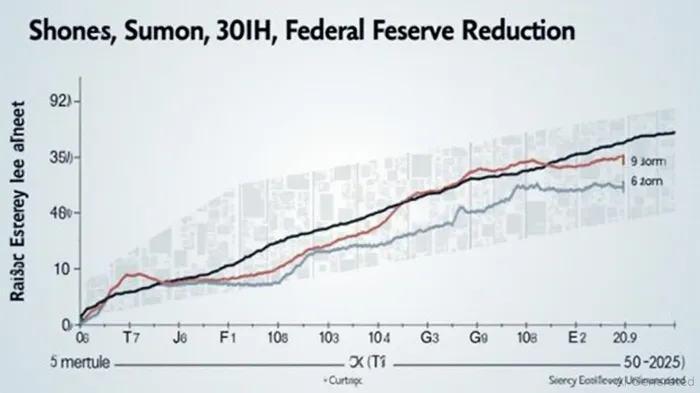
The Fed's policies have left bond markets in a narrow trading range, with 10-year Treasury yields fluctuating between 4.1% and 4.7%. This stability masks underlying vulnerabilities. The gradual balance sheet reduction—capping Treasury redemptions at $5 billion/month and MBS at $35 billion/month—aims to avoid abrupt market dislocations. Yet, the Fed's reliance on administered rates has diminished the role of open-market operations, creating a “yield floor” that limits downside potential for bonds.
Investors should note that the Fed's “wait-and-see” stance, coupled with market pricing of two rate cuts by year-end, has created a yield premium in intermediate-term Treasuries. However, prolonged tariff-driven inflation—now projected at 3.1% for core PCE—could force the Fed to recalibrate, compressing bond prices.
Equity Markets: Riding Volatility Amid Policy Uncertainty
While the S&P 500 has rebounded near all-time highs, its resilience masks sectoral divides. Cyclical stocks, such as industrials and materials, remain vulnerable to tariff-related inflation, while defensive sectors like utilities and healthcare have outperformed.
The Fed's caution on rate cuts and its focus on financial stability—particularly in mortgage markets, where agency MBS reinvestment continues—suggests a preference for high-quality fixed income over equity speculation.
Investment Strategy: Navigating the Fed's Tightrope
- Bonds: Embrace Duration with Caution
- Invest in intermediate-term Treasuries (5-7 years) to capture the yield floor while limiting exposure to rising rates. Avoid long-dated bonds, which face greater sensitivity to inflation shocks.
Consider Treasury Inflation-Protected Securities (TIPS) for protection against tariff-driven price increases.
Equities: Quality Over Momentum
- Focus on dividend-paying sectors (utilities, consumer staples) and companies with strong balance sheets.
Avoid cyclical industries directly exposed to global trade tensions.
Liquidity and Diversification
- Maintain cash reserves at the Fed's ON RRP rate (4.25%), benefiting from the “reverse repo floor.”
- Diversify into floating-rate instruments, such as bank loans or short-term corporate bonds, which align with the Fed's administered rate framework.
Risks on the Horizon
The greatest threat remains the Fed's ability to manage the transition from abundant to ample reserves without destabilizing markets. A misstep could trigger a sharp sell-off in bonds, while persistent tariff-driven inflation could force the Fed to raise rates further, prolonging the equity market's stagnation.
Conclusion: Prudence in a Policy Crossroads
The Federal Reserve's reliance on reserves has stabilized short-term rates but left bond markets in a precarious equilibrium. Investors must prioritize income generation through high-quality fixed income while hedging against inflation and policy uncertainty. As the Fed's balance sheet shrinks and its tools evolve, the mantra for 2025 remains clear: be selective, be patient, and avoid complacency.
In this landscape, the wisest course is to anchor portfolios in the Fed's administered rates—4.25% to 4.5%—while preparing for the day when the SRF's “ceiling” becomes as critical as the reverse repo's “floor.” The path to stability is narrow, but the rewards await those who tread carefully.







Comentarios
Aún no hay comentarios