
Why the Fed's Policy Shift Is Not a Green Light for a Year-End Crypto Rally
The Federal Reserve's recent policy pivot has sparked optimism in financial markets, particularly in the cryptocurrency sector. However, a closer examination of liquidity dynamics and institutional sentiment reveals that this shift is not a definitive signal for a year-end crypto rally. While the Fed's measures aim to stabilize financial conditions, their impact on crypto markets remains constrained by structural uncertainties and evolving investor behavior.
Liquidity Dynamics: A Delicate Balancing Act
The Fed's decision to conclude quantitative tightening (QT) by December 1, 2025, and initiate technical quantitative easing (QE) through monthly Treasury bill purchases of $40 billion reflects a strategic effort to maintain ample liquidity and stabilize the federal funds rate according to market analysis. These measures, however, are not a return to pre-pandemic accommodative policies but rather a recalibration to offset expected increases in non-reserve liabilities as reported by Scotiabank. For crypto markets, which are inherently sensitive to liquidity conditions, this transition has had mixed effects.
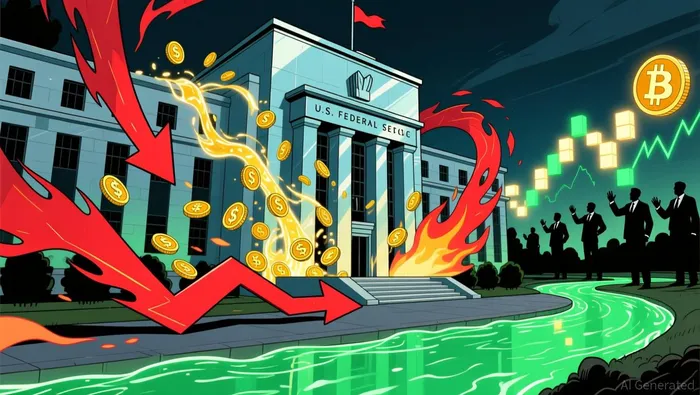 Bitcoin's price, for instance, has remained within a stable range despite the Fed's liquidity injections. On-chain data, however, reveals internal stress: significant unrealized losses, reduced leverage in futures markets, and a large portion of BTC held at a loss. This suggests that while the Fed's actions may support broader financial stability, they do not necessarily translate into renewed bullish momentum for crypto assets. The market's muted response to the October 2025 rate cut-despite the benchmark rate falling to 3.75–4.00%-further underscores this disconnect according to economic pulse data.
Moreover, the Fed's liquidity measures are being implemented against a backdrop of persistent inflation (3%) and a fragile labor market. These factors limit the scope for aggressive monetary easing, which crypto markets typically rely on for sustained rallies. As noted by a report from Liberty Street Economics, Treasury market liquidity briefly deteriorated in April 2025 amid tariff-related uncertainty but stabilized by late summer after policy clarity emerged. This pattern highlights the conditional nature of liquidity-driven market movements, which are unlikely to provide a consistent tailwind for crypto in Q4 2025.
Institutional Sentiment: Caution Amidst Regulatory Clarity
Institutional investment in BitcoinBTC-- has indeed grown, driven by regulatory developments such as the approval of spot Bitcoin ETFs and the maturation of digital assets as a legitimate asset class according to SSGA research. Bitcoin's market capitalization of $1.65 trillion as of November 2025 reflects this institutional embrace, with digital asset treasury companies (DATs) owning 3.5% of the circulating supply as reported by Coinbase. Yet, this optimism is tempered by skepticism about Bitcoin's role as an inflation hedge.
The Fed's rate cuts in late 2025 failed to elicit a strong Bitcoin rally, challenging the narrative that the cryptocurrency is a reliable hedge against inflation. Instead, Bitcoin's performance has increasingly mirrored that of high-beta technology stocks, reacting more to macroeconomic volatility than to inflationary pressures. This shift in perception complicates the case for a year-end rally, as institutional investors weigh the asset's risk-return profile against traditional alternatives.
Furthermore, institutional sentiment is clouded by mixed signals from the Fed. The delayed publication of key economic data and conflicting statements from FOMC members about future rate cuts have created uncertainty. For example, two FOMC members dissented in October 2025, with one advocating for a 0.50% rate cut and another opposing any cut according to market analysis. Such policy ambiguity discourages aggressive positioning in crypto, as investors await clearer signals before committing capital.
The Path Forward: A Cautious Outlook
While the Fed's liquidity measures and regulatory progress in crypto markets provide a supportive backdrop, they are not sufficient to guarantee a year-end rally. The transition to Reserve Management Purchases (RMP) in early 2026 may inject additional liquidity, but its impact on crypto will depend on the Fed's messaging and broader economic data. For now, the market remains in a consolidation phase, with Bitcoin's price hovering near critical support levels.
Institutional investors, though increasingly bullish on Bitcoin's long-term potential, are adopting a wait-and-see approach. The anticipated passage of a comprehensive crypto market structure bill, such as the CLARITY Act, could provide the clarity needed to unlock further demand. Until then, the Fed's policy shift should be viewed as a neutral-to-mildly supportive factor rather than a green light for aggressive crypto bets.
In conclusion, the interplay of liquidity dynamics and institutional sentiment suggests that the Fed's actions in Q4 2025 are more stabilizing than catalytic. Crypto markets, while resilient, require a clearer policy trajectory and stronger macroeconomic signals to justify a sustained rally. Investors would be wise to remain cautious, recognizing that the Fed's pivot is a tool for managing uncertainty, not a definitive endorsement of crypto's role in a diversified portfolio.





Comentarios
Aún no hay comentarios