
The Fed's 'Delicate Balance' and Its Impact on Precious Metals Volatility
The Federal Reserve's 2025 monetary policy shifts have underscored the central bank's precarious balancing act between inflation control and economic stability. As the Fed transitioned from a "higher for longer" stance to a rate-cutting cycle, the ripple effects on precious metals markets were profound. Gold and silver, long regarded as barometers of macroeconomic uncertainty, experienced unprecedented volatility, driven by both speculative demand and structural shifts in global finance. This analysis explores how evolving Fed signals have reshaped investment strategies in these assets and what lies ahead for 2026.
The Fed's Policy Pivot and Precious Metals Dynamics
The Fed's decision to cut rates in late 2025, despite internal dissent, marked a pivotal shift in monetary policy. As real yields turned negative, the opportunity cost of holding non-yielding assets like gold diminished, fueling a rally that pushed prices to record highs. By October–November 2025, amid the U.S. government shutdown and a "data blackout" period, gold surged to $4,379 per ounce, reflecting its role as a safe-haven asset during systemic uncertainty. Silver, while following a similar trajectory, exhibited heightened volatility, peaking at $59.90 per ounce by December 2025. This disparity stems from silver's dual identity as both an industrial commodity and a monetary metal, amplifying its sensitivity to shifts in the U.S. dollar and global supply chains.
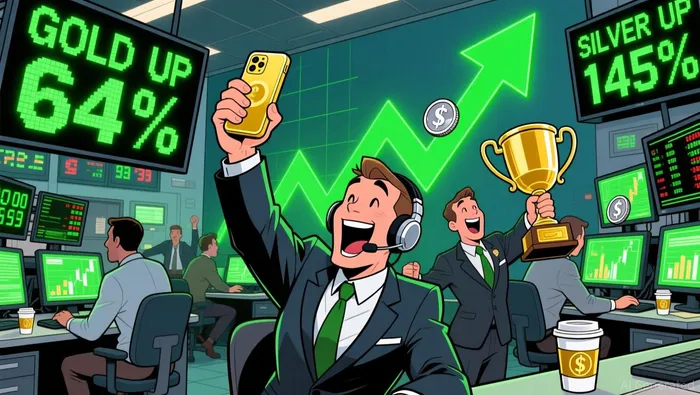
The weakening dollar, driven by fiscal concerns and policy ambiguity, further bolstered demand for bullion. As central banks-particularly in emerging markets-accelerated gold purchases to diversify reserves, the metal's structural bull case strengthened. By year-end 2025, gold's 64% price surge and silver's 145% rally highlighted their growing appeal as hedges against currency debasement and geopolitical risk.
Strategic Positioning: Hedging and Timing in a Volatile Landscape
Investors navigating this environment have increasingly turned to nuanced strategies. The gold-silver ratio, a key metric for relative value, has emerged as a critical timing tool. The so-called "80/50 rule" suggests that ratios above 80 (gold ounces per silver ounce) signal undervalued silver, while ratios below 50 indicate overbought conditions for gold. In late 2024, the ratio hovered near 80, prompting a shift into silver that proved prescient as prices doubled by year-end 2025. As of late 2025, the ratio stabilized at 64:1, suggesting a balanced market but leaving room for tactical adjustments.
Diversification across both metals has also gained traction. Gold's role as a store of value remains unassailable, particularly amid rising global debt and central bank digitalization efforts. Silver, meanwhile, benefits from its industrial applications in clean technology, including solar photovoltaics and electric vehicles. China's export controls on silver in 2025 exacerbated supply constraints, driving physical premiums to 80% in some markets and reinforcing its dual appeal as both a strategic resource and a speculative play.
The Road Ahead: 2026 and Beyond
Looking forward, the structural bull case for gold appears robust. J.P. Morgan projects prices could reach $5,000 per ounce by late 2026, supported by sustained central bank demand and elevated stock/bond correlations. For silver, the outlook hinges on its ability to balance industrial demand with its monetary role. With global solar adoption accelerating and geopolitical tensions persisting, the metal's supply-demand imbalance is unlikely to resolve quickly.
Investors are advised to maintain strategic allocations while monitoring macroeconomic signals. A diversified approach-combining physical bullion, ETFs, and derivatives-can mitigate risks while capitalizing on divergent drivers. As the Fed's "delicate balance" continues to shape market dynamics, precious metals remain indispensable tools for hedging against an uncertain future.







Comentarios
Aún no hay comentarios